GRID-REF 37°47′N 122°25′W
DISPATCH 02/26 · 9 Jun 2026
BATTLEPOLICY
Startup to front line. Strategy to consequence.
Lexicon · USA

AH-64 Apache

The Boeing AH-64 Apache is the United States’ premier attack helicopter — a twin-engine, tandem-seat anti-armor and close-air-support platform that has anchored U.S. Army rotary-wing combat power since Desert Storm.
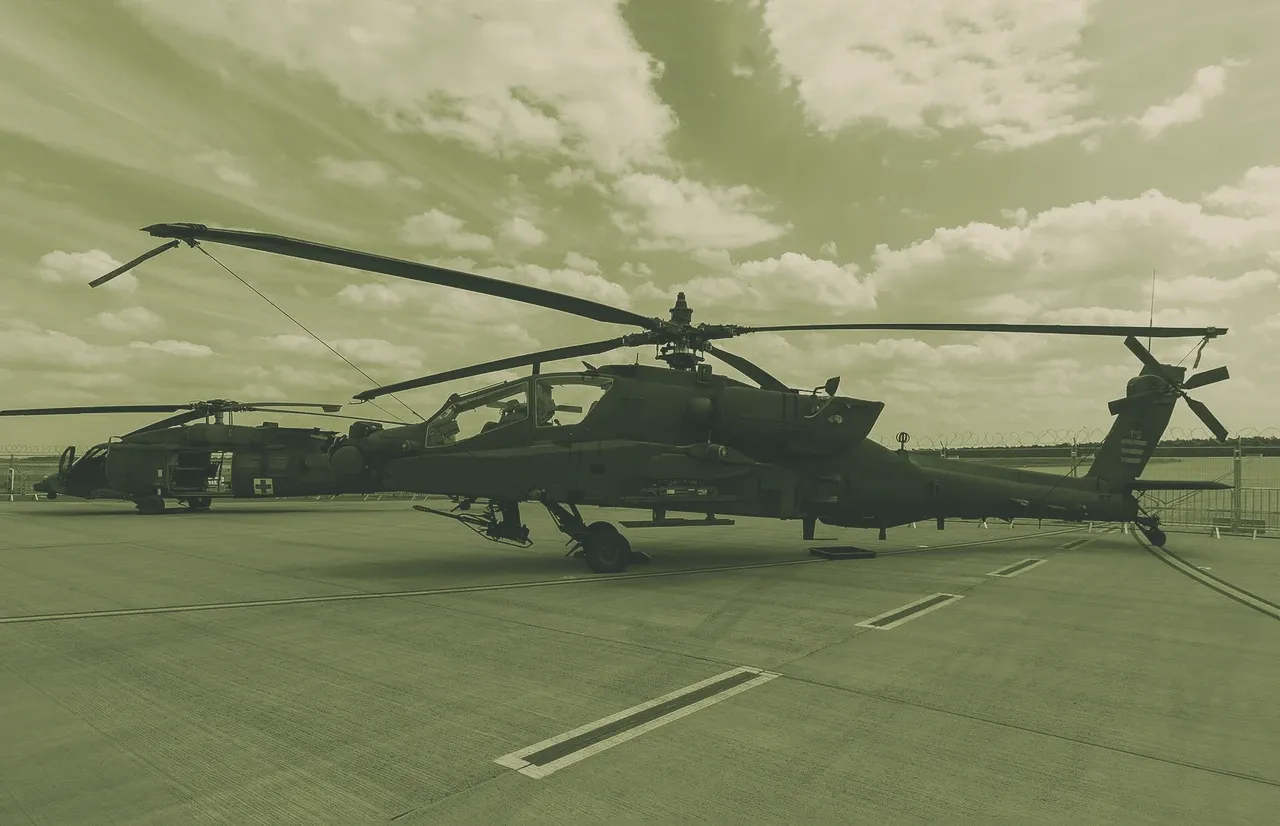
AH-64 Apache
FIG.01 · USA Image - AH-64 Apache. Photo by Matti Blume, [CC BY-SA](//commons.wikimedia.org/wiki/File:AH-64_Apache,_ILA_2024,_Schoenefeld_(ILA44641).jpg), via Wikimedia Commons.jpg).
The United States’ primary dedicated attack helicopter — a twin-engine, tandem-seat platform that delivers precision anti-armor and close air support under all-weather conditions, and the most widely operated heavy attack rotorcraft in the Western world.

Overview

The Boeing AH-64 Apache is a heavy attack helicopter operated by the U.S. Army and fourteen other nations. In its current AH-64E “Guardian” configuration it combines a nose-mounted 30 mm chain gun, wing-stub hardpoints for up to 16 Hellfire or JAGM missiles, and the AN/APG-78 Longbow millimetre-wave fire-control radar. The airframe is built around a two-seat tandem cockpit, a four-blade main rotor and twin General Electric T700 turboshafts. The type has seen continuous combat service since Operation Desert Storm and remains in full-rate production with an active manned-unmanned teaming and counter-UAS capability being integrated.

Development

The Apache traces its roots to the U.S. Army’s Advanced Attack Helicopter program of the early 1970s. Hughes Helicopters (later McDonnell Douglas, now Boeing) won the competition with the YAH-64, which first flew on 30 September 1975. After a series of tests against the Bell YAH-63, the Army selected the YAH-64 in 1976 and the first production AH-64A was delivered in 1984, with the type entering operational service in 1986. The AH-64D “Longbow” followed in 1997, introducing the mast-mounted radar; the current AH-64E Guardian reached units in 2011 with upgraded engines, composite-main-rotor blades, and full digital connectivity. More than 2,875 Apaches of all variants have been built to date, according to Boeing and open-source production totals.

Design & capabilities

The AH-64E carries the M230 30 mm chain gun in an under-fuselage turret, targeting via the helmet-mounted IHADSS sight. Each stub wing provides two hardpoints; the inner stations carry launchers for AGM-114 Hellfire (including the radar-guided AGM-114L) or the new AGM-179 JAGM, while the outer stations accept 70 mm Hydra rocket pods or APKWS laser-guided rockets. Stinger air-to-air missiles can be mounted on the wing tips. The Longbow radar on the mast provides rapid, all-weather detection and classification of ground targets, according to the manufacturer. The M-TADS/PNVS electro-optical/infrared sensor suite under the nose, Link 16 datalink and the Common Missile Warning System complete the core mission suite. The helicopter has no troop compartment; its weapon payload is typically up to 16 Hellfire missiles and 76 rockets, as noted by Boeing.

Variants

  • AH-64A – baseline production model (1986–1990s), with T700-701 engines and analogue cockpits.
  • AH-64D Apache Longbow (1997) – added mast-mounted AN/APG-78 radar, glass cockpits, and digital avionics.
  • AH-64E Guardian (2011–present) – uprated T700-GE-701D engines, composite main-rotor blades, full digital backbone, UAV-control datalink, and provisions for the AGM-179 JAGM.

Combat record / operational use

The Apache’s combat debut came in Operation Desert Storm (1991), when 277 AH-64As spearheaded the air offensive, destroying 278 tanks and hundreds of other vehicles for the loss of one airframe, as recorded by Military History Fandom. It subsequently served in Bosnia, Kosovo, Afghanistan, Iraq and Syria, and continues to fly daily in U.S. Army and allied service. In the Pacific, Australia’s 29 AH-64E helicopters are replacing the Airbus Tiger, with deliveries under way from 2025. Poland — the largest operator in Europe outside the U.S. — placed an order for 96 AH-64E airframes in late 2025 as part of a major force modernisation, reported by The Aviationist.

Advantages

  • Battle-proven anti-armor and CAS platform with over three decades of continuous operation.
  • Mast-mounted Longbow radar provides stand-off acquisition and attack in adverse weather.
  • Large payload — up to 16 precision munitions plus rockets — gives a wide engagement envelope.
  • Helmet-mounted sight allows off-bore engagement with the 30 mm cannon.
  • Open-architecture digital backbone enables manned-unmanned teaming and evolving counter-UAS capability.

Drawbacks / limitations

  • No troop-carrying capacity; dedicated only to attack and reconnaissance.
  • High unit cost (flyaway in the ~$30–35 million range) limits fleet size for export customers.
  • Mechanical complexity demands a heavy maintenance footprint.
  • Survivability against modern short-range air defense and drone threats depends on continuous system upgrades rather than raw manoeuvre.

Counterparts

Outlook

The AH-64E remains the central rotary-wing attack asset for the U.S. Army and is being fielded in growing numbers by NATO and Indo-Pacific partners. Boeing continues to refine the Guardian through block upgrades that integrate longer-range JAGM missiles, improved data links and expanded counter-UAS kits. While the airframe foundation is now four decades old, the Apache’s sensor-shooter fusion and its deep “ecosystem” of weapons keep it relevant against both peer-level armor and lower-end asymmetric threats.

Key specifications

Spec Value
Crew 2 (pilot, co-pilot/gunner)
Length / wingspan 17.73 m / 14.63 m (main rotor)
Max speed ~279–300 km/h
Service ceiling ~6,400 m
Combat radius / range ~476 km (combat radius)
Payload Up to 16 Hellfire/JAGM + 76 rockets (no internal troop capacity)
Hardpoints 4 underwing stations + M230 chin turret
Radar / sensors AN/APG-78 Longbow mmW FCR · M-TADS/PNVS · IHADSS helmet display · Link 16 · CMWS
Powerplant 2 × GE T700-GE-701D turboshaft, ~2,000 shp each
Armament M230 30 mm chain gun · AGM-114 Hellfire (L, K, R variants) · AGM-179 JAGM · Hydra 70/APKWS rockets · AIM-92 Stinger

Sources

  1. Boeing – AH-64 Apache product page. https://www.boeing.com/defense/ah-64-apache
  2. Army Recognition – AH-64E Apache Guardian data sheet. https://www.armyrecognition.com/military-products/air/helicopters/attack-helicopters/ah-64e-apache-guardian
  3. Wikipedia – Boeing AH-64 Apache. https://en.wikipedia.org/wiki/Boeing_AH-64_Apache
  4. Military History Fandom – Boeing AH-64 Apache (combat history). https://military-history.fandom.com/wiki/Boeing_AH-64_Apache
  5. Overt Defense – Australian Army AH-64E Apache helicopters on the way. https://www.overtdefense.com/2025/08/04/australian-army-ah-64e-apache-helicopters-on-the-way/
  6. The Aviationist – Poland orders 96 AH-64E Apache. https://theaviationist.com/2025/12/01/poland-96-ah64e-apache/
FIELD DISPATCH · WEEKLY

BattlePolicy Weekly — free.

Defense tech, startups, and security — weekly. No paywall.

Related
Ukraine · USA · Funding · Swarmer · drones · defense tech · venture capital · Pentagon

Ukraine turned its drone war into an industry. Now Wall Street is pricing it.

Swarmer's Nasdaq debut, a wave of Western venture money and a Pentagon FPV contract show Ukrainian defense tech crossing from battlefield to balance sheet, at a valuation that has outrun the revenue.

Ukraine · USA · Funding · Swarmer · drones · defense tech · venture capital · Pentagon
USA · Autonomy · Shifters · Ace Capital Partners

Shifters raises $10.2M to put robots first into tunnels and rubble

The US-Israeli startup raised a $10.2 million seed led by Ace Capital Partners to scale ground robots that enter tunnels and rubble before troops.

USA · Autonomy · Shifters · Ace Capital Partners
USA · Policy · AI · Anthropic · autonomous weapons · Pentagon

Trump orders faster military AI and bars vendors from switching off fielded models

A new national security memo tells the Pentagon to onboard frontier commercial AI at speed, strips vendors of the power to shut it down mid-mission, and resets the rules for autonomous weapons within 90 days.

USA · Policy · AI · Anthropic · autonomous weapons · Pentagon