AK-103
The AK-103 is Russia's 7.62×39 mm assault rifle of the AK-100 series — a modernised Kalashnikov built for export and internal security, keeping the legacy cartridge in a reliable, side-folding platform.
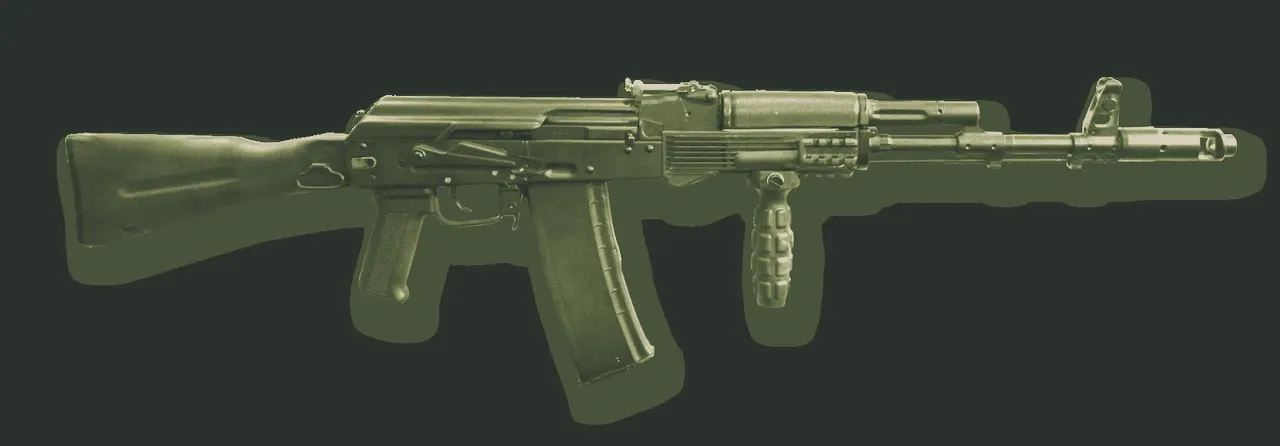
Russia's 7.62×39 mm assault rifle — the AK-100 series member that keeps the legacy cartridge in modern form, widely exported and license-produced abroad.
Overview
The AK-103 (GRAU index 6P45) is a gas-operated, rotating-bolt assault rifle chambered for the 7.62×39 mm intermediate cartridge. It is the 7.62 mm representative of the AK-100 family, a line of Kalashnikov rifles derived from the AK-74M receiver that debuted in the mid-1990s. While the Russian armed forces standardised on 5.45×39 mm rifles, the AK-103 was designed to cater to export customers and internal-security units that preferred the heavier round’s barrier-penetration and legacy ammunition stocks.
Development
The AK-103 was developed by Izhmash (now Kalashnikov Concern) in the mid-1990s as one of five AK-100-series weapons built on a common AK-74M platform, according to Wikipedia. The family was a commercial and operational response to the widespread demand for a modernised 7.62×39 mm assault rifle that retained the familiar Kalashnikov manual of arms. Series production began around 2001, and the rifle has remained in low-rate Russian production ever since, with the bulk of output directed at foreign sales and license-production agreements.
Design & capabilities
Like all AK-100 variants, the AK-103 is built around the proven long-stroke gas-piston system and a rotating bolt. It features a side-folding polymer stock, a black synthetic handguard, and a scope-mount rail on the left side of the receiver, as detailed in the Rosoboronexport export catalog. The rifle accepts all legacy 7.62×39 mm AK/AKM pattern 30-round magazines and can mount a 6H4 bayonet. Barrel length is 415 mm, the same as the AK-74M, yielding a muzzle velocity of approximately 715 m/s. Its effective range is cited as 350 m by Military Factory, though the leaf sight is graduated to 1,000 m. The cyclic rate of fire is around 600 rounds per minute.
Combat record / operational use
The AK-103 has seen action primarily in the hands of Russian internal-security forces, including Rosgvardia and Ministry of Internal Affairs special units, and it has been observed in Russian operations in Syria and Ukraine, according to Wikipedia. SOFREP notes that the weapon’s 7.62 mm punch makes it popular for close-range urban engagements where soft-armour penetration is desired. The rifle’s most significant operational footprint, however, stems from license production abroad: India manufactures an AK-103 derivative as the AK-203 through the Indo-Russian Rifles Joint Venture at Korwa, and Venezuela also produces a local copy. These license-built rifles have equipped regular and paramilitary forces in both countries.
Advantages
- Fires the widely available 7.62×39 mm cartridge, delivering greater barrier and soft-armour penetration than 5.45 mm.
- Maintains legendary Kalashnikov reliability in adverse conditions, as highlighted by the Small Arms Survey.
- Full parts commonality within the AK-100 family reduces logistics and training overhead.
- Side-folding polymer stock keeps overall length compact for transport and vehicle operations.
- Accepts all legacy 7.62 mm AK/AKM magazines and accessories.
Drawbacks / limitations
- The 7.62×39 mm round has a more pronounced trajectory drop and shorter practical range than 5.45 mm or 5.56 mm.
- Recoil is noticeably heavier than the 5.45 mm AK-74M/AK-12, reducing full-auto controllability.
- The standard sights and basic handguard offer limited provision for modern optics and accessories without after-market upgrades.
- Russian domestic production is limited; many AK-103s in service are license-built copies with varying quality control.
Counterparts
- M4 Carbine (USA)
- QBZ-95 (China)
Outlook
The AK-103 occupies a stable but secondary niche in the Russian small-arms ecosystem. While Russia’s front-line forces continue their shift to the 5.45 mm AK-12, the AK-103 will likely persist in export and license-production channels for years — especially in countries where the 7.62×39 mm cartridge remains the logistic standard. The Indian AK-203 programme in particular ensures large-scale production well into the 2030s.
Key specifications
| Spec | Value |
|---|---|
| Crew | 1 (individual weapon) |
| Combat weight | 3.6 kg empty; ~4.1 kg loaded |
| Length / width / height | 943 mm extended / 705 mm folded; width and height not publicly established |
| Main armament | 7.62×39 mm cartridge (rifle) |
| Secondary armament | None |
| Armor & protection | Not applicable |
| Engine & power | Not applicable (human-operated) |
| Power-to-weight | Not applicable |
| Road / cross-country speed | Not applicable |
| Operational range | Effective range 350–500 m; maximum sighting 1,000 m |
Sources
- Wikipedia — AK-103 — https://en.wikipedia.org/wiki/AK-103
- Rosoboronexport — AK103 7.62mm Kalashnikov Assault Rifle (export catalog) — https://roe.ru/en/production/land-forces/small-arms-sv/assault-rifles-sv/ak103-7-62mm-kalashnikov-assault-rifle-sv/
- Small Arms Survey — AK-100 Series (assault rifles reference) — https://www.smallarmssurvey.org/sites/default/files/SAS-weapons-assault-rifles-AK-100-series.pdf
- Military Factory — Kalashnikov AK-103 Assault Rifle — https://www.militaryfactory.com/smallarms/detail.php?smallarms_id=214
- SOFREP — “Is The AK-103 The BEAST Or What?” — https://sofrep.com/news/is-the-ak-103-the-beast-or-what/