AK-12
Russia's new-generation standard assault rifle — a fifth-generation Kalashnikov chambered in 5.45×39 mm, with improved ergonomics, burst-fire capability, and the combat-driven 2023 model refinements shaped by the war in Ukraine.
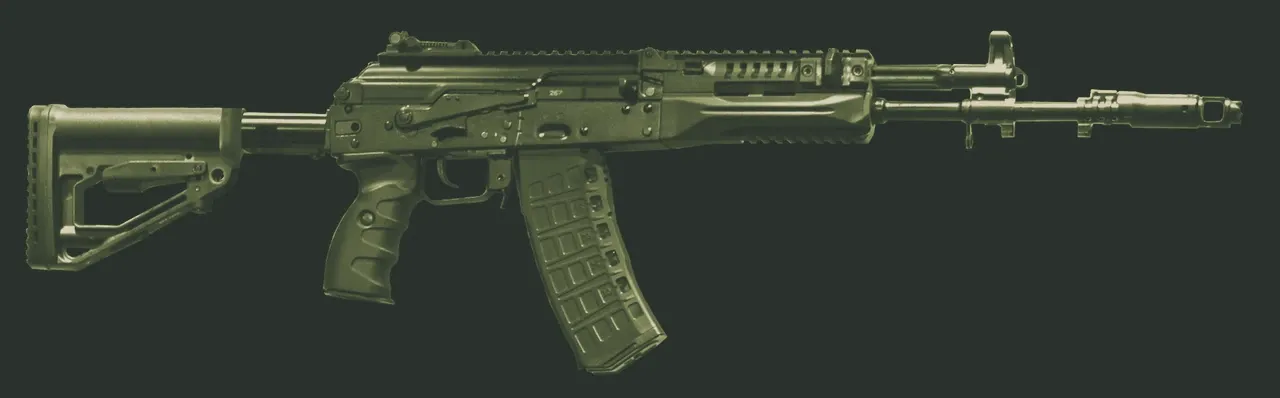
Russia's new-generation standard assault rifle — a fifth-generation Kalashnikov in 5.45×39 mm, with modular rails, a two-round burst mode, and a 2023 revision that directly incorporates lessons from the war in Ukraine.
Overview
The AK-12 is a conventional-layout, select-fire assault rifle developed by Kalashnikov Concern as the successor to the Soviet-era AK-74 / AK-74M family. Adopted in 2018 as the Russian Federation’s primary individual weapon, it retains the long-stroke gas-piston action of the Kalashnikov lineage while introducing a hinged top-cover with an integral Picatinny rail for optics, a retractable stock, and a burst-fire capability — modernisation steps that aim to close the ergonomic and sighting gap with Western and Chinese modular rifles. A mid-production overhaul, fielded as the model 2023, was explicitly shaped by combat experience in Ukraine.
Development
Work on what became the AK-12 began in the early 2010s under the Ratnik future-soldier programme, with Kalashnikov Concern (formerly Izhmash) selected as the lead designer. An early prototype, unveiled in 2012, featured a completely new upper receiver and an ambidextrous charging handle, but the finalised design reverted to a more traditional Kalashnikov chassis while incorporating modern ergonomics. The Russian Ministry of Defence formally accepted the rifle as the 6P70 and began mass deliveries in late 2018, designating it a fifth-generation Ak system, according to Small Arms Defense Journal. A modernised 6P70M variant followed in 2020–21, refining the fire-control group and ergonomics, and then — after the rifle’s first years in large-scale combat — Kalashnikov announced a more extensive “model 2023” upgrade in May 2023, driven by direct feedback from soldiers in Ukraine, per UPI.
Design & capabilities
The AK-12 is chambered for the legacy 5.45×39 mm cartridge, preserving ammunition commonality with the vast Russian stockpile and with existing AK-74 and RPK-74 magazines. The action remains a gas-operated, rotating-bolt long-stroke piston — the classic Kalashnikov mechanism — with a cyclic rate of 600–700 rounds per minute that rises to ~1,000 in the two-round burst mode. The rifle’s empty weight is listed at 3.5 kg by external reference sources such as Modern Firearms, although the manufacturer’s own 2023-model figure claims 2.9 kg empty and 3.2 kg loaded; the difference likely stems from a lighter handguard and stock assembly.
Ergonomically, the rifle abandons the fixed wooden or polymer furniture of the AK-74M in favour of a telescoping, side-folding shoulder stock and a free-floated barrel to improve accuracy. The hinged, rigidly attached receiver cover incorporates a full-length Picatinny rail, enabling direct mounting of day/night optics without the side-clamp rails of earlier AKs, and the fore-end offers M-LOK-style slots for accessories. The 2023 revision, prompted by user reports from Ukraine, redesigned the fire selector, stock, pistol grip, rear sight and handguard for better control and to reduce snag points, as detailed by Army Recognition. The muzzle velocity is approximately 900–915 m/s, and the rifle is sighted to 800 m, with a maximum range of 2,500 m.
Variants
The AK-12 family is relatively compact but distinct:
- AK-12 (6P70) — the original 2018-adopted pattern, with the 2-round burst, Picatinny dust-cover, and telescoping stock.
- AK-12 (6P70M) — 2020/21 modernisation addressing initial ergonomic gripes, including a modified fire-selector and stock.
- AK-12 model 2023 — the combat-refined configuration derived from Ukraine-war feedback, incorporating a new selector, stock, pistol grip, rear sight, and free-floated barrel.
The 7.62×39 mm sibling, the AK-15 (GRAU 6P71), shares the same receiver architecture and ergonomic concept, while the RPK-16 light machine gun is the squad-support derivative.
Combat record / operational use
The AK-12 began reaching front-line units in significant numbers after 2018, and by the late-2020s it had become the most widely seen new-pattern rifle in Russian service during the war in Ukraine. The platform’s baptism of fire in a high-intensity peer conflict quickly exposed shortcomings in the early pattern’s fire selector and stock design, especially under the mud, cold, and hard handling typical of positional warfare. Kalashnikov acknowledged the problems and introduced the model 2023 upgrade specifically in response to combat feedback, as reported by UPI and Army Recognition. The updated rifle is now produced alongside the legacy AK-74M, which remains in service with second-line and mobilised units, and the AK-12 has also been adopted by Russia’s Ministry of Internal Affairs (MVD) and the National Guard (Rosgvardia) from 2024. Outside Russia, small quantities have reportedly been delivered to Belarus, Kazakhstan, and Syria.
Advantages
- Kalashnikov ruggedness — familiar long-stroke piston action, tolerant of dirt and neglect.
- Ammunition and magazine commonality with the massive 5.45×39 mm and AK-74/RPK-74 ecosystem.
- Optics-ready via the rigid hinged cover, eliminating the old side-rail mount while retaining a back-up iron sight set.
- Two-round burst capability — a first for a standard-issue Russian rifle — improves hit probability without excessive ammunition consumption.
- Combat-driven 2023 improvement means the current production standard directly incorporates real-world feedback, something few peer rifles can claim.
Drawbacks / limitations
- Heavier than advertised — the manufacturer’s 2.9-kg claim for the 2023 model is met with scepticism; most independent figures place the rifle closer to 3.5 kg empty.
- Legacy action — the long-stroke piston and large reciprocating mass contribute more felt recoil and slower follow-up shots than competing short-stroke piston designs.
- Modularity still lags behind Western systems (M4, HK416) in terms of after-market fore-end and accessory options.
- Early-pattern ergonomic flaws — the 2018-pattern fire selector and stock proved unpopular in Ukraine, and while the 2023 model addresses them, older-production rifles will remain in the force for years.
- No full-calibre transition — unlike the US Army’s XM7 (6.8×51 mm), the AK-12 remains tied to the 5.45×39 mm cartridge, which limits terminal effect against modern body armour and may leave it on the wrong side of a future threat curve.
Counterparts
- M4 Carbine (USA) — the standard 5.56×45 mm NATO carbine, with a direct-impingement action and an immense after-market ecosystem.
- QBZ-191 (China) — the PLA’s conventional-layout, short-stroke-piston replacement for the bullpup Type 95; shares the same 5.8×42 mm cartridge as its predecessor.
Outlook
The AK-12 is the current face of Russian infantry small arms and will remain so for the foreseeable future. Its production line appears robust, and the swift 2023 revision demonstrates a willingness — unusual for the Russian defence industry — to correct a fielded design while the war that revealed its shortcomings is still underway. The fundamental choice to stay with the 5.45×39 mm round, however, means the rifle’s ballistic potential is capped, and the platform cannot directly answer the heavy-calibre bets that the United States is making with the XM7. The AK-12’s long-term standing will therefore depend less on the rifle than on whether body-armour trends force all peer armies to rethink their intermediate cartridges.
Key specifications
| Spec | Value |
|---|---|
| Crew | 1 (individual weapon) |
| Combat weight | ~3.5 kg empty (2018 baseline) / 2.9–3.2 kg (2023 model, manufacturer claim) |
| Length / width / height | 880–940 mm extended; ~690 mm folded; width & height not publicly established |
| Main armament | 5.45×39 mm cartridge (30-round box magazine) |
| Secondary armament | None (compatible with GP-34/GP-25 under-barrel grenade launchers via accessory rail) |
| Armor & protection | None |
| Engine & power | Gas-operated, long-stroke piston (not applicable) |
| Power-to-weight | Not applicable |
| Road / cross-country speed | Not applicable |
| Operational range | 800 m effective (max 2,500 m) |
Sources
- Modern Firearms — “Kalashnikov AK-12 and AK-15 assault rifle.” https://modernfirearms.net/en/assault-rifles/ak-12-ak-15-eng/
- Army Recognition — “Kalashnikov completes delivery of AK-12 model 2023 assault rifles to Russian Armed Forces.” https://www.armyrecognition.com/archives/archives-land-defense/land-defense-2024/kalashnikov-completes-delivery-of-ak-12-model-2023-assault-rifles-to-russian-armed-forces
- UPI — “Russian gunmaker Kalashnikov upgrades AK-12 design to suit Ukraine war.” https://www.upi.com/Top_News/World-News/2023/05/27/russian-gunmaker-kalashnikov-upgrades-ak-12-design-ukraine-war/1371685235414/
- The National Interest — “Russia Continues to Improve the AK-12 Assault Rifle.” https://nationalinterest.org/blog/buzz/russia-continues-improve-ak-12-assault-rifle-ps-012126
- Small Arms Defense Journal — “AK-12 & AK-15 5th Generation Kalashnikov Rifles for the 21st Century Russian Military.” https://sadefensejournal.com/ak-12-ak-15-5th-generation-kalashnikov-rifles-for-the-21st-century-russian-military/
- Wikipedia — “AK-12.” https://en.wikipedia.org/wiki/AK-12