GRID-REF 37°47′N 122°25′W
DISPATCH 02/26 · 9 Jun 2026
BATTLEPOLICY
Startup to front line. Strategy to consequence.
Lexicon · USA

AMPV

The U.S. Army’s modern tracked armored personnel carrier, built on a Bradley-derived chassis to replace the M113 family across the Armored Brigade Combat Team.
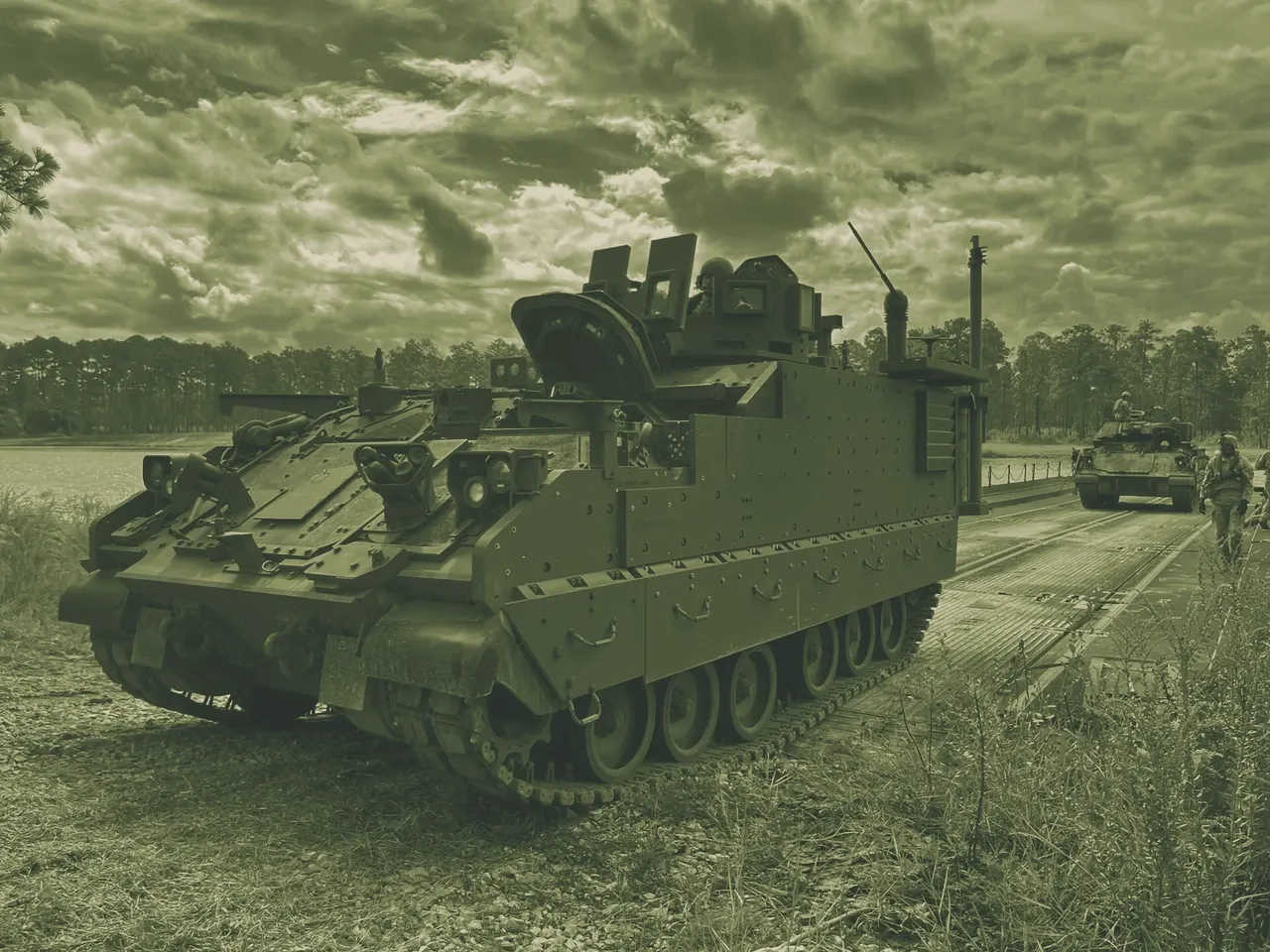
AMPV
FIG.01 · USA Image - AMPV. Photo by Kevin Larson, Public domain, via Wikimedia Commons.
The U.S. Army’s modern tracked armored personnel carrier, built on a Bradley-derived chassis to replace the Vietnam-era M113 family across the Armored Brigade Combat Team.

Overview

The Armored Multi-Purpose Vehicle (AMPV) is a family of tracked armored vehicles designed to replace the aging M113 series in the U.S. Army’s Armored Brigade Combat Teams (ABCTs). Built by BAE Systems on a common chassis shared with the Bradley Fighting Vehicle and the M109A7 Paladin self-propelled howitzer, the AMPV prioritizes parts commonality, survivability, and modularity. The program encompasses five variants—General Purpose (GP), Mission Command (MCmd), Mortar Carrier (MCV), Medical Evacuation (MEV), and Medical Treatment (MTV)—all intended to provide protected mobility and support functions across the formation.

Development

The U.S. Army initiated the AMPV program to remedy the M113’s obsolescence and vulnerability, awarding BAE Systems a contract for Engineering and Manufacturing Development in 2014. Full-rate production was approved in August 2023, following low-rate initial production lots and operational testing. According to BAE Systems, the platform leverages proven components from the Bradley and M109A7 to accelerate fielding and reduce lifecycle costs. The Army’s objective is to acquire approximately 2,897 AMPVs, with initial fielding to active units beginning in the same year, as detailed in a U.S. Army fact sheet.

Design & capabilities

The AMPV retains the Bradley’s hull and powerpack to maximize commonality, but forgoes the turret in favor of a raised roofline and mission-specific internal configurations. The base General Purpose variant carries a crew of two and up to six troops, armed with a roof-mounted remote weapon station (RWS) capable of mounting a .50-caliber M2 heavy machine gun or a Mk 19 40 mm automatic grenade launcher. The vehicle’s armor package provides Bradley-class protection, supplemented by an underbody kit designed to resist IEDs and mines, according to Army Recognition. A 600-horsepower Cummins engine gives the platform a road speed of up to 61 kilometers per hour and an operational range of approximately 362 kilometers. The chassis was also used to demonstrate a 30 mm turreted variant in 2024, signaling potential future lethality upgrades.

Variants

The AMPV program fields five variants, all built on the same hull: - M1283 General Purpose (GP): Protected personnel transport (2 crew + 6 dismounts) with an RWS. - M1284 Mission Command (MCmd): Mobile command post with enhanced communications, workstations, and a mast. - M1285 Mortar Carrier (MCV): Turretless vehicle mounting a 120 mm mortar system for organic indirect fire support, with a two-person crew. - M1286 Medical Evacuation (MEV): Protected evacuation platform with litters and attendant seats. - M1287 Medical Treatment (MTV): Larger rear compartment for advanced battlefield medical treatment, comparable to a tracked ambulance.

Combat record / operational use

As of 2026, the AMPV has not been deployed in combat. The vehicle is in the process of replacing M113-series platforms in U.S. Army armored brigades, with fielding focused on active component units and eventual National Guard transition. No export sales have been recorded, and the platform remains exclusively in U.S. service, as noted by Wikipedia, which reflects the absence of operational deployments.

Advantages

  • High parts commonality with the Bradley and Paladin fleets reduces maintenance footprint and training burden.
  • Bradley-level ballistic and mine protection in a turretless, mission-configurable hull.
  • Modular variant set covers command, mortar, medical, and transport roles, preserving ABCT operational effectiveness.
  • Path to future lethality enhancements (30 mm turret demonstration) without a new vehicle program.
  • RWS allows crew-served weapons employment from under armor, improving survivability in urban and contested environments.

Drawbacks / limitations

  • Heavier than the M113, potentially limiting air-transport options; at 34–36 tons, it requires a C-17 or larger for strategic transport.
  • No active protection system (APS) is fitted as baseline, unlike the Bradley A4E1 or some CV90 variants.
  • Limited dismount capacity (six troops) compared to dedicated APCs, prioritizing protection and support roles.
  • No combat record means battlefield performance under modern threats (drones, top-attack munitions) remains untested.

Counterparts

  • BTR-82A (Russia) — 8x8 wheeled APC with a 30 mm autocannon, serving as Russia’s modern motor-rifle carrier.
  • M2 Bradley (USA) — the IFV from which the AMPV derives, providing direct-fire support in ABCTs.

Outlook

The AMPV is the U.S. Army’s definitive replacement for the M113 and will form the backbone of brigade-level armored mobility for decades. As the fleet ramps up, attention will turn to integrating active protection systems and possibly counter-drone defenses, given the lessons of Ukraine. The demonstration of a turreted 30 mm variant signals potential for a subset of AMPVs to take on direct-fire roles, blurring the line between APC and IFV. Steady production through the late 2020s is anticipated to fully equip active ABCTs, with National Guard units following.

Key specifications

Spec Value
Crew 2 + 6 (GP variant)
Combat weight ~34–36 t
Length / width / height not publicly established
Main armament .50-cal M2 MG or Mk 19 AGL on RWS (GP)
Secondary armament 7.62 mm coaxial MG, smoke grenade launchers
Armor & protection Bradley-class hull armor, underbody IED protection
Engine & power Cummins 600 hp
Power-to-weight ~16.7–17.6 hp/t
Road / cross-country speed 54–61 km/h (road); cross-country: not publicly established
Operational range ~362 km

Sources

  1. BAE Systems — Armored Multi-Purpose Vehicle (AMPV) product page. https://www.baesystems.com/en/product/armored-multipurpose-vehicle-ampv
  2. Army Recognition — AMPV technical data sheet. https://armyrecognition.com/military-products/army/armoured-personnel-carriers/tracked-vehicles/ampv-armored-multi-purpose-vehicle-bae-systems-technical-data-sheet-specifications-pictures-video-12112166
  3. U.S. Army — AMPV Fact Sheet (September 2020). https://home.army.mil/huachuca/6217/2124/1317/LCEA_Armored_Multi-Purpose_Vehicle_Sep_2020.pdf
  4. Wikipedia — Armored Multi-Purpose Vehicle. https://en.wikipedia.org/wiki/Armored_Multi-Purpose_Vehicle
FIELD DISPATCH · WEEKLY

BattlePolicy Weekly — free.

Defense tech, startups, and security — weekly. No paywall.

Related
Ukraine · USA · Funding · Swarmer · drones · defense tech · venture capital · Pentagon

Ukraine turned its drone war into an industry. Now Wall Street is pricing it.

Swarmer's Nasdaq debut, a wave of Western venture money and a Pentagon FPV contract show Ukrainian defense tech crossing from battlefield to balance sheet, at a valuation that has outrun the revenue.

Ukraine · USA · Funding · Swarmer · drones · defense tech · venture capital · Pentagon
USA · Autonomy · Shifters · Ace Capital Partners

Shifters raises $10.2M to put robots first into tunnels and rubble

The US-Israeli startup raised a $10.2 million seed led by Ace Capital Partners to scale ground robots that enter tunnels and rubble before troops.

USA · Autonomy · Shifters · Ace Capital Partners
USA · Policy · AI · Anthropic · autonomous weapons · Pentagon

Trump orders faster military AI and bars vendors from switching off fielded models

A new national security memo tells the Pentagon to onboard frontier commercial AI at speed, strips vendors of the power to shut it down mid-mission, and resets the rules for autonomous weapons within 90 days.

USA · Policy · AI · Anthropic · autonomous weapons · Pentagon