GRID-REF 37°47′N 122°25′W
DISPATCH 02/26 · 9 Jun 2026
BATTLEPOLICY
Startup to front line. Strategy to consequence.
Lexicon · Russia

BMP-3

Russia's heavily armed tracked infantry fighting vehicle — a 100 mm gun-launcher with an integral 30 mm autocannon, amphibious, and a staple of mechanized units that has suffered catastrophic losses in Ukraine.
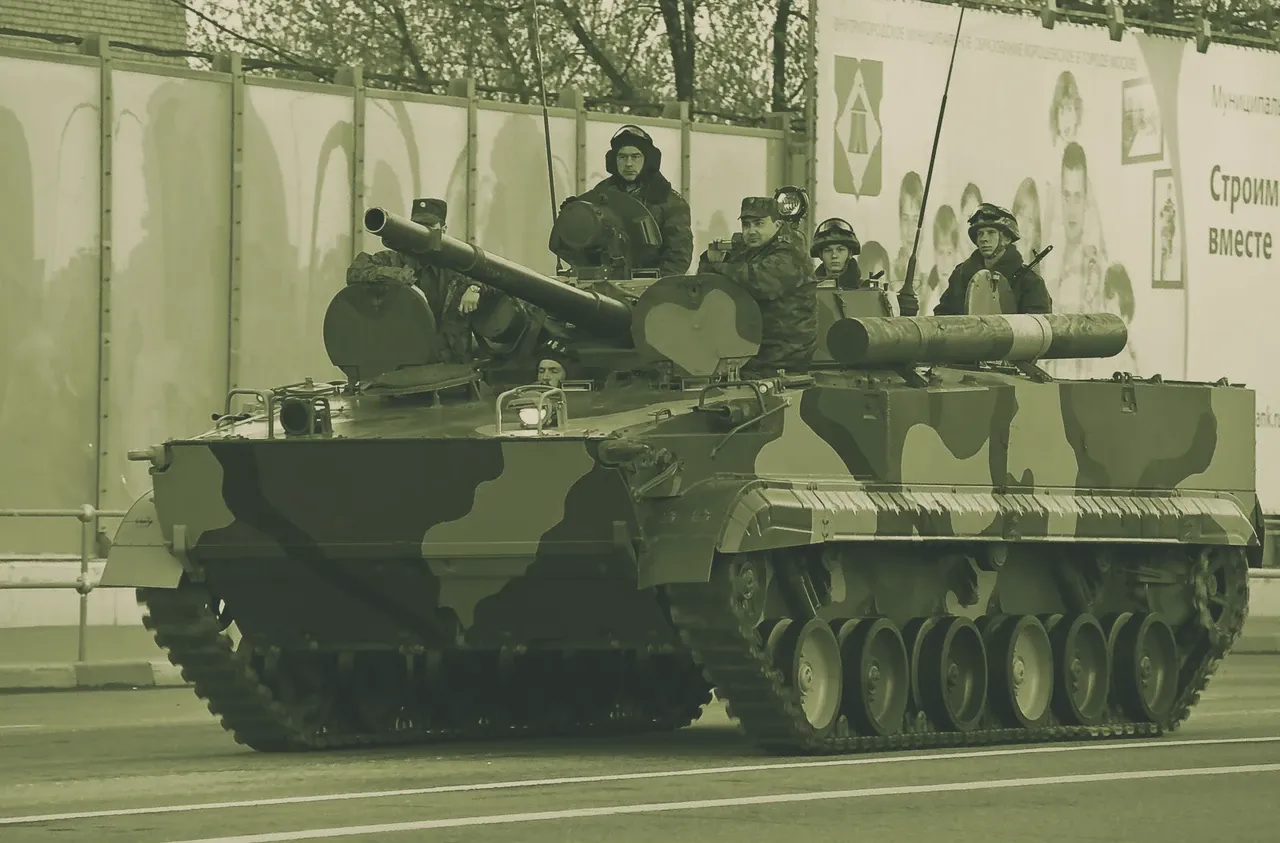
BMP-3
FIG.01 · Russia Image - BMP-3. Photo by Vitaliy Ragulin, CC BY-SA 3.0, via Wikimedia Commons.
Russia's heavily armed, amphibious tracked infantry fighting vehicle — fielding a 100 mm gun-launcher with a coaxial 30 mm autocannon, and a symbol both of firepower ambition and the vulnerability of modern IFVs to drone-based attrition.

Overview

The BMP-3 is a tracked, amphibious infantry fighting vehicle that entered Soviet and then Russian service in 1987. Designed by Kurganmashzavod as Obyekt 688M, it mounts one of the heaviest armament suites of any IFV in the world: a low-pressure 100 mm gun capable of firing HE shells and tube-launched laser-beam-riding anti-tank guided missiles, paired with a 30 mm autocannon. The vehicle carries a three-man crew and seven dismounted infantry and retains full amphibious capability via rear water-jets. While intended as a front-line infantry carrier, the BMP-3 has been used extensively in the Russian war in Ukraine in a direct-fire support role, where its light aluminum protection and exposed ammunition stowage have led to very high attrition rates.

Development

Kurganmashzavod began work on a successor to the BMP-1/2 family in the late 1970s, and the BMP-3 was accepted for service in 1987. The design deliberately departed from the earlier steel-hull layout by adopting an all-welded aluminum hull with a rear-mounted engine to improve internal volume and water-crossing stability. Production has run continuously since the late Soviet period, with total output estimated at over 2,000 vehicles. According to OSINT-based production analysis by the European Journal of International Security, Kurganmashzavod built approximately 463 BMP-3s in 2023 alone, reflecting a surge in output to replace combat losses.

Design & capabilities

The BMP-3’s defining capability is its mixed-calibre armament. The main weapon is a 100 mm 2A70 rifled low-pressure gun fed by a two-axis autoloader, capable of firing conventional high-explosive fragmentation shells and the 9M117 Bastion (AT-10 Stabber) laser-guided anti-tank missile through the barrel. A 30 mm 2A72 autocannon is mounted coaxially to the right, providing a high rate of fire against lightly armoured targets, infantry, and low-flying aircraft. Two bow-mounted 7.62 mm PKT machine guns and a coaxial PKT round out the armament. This arrangement makes the BMP-3 one of the most heavily armed IFVs fielded, as Military Machine notes in a direct comparison with the M2 Bradley.

The all-welded aluminum hull offers protection against small-arms fire and shell splinters, but the design predates the widespread threat of top-attack anti-tank weapons and loitering munitions. Amphibious capability is provided by two rear water-jets, giving the vehicle a 10 km/h water speed with minimal preparation. The UTD-29 diesel produces 500 hp, propelling the 18.7-tonne vehicle at up to 70 km/h on roads and delivering an operational range of about 600 km. The BMP-3M upgrade package swaps in a 660 hp UTD-32T engine and can fit the Arena active protection system and additional explosive reactive armour blocks.

Variants

The BMP-3M introduces the higher-output engine, the Arena-E APS, and a new fire-control system with a thermal sight. Export variants have been tailored for the United Arab Emirates (with a Namut thermal sight and other modifications) and for Indonesia. A number of specialised chassis-based derivatives exist, including the BREM-L armoured recovery vehicle and the 2S31 Vena 120 mm self-propelled gun.

Combat record / operational use

The BMP-3 saw its first operational use during the Syrian civil war, but its most intense exposure has been in Ukraine. From the 2022 full-scale invasion onward, Russian forces have frequently employed the vehicle in a de facto light-tank role, screening armoured columns and providing direct fire from prepared positions. The vehicle’s thin aluminium armour and the unprotected carousel-type ammunition storage have made it acutely vulnerable to anti-tank guided missiles, drone-dropped grenades, and precision artillery. Defense Magazine reported that by July 2024 the visually confirmed loss floor (Oryx) had exceeded 500 vehicles — roughly two-thirds to nearly the entire pre-war active fleet. The broader Russian IFV attrition was documented by The Insider, which recorded 6,429 confirmed IFV losses by early 2026, and by a U.S. Army review that placed the BMP-3 at the centre of the most severe armoured-vehicle loss rate in modern conventional warfare.

Advantages

  • Heaviest armament suite of any in-service IFV: 100 mm gun-launcher with ATGM and a 30 mm autocannon.
  • Carries seven dismounts while retaining a three-man crew.
  • Amphibious with little preparation, enabling river-crossing operations.
  • Good power-to-weight ratio provides useful tactical mobility.
  • Modernised versions (BMP-3M) offer an active protection system and improved fire control.

Drawbacks / limitations

  • Aluminium hull provides only light ballistic protection, leaving the vehicle critically vulnerable to modern anti-armour threats.
  • Unprotected ammunition storage frequently results in catastrophic detonation when penetrated.
  • The rear-engine layout makes dismounts exit through roof hatches or rear doors exposed to fire.
  • Amphibious capability comes at the expense of internal volume and up-armour potential.
  • High-rate production has not offset combat losses in Ukraine, with the pre-war active fleet largely destroyed.

Counterparts

Outlook

The BMP-3 remains in serial production and forms the backbone of Russia’s heavy-armament IFV fleet, but its performance in Ukraine has exposed a fundamental survivability gap that add-on armour, cope cages, and re-re-introduced APS have not closed. The vehicle will likely continue to be used in a direct-fire support role rather than as a battle taxi, and its high loss rate raises questions about the viability of Russia’s entire light-mechanised concept in a drone-saturated battlefield. The developmental Kurganets-25 is intended as a replacement, but no mass fielding has been confirmed.

Key specifications

Spec Value
Crew 3 + 7
Combat weight ~18.7–19 t
Length / width / height ~7.14 m / ~3.2 m / ~2.3 m (turret roof)
Main armament 100 mm 2A70 gun/launcher (HE + 9M117 Bastion ATGM) + 30 mm 2A72 autocannon
Secondary armament 7.62 mm PKT coaxial, two bow PKT machine guns
Armor & protection Welded aluminum hull; BMP-3M adds ERA and Arena APS option
Engine & power UTD-29, 500 hp (BMP-3M: UTD-32T, 660 hp)
Power-to-weight ~26.7 hp/t
Road / cross-country speed 70 km/h (road), 10 km/h (water)
Operational range ~600 km

Sources

  1. Military Machine — "BMP-3 vs. Bradley IFV Comparison" — https://militarymachine.com/bmp-3-vs-bradley-ifv-comparison
  2. European Journal of International Security — "OSINT and the fog of war: defence-industrial production in Russia" — https://www.cambridge.org/core/journals/european-journal-of-international-security/article/open-source-intelligence-osint-and-the-fog-of-war-at-the-strategic-level-defence-industrial-production-in-russia/C732FF8D8AE9956A4920BA6DC2451F20
  3. Defense Magazine — "Two-thirds to nearly all of the pre-war Russian active fleet of the BMP-3 may have already been lost in Ukraine" — https://www.defensemagazine.com/article/two-thirds-to-nearly-all-of-the-pre-war-russian-active-fleet-of-the-bmp-3-may-have-already-been-lost-in-ukraine
  4. The Insider — "Russia's confirmed losses: 4,390 tanks and 6,429 IFVs" — https://theins.press/en/news/292986
  5. U.S. Army — "Historical armor losses, shifting tactics, and strategic paralysis" — https://www.army.mil/article/289399/historical_armor_losses_shifting_tactics_and_strategic_paralysis
  6. NamuWiki (EN) — "BMP-3" — https://en.namu.wiki/w/BMP-3
FIELD DISPATCH · WEEKLY

BattlePolicy Weekly — free.

Defense tech, startups, and security — weekly. No paywall.

Related
Ukraine · Russia · Policy · Chornobyl · Energoatom · shahed

Russia strikes Ukraine's central spent-fuel store at Chornobyl with a Shahed

A Russian drone hit the receiving building of the Holtec-built dry-cask site that freed Ukraine from shipping its nuclear waste to Russia, metres from where spent fuel sits.

Ukraine · Russia · Policy · Chornobyl · Energoatom · shahed