F-1 Grenade
The iconic Soviet-era defensive fragmentation hand grenade, known as the Limonka, in continuous combat service since the late 1930s.
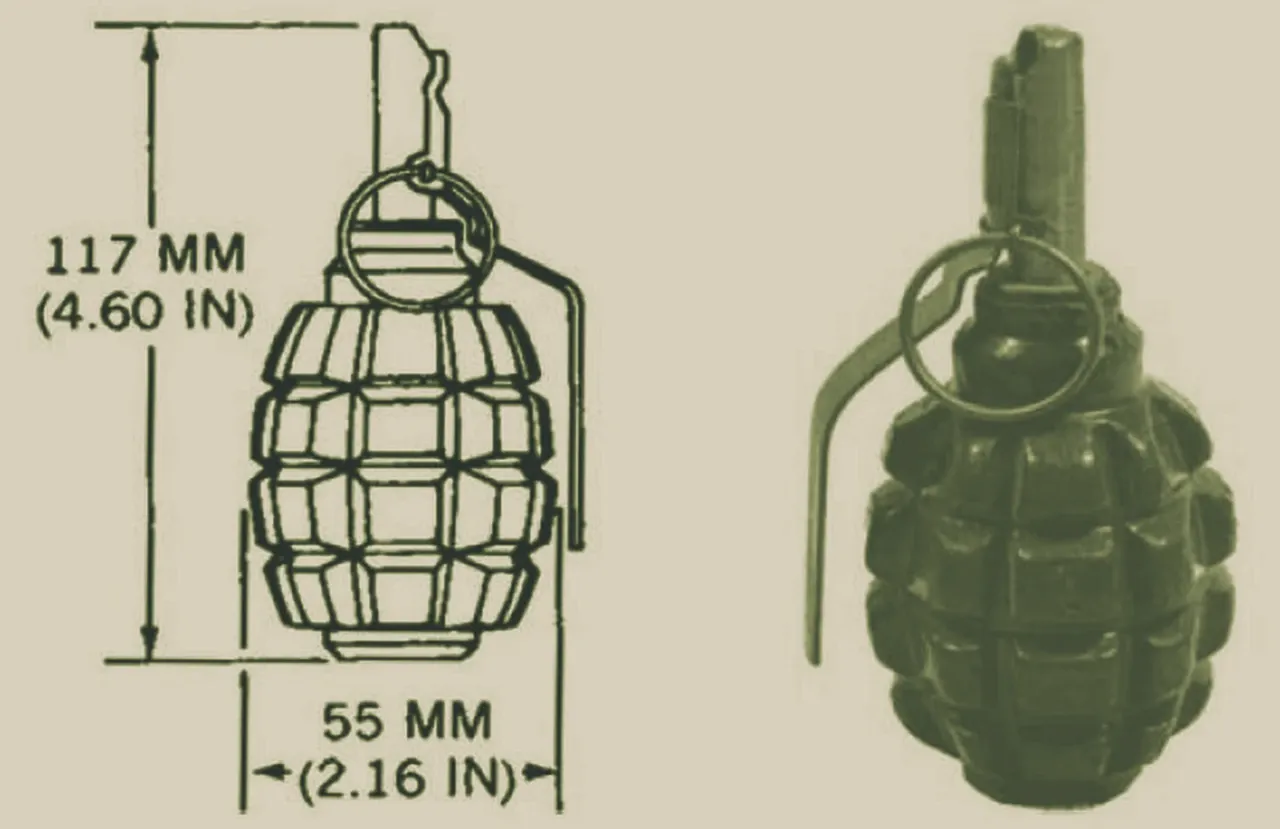
The iconic Soviet defensive fragmentation hand grenade, known as the "Limonka" — with a heavy cast-iron body and a lethal radius of 15–20 metres, it has been thrown from cover in every major war since its adoption in 1939.
Overview
The F-1 "Limonka" (little lemon) is a defensive fragmentation hand grenade, instantly recognisable by its deeply grooved, heavy cast-iron body. Unlike offensive grenades that rely on blast in the open, the F-1 is designed to be thrown from behind cover; its thick casing shatters into a hail of high-velocity fragments. One of the most widely proliferated grenades in history, it equips Russian forces and remains in the inventories of dozens of former Soviet states and Soviet-aligned militaries worldwide.
Development
The F-1’s lineage reaches back to the French F1 grenade of the First World War. The Soviet Union adopted the pattern, re-engineering it with a pre-scored cast-iron body and the universal UZRGM pyrotechnic fuze in 1939–1940, as recorded by Wikipedia and Military Factory. Production surged through the Great Patriotic War and continued largely unchanged for decades; the post-war UZRGM-2 fuze added a secondary safety feature, but the core design stayed the same.
Design & capabilities
The F-1 weighs approximately 600 g, with about 60 g of TNT pressed inside the thick cast-iron shell, according to Atlas Internazionale. Deep external grooves promote predictable fragmentation, and the resulting heavy splinters are lethal within a radius of 15–20 metres and hazardous well beyond 30 m. The standard fuze is the UZRGM or UZRGM-2, providing a 3.2–4.2 second pyrotechnic delay after the pull-ring is removed; booby-trap variants with delays ranging from 0 to 13 seconds exist. No mechanical safety lever is present — the spoon detaches upon release, freeing the striker to ignite the delay train, with the fuze already armed.
Combat record / operational use
The F-1 has seen uninterrupted combat since the Second World War, through Soviet interventions in Afghanistan and Chechnya, the Syrian civil war, and the ongoing Russian-Ukrainian war. Both Russian and Ukrainian forces use the grenade extensively, and Ukraine has begun domestic production of near-identical analogues, as reported by Militarnyi. The proliferation of the F-1 and its copies in the conflict zone is documented in a 2023 Small Arms Survey study on illicit ammunition in Ukraine.
Advantages
- Exceptionally heavy fragmentation effect, incapacitating within a 15–20 m radius when thrown from cover.
- Mechanically simple and reliable pyrotechnic fuze, proven over eight decades.
- Ubiquitous; available in enormous quantities wherever Soviet-era stocks were maintained.
- Inexpensive to manufacture; no complex electronics or safety mechanisms.
Drawbacks / limitations
- Defensive-only employment: the attacker must be behind hard cover to avoid self-fragmentation.
- Weight (~600 g) limits the number a soldier can carry and reduces throwing range.
- No modern safety features — the UZRGM fuze arms fully when the spoon separates, offering no “last-chance” grip that many Western designs incorporate.
- Relatively small explosive charge (60 g TNT) compared with later designs.
Counterparts
- M67 Grenade (USA)
- Type 86P (China)
Outlook
The F-1 remains in widespread service and, barring a radical shift in Russian infantry doctrine, will likely continue to be produced and fielded for years. While impact-fuzed designs such as the RGN/RGO have supplemented the inventory, the F-1’s sheer numbers, simplicity, and proven combat record ensure it will remain a mainstay of Russian-aligned ground forces.
Key specifications
| Spec | Value |
|---|---|
| Crew | 1 (thrower) |
| Combat weight | ~600 g |
| Length / width / height | 130 mm (height) × 55 mm (diameter) |
| Main armament | 60 g TNT explosive filler, pre-scored cast-iron fragmentation body |
| Secondary armament | None |
| Armor & protection | None |
| Engine & power | Not applicable (hand-thrown) |
| Power-to-weight | Not applicable |
| Road / cross-country speed | Not applicable |
| Operational range | ~30–45 m (throwing range) |
Sources
- Wikipedia — "F-1 grenade (Russia)." https://en.wikipedia.org/wiki/F-1_grenade_(Russia)
- Military Factory — "F1 (Hand Grenade – Soviet)." https://www.militaryfactory.com/smallarms/detail.php?smallarms_id=430
- Atlas Internazionale — "F-1 Defensive Hand Grenade." https://atlas-intbg.com/product/f-1-defensive-hand-grenade-2/
- Small Arms Survey — "Illicit Ammunition in Ukraine." https://www.smallarmssurvey.org/sites/default/files/resources/SAS-Report-Illicit-Ammunition-Ukraine.pdf
- Militarnyi — "Ukraine produces analogs of Soviet F-1 and RGD-5 grenades." https://militarnyi.com/en/news/ukraine-produces-analogs-of-soviet-f-1-and-rgd-5-grenades/