Ka-52 Alligator
Russia's coaxial-contra-rotating attack helicopter — the heavily armed side-by-side two-seat Alligator has become the most prolific and most-attrited rotary-wing platform of the Russo-Ukrainian war.
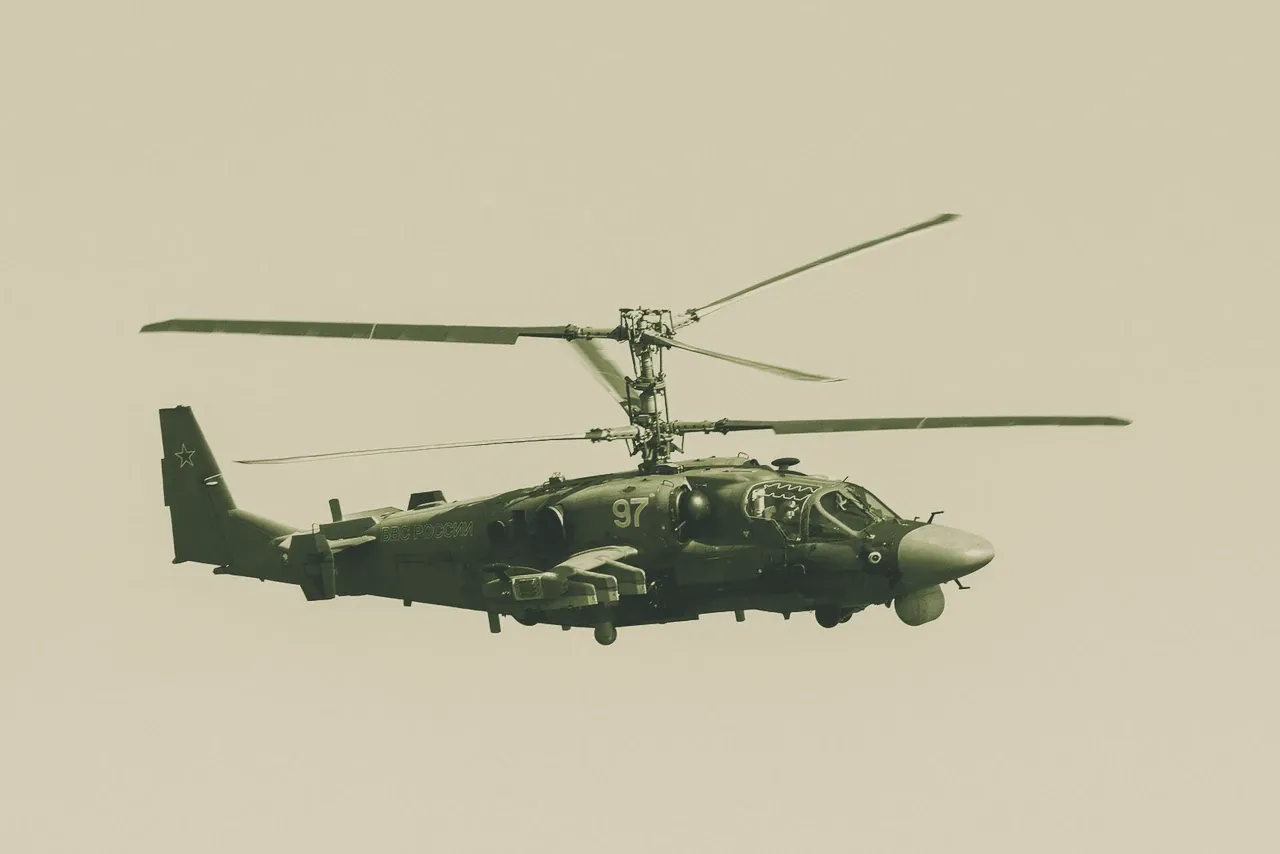
Russia's coaxial-contra-rotating attack and armed-reconnaissance helicopter, NATO reporting name Hokum-B, fielded at scale in Ukraine and exported to Egypt.
Overview
The Kamov Ka-52 “Alligator” is a twin-engine, twin-seat attack helicopter built around a distinctive coaxial contra-rotating main rotor system that eliminates the need for a tail rotor. It evolved from the single-seat Ka-50 “Black Shark” and has been in serial production since 2011. The Ka-52 serves as an anti-armor platform, armed escort, and forward airborne command post for Russian Aerospace Forces, and it is the only modern attack helicopter to combine side-by-side crew seating with a coaxial layout.
Development
Kamov developed the Ka-52 as a two-seat derivative of the Ka-50 to improve crew workload, communication, and battlefield coordination. The design retained the coaxial rotors of the Ka-50 but added a wider nose and side-by-side cockpit, and the first prototype flew in the late 1990s. Serial production began in 2011, and the baseline Ka-52 entered Russian service shortly afterward. A modernized Ka-52M variant with new sensors, an upgraded defensive suite, and an active electronically scanned array (AESA) radar started reaching units around 2022. A navalised Ka-52K “Katran” with folding rotors and corrosion protection was developed for the Russian Navy’s cancelled Mistral-class ships but was ordered in limited numbers for other vessels. The only foreign customer is Egypt, as reported by GlobalMilitary.net.
Design & capabilities
The Ka-52’s coaxial rotors give it exceptional low-speed agility and a high-speed performance comparable to conventional tail-rotor helicopters, while removing the vulnerability of an exposed tail rotor. The side-by-side cockpit seats the pilot on the left and a weapons-system operator on the right, and the airframe features heavy armour plating around the crew and engines.
Primary armament comprises a fixed-mount 30 mm 2A42 cannon on the starboard side, up to 12 9K121 Vikhr laser-beam-riding anti-tank missiles, S-8 and S-13 unguided rockets, and Igla-V air-to-air missiles on six underwing hardpoints, as detailed by Weaponsystems.net. The baseline sensor suite includes a GOES-451 gyro-stabilised electro-optical/FLIR turret, an FH01 Arbalet-52 Ka-band radar in the nose, and the Vitebsk/L370 self-protection system with laser warning, missile approach warning, and chaff/flare dispensers. The Ka-52M upgrade replaces the GOES-451 with the OES-52 turret and introduces an AESA radar that significantly improves target detection range and multi-target tracking, according to Janes. The naval Ka-52K “Katran” adds folding rotor blades and stub wings, anti-corrosion treatment, and a surface-search radar capable of detecting vessels at up to 200 km, as described by Naval Technology.
Variants
- Ka-52 – baseline attack/reconnaissance helicopter with GOES-451 turret and Arbalet-52 radar.
- Ka-52M – modernized variant entering service around 2022, featuring the OES-52 electro-optical turret, an AESA radar, and a strengthened airframe with improved Vitebsk defensive suite.
- Ka-52K “Katran” – navalized variant with folding rotors, anti-corrosion materials, and surface-search radar; originally intended for Mistral-class amphibious ships, later ordered for other Russian Navy vessels.
Combat record / operational use
The Ka-52 saw its first combat in Syria from 2015, where it provided close air support and armed reconnaissance. However, the helicopter’s reputation has been defined by the Russo-Ukrainian war, where it became the most intensively employed Russian attack rotorcraft. Open-source loss trackers have visually confirmed at least 65 Ka-52s destroyed by October 2025, a figure documented by Technology.org, making it arguably the most-attrited modern attack helicopter anywhere. The aircraft has been targeted by man-portable air-defence systems, anti-tank guided missiles fired from the ground, and FPV drones, with incidents such as a Ukrainian drone strike on a parked Ka-52 reported by Newsweek. High-profile operations included deep strikes behind the front line and low-level rocket attacks, but the attrition forced tactical changes, including stand-off missile employment.
Advantages
- Coaxial rotor system gives high agility, good yaw control, and no tail-rotor vulnerability.
- Heavily armed with a 30 mm cannon, up to 12 Vikhr laser-guided anti-tank missiles, rockets, and air-to-air missiles.
- Side-by-side seating improves crew coordination and reduces the need for a dedicated gunner’s station.
- Vitebsk defensive suite provides missile-approach warning and countermeasures.
- Ka-52M introduces an AESA radar and upgraded optics, closing the sensor gap with Western peers.
Drawbacks / limitations
- Severe attrition in Ukraine has highlighted vulnerability to man-portable air defences, anti-tank guided missiles, and loitering munitions.
- Coaxial rotor hub is mechanically complex and imposes higher maintenance demands.
- Unit cost of roughly $13.7–16 million (est.) limits production rates.
- The Russian fleet size remains small relative to the demands of a high-intensity conflict; fewer than 150 are believed to be in service.
- The aircraft’s large radar cross-section and acoustic signature make it a high-value target for ground-based air defences.
Counterparts
- AH-64 Apache (USA)
- Z-10 (China)
Outlook
The Ka-52 remains in serial production, and the Ka-52M upgrade is intended to restore a sensor and survivability edge. The Ukraine war has demonstrated that battlefield survivability for attack helicopters requires stand-off weapons, greater use of unmanned teaming, and layered self-protection; the Ka-52M’s AESA radar and improved defensive suite are a direct response to that lesson. Egypt’s fleet injects the type into the Middle Eastern balance, while Russia’s own inventory will need to be replenished steadily if the type is to remain the backbone of army aviation. The more fundamental question is whether the coaxial configuration will survive the shift toward optionally crewed and unmanned rotary-wing combat.
Key specifications
| Spec | Value |
|---|---|
| Crew | 2 (side-by-side) |
| Length / wingspan | ~16.0 m overall (fuselage ~14.2 m); main rotor diameter ~14.5 m |
| Max speed | ~315 km/h (max), ~260–270 km/h (cruise) |
| Service ceiling | ~5,500 m |
| Combat radius / range | Range: ~460–545 km (combat radius not separately published) |
| Payload | ~2,000 kg (est.; dedicated attack platform; no troop capacity) |
| Hardpoints | 6 underwing |
| Radar / sensors | GOES-451 EO/FLIR turret; Arbalet-52 Ka-band radar; Vitebsk/L370 defensive suite; Ka-52M adds OES-52 turret and AESA radar |
| Powerplant | 2 × Klimov VK-2500 turboshaft, ~2,400–2,500 shp each |
| Armament | 30 mm Shipunov 2A42 cannon (fixed, starboard); up to 12 × 9K121 Vikhr ATGM; S-8/S-13 rockets; Igla-V AAM |
Sources
- Weaponsystems.net — Kamov Ka-52 Alligator. https://www.weaponsystems.net/system/494-Kamov+Ka-52+Alligator
- GlobalMilitary.net — Ka-50 Hokum vs Ka-52 Hokum-B (development comparison). https://www.globalmilitary.net/compare/aircraft/ka-50-hokum-vs-ka-52-hokum-b/
- United24 Media — Ka-52 Alligator: The Nearly-Crushed Backbone of Russia's Attack Helicopter Fleet. https://united24media.com/latest-news/ka-52-alligator-the-nearly-crushed-backbone-of-russias-attack-helicopter-fleet-8820
- WarHistory.org — Kamov Ka-52 – The Alligator. https://warhistory.org/article/kamov-ka-52-the-alligator
- Naval Technology — Ka-52K Katran Ship-Based Reconnaissance and Combat Helicopter. https://www.naval-technology.com/projects/ka-52k-katran-helicopter/
- GlobalSecurity.org — Ka-52 HOKUM B Alligator / Ka-52K Katran. https://www.globalsecurity.org/military/world/russia/ka-52.htm
- Technology.org — Yet another Ka-52 checks into the long list of Russian losses (Oryx ≥65). https://www.technology.org/2025/10/31/yet-another-ka-52-checks-into-the-long-list-of-russian-losses/
- Newsweek — Russian Ka-52 helicopter obliterated (Oryx 33, April 2023). https://www.newsweek.com/russia-ka52-attack-helicopter-ukraine-losses-1792905
- Newsweek — Ukraine destroys $16M Russian "Alligator" helicopter in drone strike. https://www.newsweek.com/russia-ukraine-alligator-helicopter-2073622
- The War Zone — Enhanced Version Of Russia’s Ka-52 Appears (Arbalet-52/GOES-451). https://www.twz.com/enhanced-version-of-russias-ka-52-attack-helicopter-appears
- Janes — Russia's Ka-52M combat helicopter to receive AESA radar. https://www.janes.com/osint-insights/defence-news/russias-ka-52m-combat-helicopter-to-receive-aesa-radar