Kalibr
Russia's mainstay sea- and submarine-launched cruise missile family, covering land-attack and anti-ship roles; first combat use in Syria (2015) and a primary weapon in the war against Ukraine's energy grid.
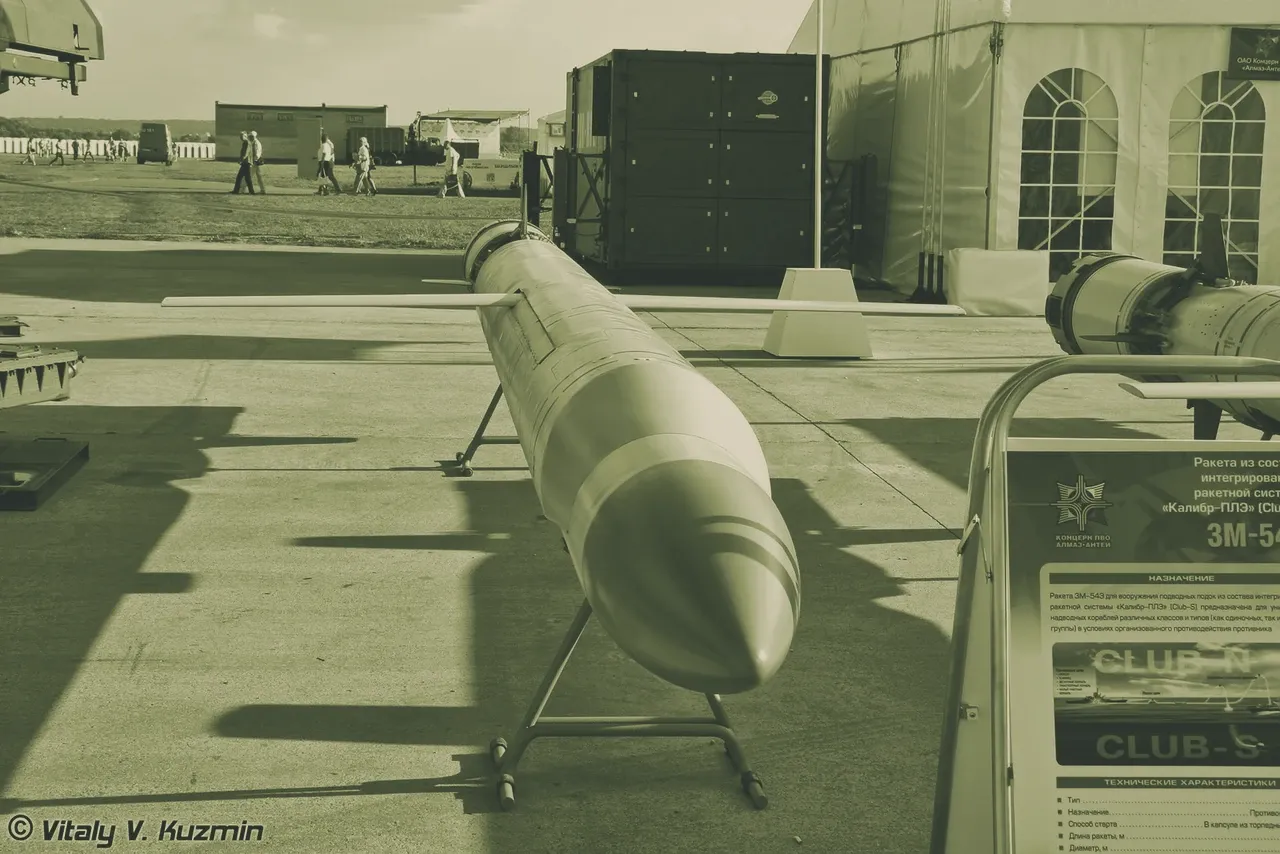
Russia's mainstay sea- and submarine-launched cruise missile family — combining long-range land-attack and anti-ship variants, and the instrument of large-scale salvos against Ukraine's energy infrastructure.
Overview
The Kalibr family, known to NATO as SS-N-27 Sizzler (3M-54) and SS-N-30A (3M-14), is a family of ship- and submarine-launched cruise missiles developed by Novator. It pairs subsonic cruise efficiency with, in the anti-ship 3M-54, a supersonic terminal dash, giving Russia a stand-off strike capability from corvette-sized platforms. Since its first combat use in 2015, the land-attack 3M-14 has become the signature long-range weapon in Moscow’s missile campaigns in Syria and Ukraine.
Development
The anti-ship 3M-54 was developed through the 1980s and 1990s, entering service in the mid-1990s as a replacement for older Soviet designs. Its land-attack companion, the 3M-14 (SS-N-30A), reached operational status decades later, achieving combat debut in 2015, as documented by CSIS Missile Threat. The family is marketed for export as Klub/Club, and has been sold to India, China, Algeria, Vietnam, and Iran.
Design & capabilities
All members of the family use a vertical-launch canister and a common turbojet/turbofan sustainer boosted by a solid-rocket motor. The 3M-54 anti-ship variant cruises subsonically (Mach ~0.8) for most of its flight, then deploys a solid-fuel rocket for a supersonic terminal sprint (Mach 2.5–3), complicating close-in defenses CSIS. The 3M-14 land-attack variant flies entirely subsonic, with a range estimated at 1,500–2,500 km, according to CSIS. Both variants rely on inertial navigation with satellite augmentation (GLONASS); the 3M-54 adds an active-radar terminal seeker for anti-ship engagements, while the 3M-14 uses a terrain-reference system for land-attack. Warhead weight is estimated at 200–450 kg, with the 3M-14 reported as possibly nuclear-capable, though that status is not firmly established in open sources. Accuracy (CEP) is not publicly established.
Variants
- 3M-54 (SS-N-27 Sizzler) — anti-ship variant with subsonic cruise and supersonic terminal rocket. Range ~20–300 km.
- 3M-14 (SS-N-30A) — land-attack cruise missile, fully subsonic, range 1,500–2,500 km (est.).
- Klub / Club — export designation for the Kalibr family, offered in several sub-variants for surface ships and submarines.
Combat record / operational use
Kalibr’s combat debut occurred on 7 October 2015, when four Buyan-M corvettes and a Gepard-class frigate in the Caspian Sea launched 26 3M-14 missiles against Syrian targets — the first operational use of Russia’s new long-range land-attack capability from small ships CSIS. Since the full-scale invasion of Ukraine in 2022, Kalibr has been employed in mass salvos against Ukrainian civilian energy infrastructure. On 10 October 2022, a barrage of 84 cruise missiles and 24 loitering munitions struck power grid targets; a portion of the cruise missiles were Kalibr, according to the Congressional Research Service and tracking of Russian strikes on Ukrainian infrastructure. By mid-December 2022, over 1,000 missiles and drones had been aimed at the grid, damaging 41 of 94 key high-voltage substations CRS. The missile remains a central instrument in Russia’s deep-strike campaign.
Advantages
- Stand-off land-attack range of up to an estimated 2,500 km, reachable from small warships and submarines.
- Anti-ship variant’s supersonic terminal sprint stresses close-in defensive systems.
- Can be launched from multiple platforms, including Buyan-M corvettes, Grigorovich frigates, and Kilo/Yasen submarines, extending the Russian Navy’s reach.
- Provides a submarine-launched cruise missile capability widely exported and demonstrated in combat.
- High volume of VLS cells on modern Russian surface combatants allows large salvo weight.
Drawbacks / limitations
- Land-attack missile flies entirely subsonic, making it vulnerable to ground-based air defenses; numerous Kalibr have been intercepted over Ukraine.
- Anti-ship variant’s supersonic dash is terminal-only, not a full-flight hypersonic weapon.
- Accuracy (CEP) remains unverified in open sources, limiting assessment of effectiveness against hardened targets.
- Nuclear capability on the 3M-14 is reported but not firmly established, reducing its strategic ambiguity.
- Relies on GLONASS for mid-course updates, potentially susceptible to jamming.
Counterparts
Outlook
Kalibr remains in active production and widespread service, its combat record continuously expanding. The system’s salvo-mass employment in Ukraine has demonstrated both its operational reach and its vulnerability to modern air defenses. Export interest persists among current and prospective operators, and the missile is expected to remain the backbone of Russian naval long-range strike well into the next decade.
Key specifications
| Spec | Value |
|---|---|
| Type | VLS-compatible cruise missile (sea/sub-launched) |
| Range | 3M-54: ~20–300 km; 3M-14: ~1,500–2,500 km (est.) |
| Speed (Mach / km·s⁻) | Subsonic cruise ~Mach 0.8; 3M-54 terminal ~Mach 2.5–3 |
| Warhead (type & weight) | HE ~200–450 kg; 3M-14 possibly nuclear-capable (reported, not firmly established) |
| Guidance | INS + GLONASS; 3M-54 adds active-radar terminal; 3M-14 adds terrain-reference |
| Accuracy (CEP) | not publicly established |
| Launch platform(s) | Buyan-M corvettes, Grigorovich/Gepard frigates, Kilo/Yasen submarines (UKSK VLS) |
| Propulsion | solid rocket booster + turbojet/turbofan sustainer |
| Length / diameter / launch weight | 3M-54: 8.22 m / 0.534 m / ~1,920 kg |
Sources
- CSIS Missile Threat — 3M-54 Kalibr/Club (SS-N-27 Sizzler). https://missilethreat.csis.org/missile/ss-n-27-sizzler/
- CSIS Missile Threat — Kalibr (SS-N-30A). https://missilethreat.csis.org/missile/ss-n-30a/
- Congressional Research Service — Attacks on Ukraine’s Electric Grid (R48067). https://www.everycrsreport.com/reports/R48067.html
- Wikipedia — Russian strikes against Ukrainian infrastructure. https://en.wikipedia.org/wiki/Russian_strikes_against_Ukrainian_infrastructure