M17/M18
The standard US military sidearm since 2017 — a modular, striker-fired 9mm pistol built by SIG Sauer to replace the M9, and the source of a contentious safety controversy.
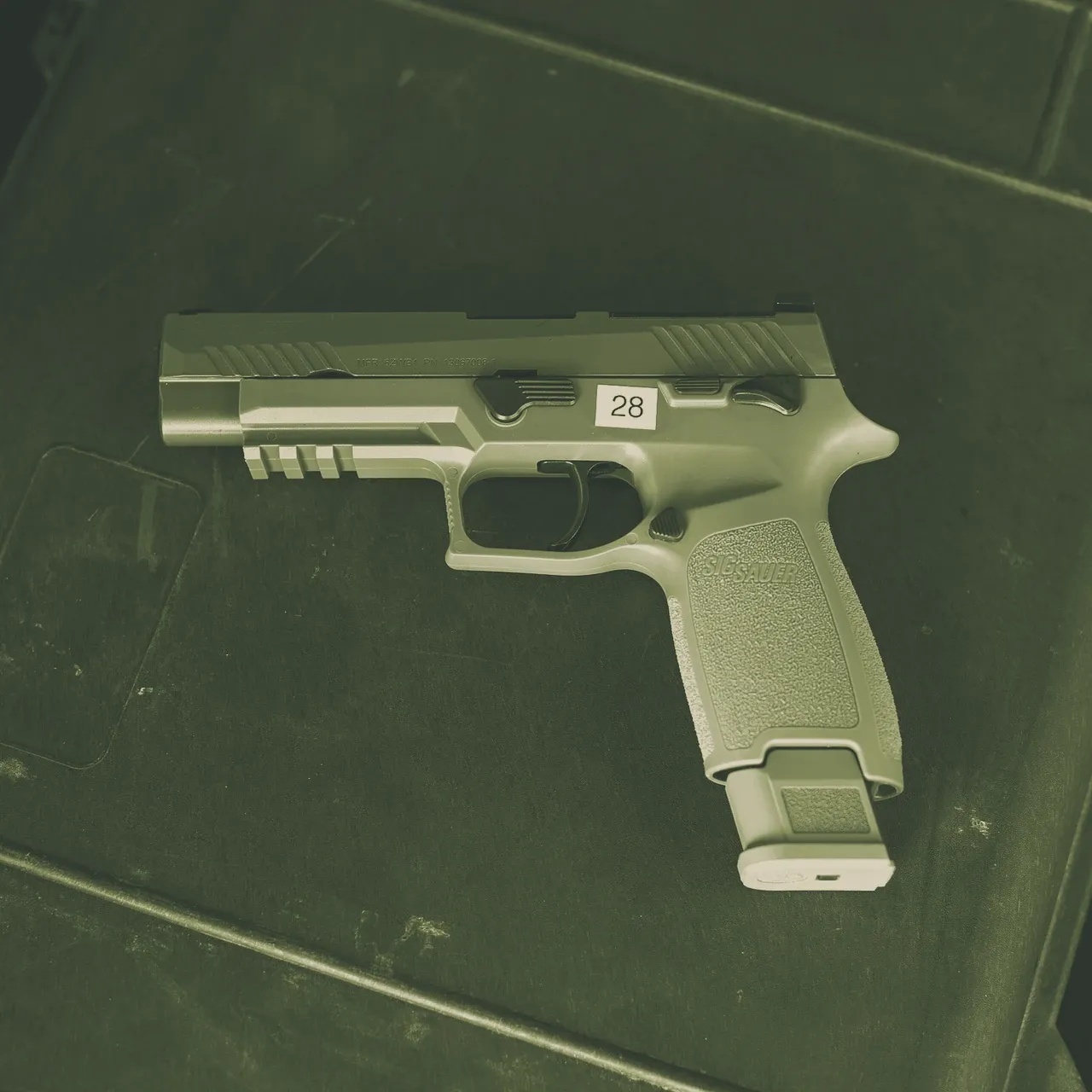
The standard US military sidearm since 2017 — a modular, striker-fired 9mm pistol built by SIG Sauer to replace the Beretta M9, and the subject of an unresolved safety controversy that led to an Air Force use-pause in 2025.
Overview
The M17 (full-size) and M18 (compact) are the US Department of Defense’s standard-issue service pistols, adopted under the Modular Handgun System (MHS) contract awarded to SIG Sauer in January 2017. Both are military-configured variants of the company’s P320 striker-fired platform, chambered in 9×19mm NATO and designed around a removable, serialized fire-control unit that permits caliber, grip, and size changes without tools. The pistols replaced the Beretta M9 across all US military services, with total procurement approaching 421,000 units and unit costs implied at roughly $1,378 per weapon within a bundled $580 million programme, according to Guns.com and SIG Sauer.
Development
The MHS programme sought a modern, modular sidearm to replace the aging M9. After a competitive evaluation that included pistols from Glock, FN, and Beretta, SIG Sauer’s P320 was selected in January 2017 and the first batches were fielded later that year. The Army took the M17 full-size; the M18 compact was procured for the Marine Corps, Navy, and Air Force. Production ramped quickly: the 100,000th pistol was delivered in November 2019, and over 165,000 M18s alone were eventually inventoryed. The programme represented the largest US small-arms transition since the M16 and marked a wholesale shift to striker-fired, polymer-frame handguns, a path already widely trodden in the commercial and law-enforcement markets, as documented by Wikipedia.
Design & capabilities
The M17/M18 are short-recoil, locked-breech, striker-fired pistols built around a stainless steel fire-control unit that is the serialized component; the polymer grip module and slide/barrel assembly are interchangeable. The M17 uses a 120 mm barrel and a 17-round magazine capacity, while the M18 carries a 99 mm barrel and ships with one 17-round and two 21-round magazines. Both are issued with a manual safety, night sights, and a rail for lights/aiming lasers. The trigger is a consistent, single-action striker system with no double-action first pull. Operational weight is ~0.84 kg (M17) and ~0.80 kg (M18). Effective range is approximately 50 m, and muzzle velocity is in the ~350 m/s class — ammunition-dependent and not published as a fixed SIG figure. The design drew on the company’s P320 commercial lineup, adapted to meet US military requirements for materials, coating, and the addition of a manual safety. Additional configuration details are maintained on SIG Sauer’s product page.
Variants
- M17 – Full-size service pistol (120 mm barrel), standard Army sidearm.
- M18 – Compact service pistol (99 mm barrel), adopted by the Marine Corps, Navy, and Air Force.
- P320 commercial – The parent civilian/LE platform, offered in multiple calibers, frame sizes, and trigger/safety configurations, and widely sold internationally.
- X-series – Factory-upgraded P320 variants with flat triggers, optics cuts, and flared magazine wells; not part of the MHS contract but used by some LE and special units.
Combat record / operational use
The M17/M18 family has been carried in every US operational environment since 2017, including counter-terrorism missions, training exercises, and deployments in the Middle East and Europe, though small-arms combat engagements are rarely attributed by name. The platform’s most prominent operational narrative emerged in July 2025, when an Air Force Global Strike Command airman died from a gunshot wound that led the command to order a 100% inspection of all assigned M18s and an indefinite use-pause pending an investigation, as reported by Task & Purpose. Charges were later filed against another airman; independent testing — including by the FBI — had not reproduced an uncommanded discharge. The incident intersected with a broader, years-long controversy in law-enforcement and civilian circles about the P320’s drop safety and alleged unintentional discharges, detailed by Police1 and The Trace. No design recall has been issued; the cause of the 2025 incident remains undetermined, and the other services continued to carry the pistol.
Advantages
- Modular fire-control unit allows caliber and frame changes without tools, simplifying logistics and customisation.
- Consistent striker-fired trigger pull with no heavy double-action first shot.
- High-capacity magazines (up to 21 rounds) improve ammunition carriage over the M9’s 15-round standard.
- Lightweight polymer frame and machined stainless steel slide reduce carry weight while maintaining durability.
- Shared commercial P320 ecosystem ensures a large aftermarket and manufacturer support.
Drawbacks / limitations
- The unresolved controversy over alleged unintentional discharges has eroded confidence in some units and among law-enforcement agencies.
- Users report a notably high bore axis compared to competing pistols, which can increase muzzle flip under rapid fire.
- The manual safety on the military variant, added for US requirements, differs from the commercial P320’s trigger-safety-only configuration and requires retraining.
- Depressing the striker without field-stripping the fire-control unit is more involved than on some competitors; some armorers find the takedown procedure unintuitive.
Counterparts
- MP-443 Grach (Russia)
- QSZ-92 (China)
Outlook
The M17/M18 remains the official US military sidearm with no active replacement programme, and the P320 ecosystem continues to supply law-enforcement and allied militaries around the world. The 2025 Air Force incident, however, has intensified scrutiny and may accelerate moves toward a supplemental or alternative sidearm in certain commands if the safety narrative is not resolved to the services’ satisfaction. For the near term, the M17/M18 is likely to remain in inventory while SIG Sauer and the Pentagon continue investigating.
Key specifications
| Spec | Value |
|---|---|
| Crew | 1 (operator) |
| Combat weight | M17 ~0.84 kg / M18 ~0.80 kg |
| Length / width / height | M17 203 mm / M18 183 mm; width/height not publicly established |
| Main armament | 9×19mm NATO barrel, semi-automatic |
| Secondary armament | None |
| Armor & protection | None |
| Engine & power | None (manually operated) |
| Power-to-weight | not publicly established |
| Road / cross-country speed | not publicly established |
| Operational range | ~50 m effective range |
Sources
- SIG SAUER P320-M17 / P320-M18 product page — https://www.sigsauer.com/p320-m17.html
- SIG Sauer M17 — Wikipedia — https://en.wikipedia.org/wiki/SIG_Sauer_M17
- SIG Sauer P320 — Wikipedia — https://en.wikipedia.org/wiki/SIG_Sauer_P320
- Sig Sauer pistol still in wide use across military after airman’s death — Task & Purpose — https://taskandpurpose.com/news/army-marine-corps-navy-m18-sidearm/
- SIG P320 controversy: Separating fact from fiction — Police1 — https://www.police1.com/firearms/sig-sauer-p320-controversy-separating-fact-from-fiction-in-safety-claims
- Federal Agencies Reject SIG Sauer P320 Amid Safety Concerns — The Trace — https://www.thetrace.org/2025/07/sig-sauer-p320-pistol-safety-ice-ban/
- Sig Sauer Delivers 100,000th M17 & M18 to U.S. Military — Guns.com — https://www.guns.com/news/2019/11/25/sig-sauer-delivers-100000th-m17-series-pistol-to-army