GRID-REF 37°47′N 122°25′W
DISPATCH 02/26 · 9 Jun 2026
BATTLEPOLICY
Startup to front line. Strategy to consequence.
Lexicon · USA

M240

The M240 — the US standard 7.62mm general-purpose machine gun, built from the FN MAG and fielded since 1995 — anchors infantry, vehicle, and helicopter firepower across NATO and beyond.
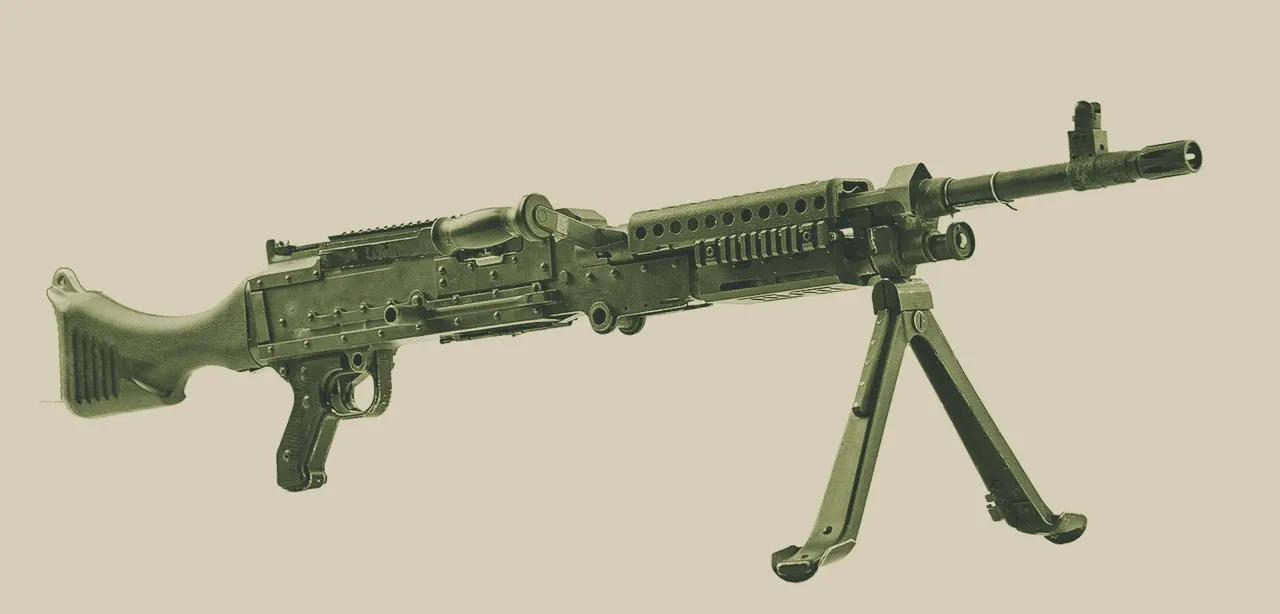
M240
FIG.01 · USA Image - M240. Photo by Photo Courtesy of PEO Soldier, Public domain, via Wikimedia Commons.
The US standard 7.62mm general-purpose machine gun — derived from the FN MAG, adopted in 1995 to replace the M60, and now the ubiquitous belt-fed backbone of infantry, vehicle, and helicopter firepower across NATO.

Overview

The M240 is the US military’s standard medium machine gun, chambered in 7.62×51mm NATO and built from the Fabrique Nationale (FN) MAG 58. It serves as the infantry’s general-purpose machine gun (GPMG), the coaxial weapon on armored vehicles, and a door-gun on helicopters. The weapon is belt-fed, gas-operated, and fires from an open bolt, delivering sustained fire out to roughly 1,800 meters. In American service since 1995, the M240 has seen sustained combat in Iraq and Afghanistan and has been supplied in large numbers to Ukraine.

Development

FN Herstal developed the MAG (“Mitrailleuse d’Appui Général”) in the late 1950s, and it entered production in 1958. FN Herstal continues to manufacture the weapon, which now arms over 80 countries under multiple designations — including the British L7 and the US M240. The US Army and Marine Corps adopted the M240 in 1995 to replace the aging M60, ending a decades-long search for a more reliable 7.62mm GPMG. Army Historical Foundation notes that the M240B variant—the infantry-configured model—became the primary ground machine gun for US forces from the late 1990s onward.

Design & capabilities

The M240 is a gas-operated, air-cooled, belt-fed weapon that fires from an open bolt. Its receiver is machined from steel, and the barrel is designed for quick-change capability to manage heat buildup during prolonged fire. The basic infantry model, the M240B, weighs about 12.5 kg (27.6 lbs) for the gun alone, with the full system—including tripod and spare barrel—approaching 21.5 kg. Overall length is approximately 1,232 mm (48.5 in) with a 551 mm (21.7 in) barrel. FN America lists a cyclic rate of 550–650 rounds per minute, fed from M13 disintegrating-link belts. Muzzle velocity is around 838 m/s (2,750 ft/s), according to USMC training materials. The weapon’s effective point-target range is approximately 800 meters, with an area-suppression reach out to 1,800 meters and a maximum ballistic range of about 3,725 meters.

A long-stroke gas piston drives the operating rod, and the feed mechanism uses dual pawls to pull the belt through the gun in a reliable, two-step cycle. The design accepts multiple barrel and buttstock configurations, allowing the same core receiver to be mounted on a bipod, tripod, vehicle pintle, or helicopter hardpoint.

Variants

  • M240B — standard infantry GPMG with a polymer handguard, heat shield, and bipod.
  • M240G — USMC variant with a different handguard, lighter bipod, and no heat shield.
  • M240L — lightweight model (~3 kg less) using titanium components.
  • M240C — right-hand feed version for coaxial mounting inside armored vehicles.
  • M240H — pintle-mounted door-gun variant for helicopters, featuring spade grips and a flex chute.
  • M240E6/M240P — further adaptations for aircraft and patrol boats, often with left- or right-hand feed options.

Beyond these, the parent FN MAG family spans dozens of national variants, including the British L7A2 and Canadian C6, all sharing the same fundamental operating mechanism.

Combat record / operational use

The M240 and its FN MAG forebears have seen decades of continuous use. The US employed the M240B as a squad- and platoon-level GPMG throughout the Iraq and Afghanistan campaigns, where the weapon earned a reputation for reliability in dusty, high-rate-of-fire conditions. Army Historical Foundation underscores that the M240’s ability to deliver sustained, accurate 7.62mm fire made it a critical support weapon during urban and open-terrain engagements. The gun also became a staple on armored vehicles such as the M1 Abrams and M2/M3 Bradley, and as a door gun on UH-60 Black Hawks and CH-47 Chinooks. Since 2022, thousands of M240-pattern weapons (including FN MAGs from multiple NATO countries) have been transferred to Ukraine, reinforcing infantry and vehicle-borne units.

Advantages

  • Reliable, battle-proven design — the MAG action has been validated over 65 years and across every climate.
  • Flexible mount options — the same receiver can be used as an infantry GPMG, coaxial vehicle gun, or aerial door gun.
  • Sustained fire capability — quick-change barrels and robust construction allow high volumes of fire without stoppages.
  • Effective range — 7.62×51mm ammunition provides reach and barrier penetration that 5.56mm squad automatics cannot match.

Drawbacks / limitations

  • Weight — the infantry M240B is heavy (12.5 kg gun alone), placing a significant burden on the gunner and assistant gunner in foot-mobile operations.
  • Bulk — the weapon is longer and more cumbersome than squad-level 5.56mm options, limiting maneuverability in close quarters.
  • Sustained fire discipline — high cyclic rate requires careful fire control to avoid ammunition wastage and barrel overheating.
  • Logistically tied to 7.62×51mm — adds a separate ammunition chain alongside 5.56mm in dismounted units.

Counterparts

Outlook

The M240 remains the undisputed 7.62mm GPMG of US and many NATO forces. While the US Army’s Next Generation Squad Weapon program is introducing the 6.8mm M250 as a squad automatic weapon to replace the 5.56mm M249, the M240 will continue to serve at the medium machine gun level for years to come. The lightweight M240L variant is gradually expanding its footprint, and the weapon’s role as a vehicle and aircraft coaxial/pintle gun ensures production and upgrade activity well into the future.

Key specifications

Spec Value
Crew 2–3 (gunner, assistant gunner)
Combat weight ~12.5 kg gun; ~21.5 kg full system
Length / width / height Length ~1,232 mm; width and height not fixed
Main armament 7.62×51mm NATO belt-fed GPMG; 550–650 rpm
Secondary armament None
Armor & protection None
Engine & power
Power-to-weight
Road / cross-country speed
Operational range Point: ~800 m, area: ~1,800 m, max: ~3,725 m

Sources

  1. FN America — M240B product page. https://fnamerica.com/products/machine-guns/fn-m240b/
  2. USMC Training and Education Command — M240B Medium Machine Gun Student Handout. https://www.trngcmd.marines.mil/Portals/207/Docs/TBS/B3M4178%20M240B%20Medium%20Machine%20Gun.pdf
  3. Army Historical Foundation — “The M240B General Purpose Machine Gun.” https://armyhistory.org/the-m240b-general-purpose-machine-gun/
  4. FN Herstal — FN MAG product page. https://fnherstal.com/en/defence/portable-weapons/fn-mag/
FIELD DISPATCH · WEEKLY

BattlePolicy Weekly — free.

Defense tech, startups, and security — weekly. No paywall.

Related
Ukraine · USA · Funding · Swarmer · drones · defense tech · venture capital · Pentagon

Ukraine turned its drone war into an industry. Now Wall Street is pricing it.

Swarmer's Nasdaq debut, a wave of Western venture money and a Pentagon FPV contract show Ukrainian defense tech crossing from battlefield to balance sheet, at a valuation that has outrun the revenue.

Ukraine · USA · Funding · Swarmer · drones · defense tech · venture capital · Pentagon
USA · Autonomy · Shifters · Ace Capital Partners

Shifters raises $10.2M to put robots first into tunnels and rubble

The US-Israeli startup raised a $10.2 million seed led by Ace Capital Partners to scale ground robots that enter tunnels and rubble before troops.

USA · Autonomy · Shifters · Ace Capital Partners
USA · Policy · AI · Anthropic · autonomous weapons · Pentagon

Trump orders faster military AI and bars vendors from switching off fielded models

A new national security memo tells the Pentagon to onboard frontier commercial AI at speed, strips vendors of the power to shut it down mid-mission, and resets the rules for autonomous weapons within 90 days.

USA · Policy · AI · Anthropic · autonomous weapons · Pentagon