GRID-REF 37°47′N 122°25′W
DISPATCH 02/26 · 9 Jun 2026
BATTLEPOLICY
Startup to front line. Strategy to consequence.
Lexicon · USA

M249 SAW

The M249 SAW — FN's belt-fed, 5.56mm squad automatic weapon adopted by the US in 1984 and exported to 75+ countries, now being supplemented by the 6.8mm XM250.
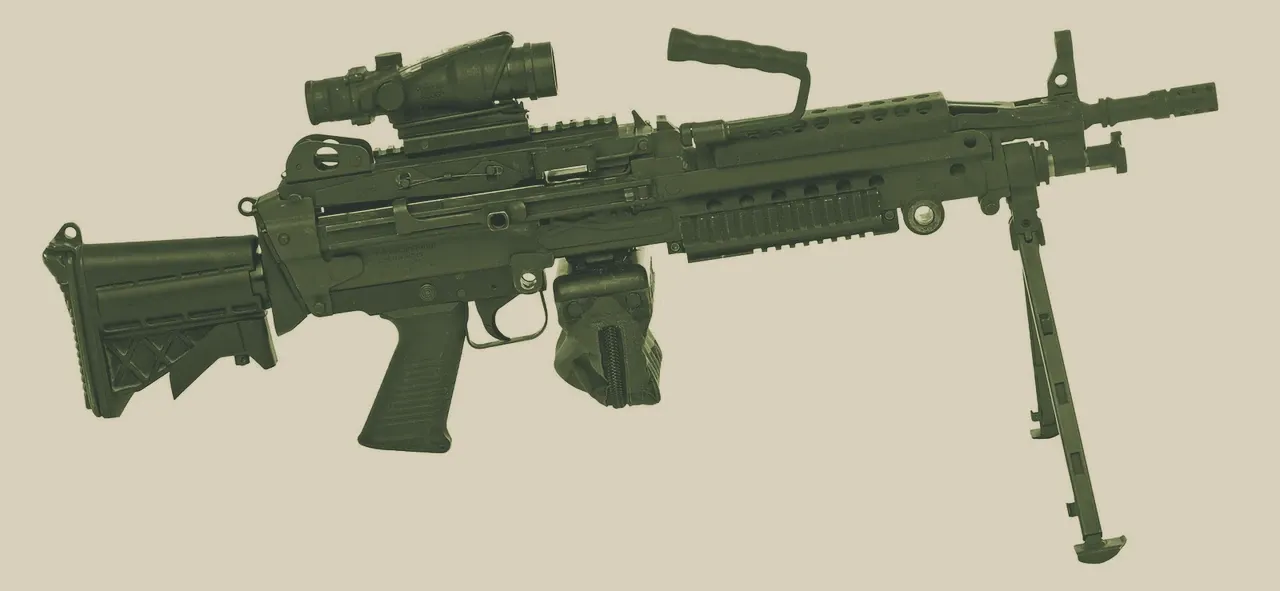
M249 SAW
FIG.01 · USA Image - M249 SAW. Photo by Photo Courtesy of PEO Soldier, Public domain, via Wikimedia Commons.
The US military's 5.56mm squad automatic weapon since 1984 — a belt-fed, quick-change-barrel light machine gun derived from the Belgian FN Minimi, fielded in every major American conflict and now being succeeded in close-combat squads by the 6.8mm XM250.

Overview

The M249 Squad Automatic Weapon is a gas-operated, air-cooled, belt-fed light machine gun chambered in 5.56×45mm NATO. Derived from the Belgian FN Minimi, it was adopted by the US military in 1984 as the standard squad-level automatic weapon and has since been exported to more than 75 countries. The M249 fires from an open bolt, features a quick-change barrel for sustained fire, and uniquely accepts both M27 disintegrating-link belts and standard STANAG magazines — giving the gunner the ability to fall back on rifle magazines when belts are exhausted. After four decades of service across every major US ground campaign, the M249 is now being supplemented in US Army and Marine Corps close-combat squads by the 6.8×51mm XM250/M250 under the Next Generation Squad Weapon program.

Development

FN Herstal developed the Minimi in the late 1970s and early 1980s, with the design credited to Ernest Vervier, the same engineer behind the FN MAG general-purpose machine gun. The goal was a lightweight, belt-fed automatic weapon that could keep pace with rifle squads while delivering sustained suppressive fire. The Minimi entered production in 1982 and was quickly entered into the US Army's Squad Automatic Weapon trials, which sought a replacement for the Vietnam-era M16A1 with its automatic rifleman role, according to the Small Arms Defense Journal. The Minimi won the competition, and the US adopted it as the M249 in 1984. FN America, based in South Carolina, has been the primary US military production source. An initial product-improvement program in the late 1980s and early 1990s addressed early reliability complaints, yielding the M249 PIP (Product Improvement Program) variant that became the baseline for all subsequent configurations. The weapon's STANAG magazine feed — a deliberate design choice rare among belt-fed machine guns — was included at the US Army's insistence as a logistical hedge, per the Wikipedia reference entry.

Design & capabilities

The M249 is a gas-operated, long-stroke piston weapon that fires from an open bolt, promoting cooling between bursts. Its quick-change barrel can be swapped in seconds by depressing a lever on the left side of the receiver, allowing sustained fire without overheating. The weapon feeds primarily from 200-round M27 disintegrating-link belts carried in a plastic box magazine clipped beneath the receiver, but a secondary magazine well accepts standard 30-round STANAG magazines — a dual-feed capability that proved valuable when belts ran low in extended engagements. The cyclic rate of fire is approximately 700–850 rounds per minute under normal conditions, rising to roughly 950–1,150 rpm on the adverse gas setting. Muzzle velocity with standard M855 ball ammunition is approximately 915 meters per second. The effective point-target range is around 700–800 meters, with an area-suppression range extending to roughly 1,000 meters. The standard barrel length is approximately 465 mm, contributing to an overall length of about 1,035 mm. Empty weight is approximately 7.5 kilograms. The M249 can be fired from an integral bipod, from a tripod (M192 lightweight ground mount), or from vehicle pintle mounts.

Variants

The M249 family includes the baseline M249 PIP (standard infantry configuration with solid stock and long barrel), the M249 Para (collapsible buttstock and 349 mm short barrel for airborne and vehicle crews), the M249 SPW (Special Purpose Weapon — a further-lightened Para variant with a railed handguard for SOF use), and the Mk 46 (a USSOCOM-specific Para derivative stripped of the STANAG magazine well and fitted with a railed fore-end, optimized for special operations). The FN Minimi is also produced in a 7.62×51mm NATO variant (known as the Minimi 7.62 or, in US SOF service, the Mk 48). The commercial semi-automatic FN M249S is offered by FN America for the US civilian market.

Combat record / operational use

The M249 has been a fixture of US infantry squads since the mid-1980s. It saw its first major combat in Operation Just Cause (Panama, 1989) and was carried through the Gulf War (1990–91), Somalia (1992–93), the Balkans (1990s), and — most intensively — the wars in Iraq and Afghanistan (2001–2021), where it earned a reputation as a reliable, high-volume suppressive-fire platform despite complaints about its weight and sensitivity to fine sand. According to the Wikipedia reference, the M249 was widely supplied to Ukrainian forces following Russia's full-scale invasion in 2022, appearing in both standard and Para configurations in frontline units. The weapon's four-decade tenure is now winding down in US close-combat formations: the XM250/M250, a belt-fed automatic rifle chambered in 6.8×51mm, began fielding in 2024 as part of the Next Generation Squad Weapon program and is slated to replace the M249 in infantry, scout, and combat engineer squads. The M249 is expected to remain in service in non-close-combat roles and with allied forces for years to come.

Advantages

  • Belt-fed sustained fire with a 200-round link capacity, giving squads a base of suppressive fire unmatched by magazine-fed rifles.
  • Quick-change barrel enables prolonged fire without the cook-off risks of fixed-barrel squad automatics.
  • Dual-feed design — M27 belts plus STANAG magazine compatibility — provides logistical flexibility when belts are exhausted.
  • Proven across four decades of combat, from jungle and desert to urban terrain, with widespread allied and partner adoption.
  • Lighter than a GPMG while delivering automatic fire at the squad level, filling a critical weight-to-firepower niche.

Drawbacks / limitations

  • Heavy for a 5.56mm weapon at ~7.5 kg empty; fully loaded with a 200-round belt, the system exceeds 10 kg, burdening the automatic rifleman on dismounted patrols.
  • The STANAG magazine feed is a frequent reliability pain point — magazine-induced malfunctions are common enough that gunners are trained to use it only as a last resort.
  • Aging design; the US Army and Marine Corps are replacing it in close-combat squads with the 6.8mm XM250/M250, which offers superior range and barrier penetration against near-peer body armor.
  • Maintenance-intensive in sandy and dusty conditions; the open-bolt design and belt-feed mechanism demand rigorous cleaning cycles in arid environments.

Counterparts

Outlook

The M249 remains in widespread service across NATO and partner forces, but its role in US close-combat formations is being deliberately wound down in favor of the 6.8mm XM250/M250. The shift reflects a doctrinal pivot: where the M249 was optimized for sustained suppressive fire against adversaries in soft armor, the NGSW automatic rifle is designed to defeat modern body armor at extended ranges. The M249 will persist in vehicle-mounted, rear-area, and non-close-combat roles, and it will continue to serve in the arsenals of dozens of allied states for the foreseeable future. Its four-decade run as the defining squad automatic of the American infantry makes it one of the most consequential small arms of the post-Vietnam era.

Key specifications

Spec Value
Crew 1 (gunner); 2 recommended (gunner + assistant gunner)
Combat weight ~7.5 kg (gun empty); ~10 kg with 200-rd belt, sling, and cleaning kit
Length / width / height ~1,035 mm / ~100 mm / ~250 mm (est.)
Main armament 5.56×45mm NATO
Secondary armament None
Armor & protection None
Engine & power Manually operated; gas-operated, long-stroke piston
Power-to-weight Not applicable
Road / cross-country speed Not applicable
Operational range ~700–800 m point target; ~1,000 m area suppression

Sources

  1. Small Arms Defense Journal — "FN Minimi 5.56×45mm Light Machine Gun." https://sadefensejournal.com/fn-minimi-5-56x45mm-light-machine-gun/
  2. FN America — "FN M249S" product page. https://fnamerica.com/products/rifles/fn-m249s/
  3. Wikipedia — "M249 Squad Automatic Weapon." https://en.wikipedia.org/wiki/M249_Squad_Automatic_Weapon
  4. FN Herstal — "FN Minimi" (parent design reference). https://fnherstal.com/en/defence/portable-weapons/fn-mag/
  5. USMC TBS — "M240B Medium Machine Gun Student Handout" (contextual reference for US small-arms doctrine). https://www.trngcmd.marines.mil/Portals/207/Docs/TBS/B3M4178%20M240B%20Medium%20Machine%20Gun.pdf
FIELD DISPATCH · WEEKLY

BattlePolicy Weekly — free.

Defense tech, startups, and security — weekly. No paywall.

Related
Ukraine · USA · Funding · Swarmer · drones · defense tech · venture capital · Pentagon

Ukraine turned its drone war into an industry. Now Wall Street is pricing it.

Swarmer's Nasdaq debut, a wave of Western venture money and a Pentagon FPV contract show Ukrainian defense tech crossing from battlefield to balance sheet, at a valuation that has outrun the revenue.

Ukraine · USA · Funding · Swarmer · drones · defense tech · venture capital · Pentagon
USA · Autonomy · Shifters · Ace Capital Partners

Shifters raises $10.2M to put robots first into tunnels and rubble

The US-Israeli startup raised a $10.2 million seed led by Ace Capital Partners to scale ground robots that enter tunnels and rubble before troops.

USA · Autonomy · Shifters · Ace Capital Partners
USA · Policy · AI · Anthropic · autonomous weapons · Pentagon

Trump orders faster military AI and bars vendors from switching off fielded models

A new national security memo tells the Pentagon to onboard frontier commercial AI at speed, strips vendors of the power to shut it down mid-mission, and resets the rules for autonomous weapons within 90 days.

USA · Policy · AI · Anthropic · autonomous weapons · Pentagon