M4 Carbine
The standard US carbine of the post-Cold-War era — a compact, 5.56 mm direct-impingement select-fire weapon that served across Afghanistan, Iraq and dozens of allied forces.
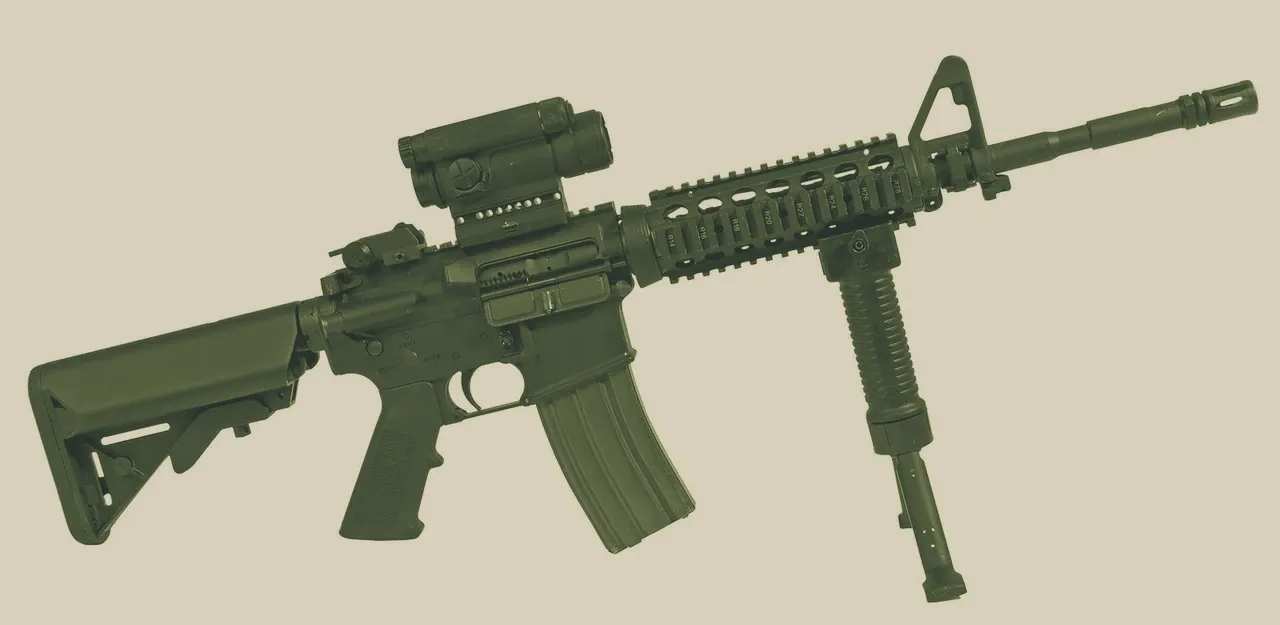
Overview
The M4 Carbine (and the full-auto M4A1) is a lightweight, magazine-fed, gas-operated, direct-impingement carbine chambered for 5.56×45 mm NATO. A direct descendant of the M16 rifle, it mates a 14.5-inch barrel with a collapsible stock and a MIL-STD-1913 rail mounting interface. It has been the individual weapon of the US Army, Navy, Air Force, Marine Corps, and Special Operations Forces since the mid-1990s, and is widely exported or licence-produced for over 60 allied countries. The weapon remains in large-scale service although the US Army is introducing the SIG XM7 (6.8 mm) to replace the M4 in close-combat units.
Development
Colt’s Manufacturing Company developed the M4 in the early 1990s as a shorter-barrelled evolution of the M16A2, intended for vehicle crews, airborne troops and personnel operating in confined spaces. The original M4 entered US service in 1994 with a three-round-burst trigger group. From the 2011 timeframe, the US Army began converting its fleet to the M4A1 configuration across a Product Improvement Program, replacing the burst mechanism with a full-automatic fire mode and adding an ambidextrous safety/selector, improved barrel profile and heavier-duty extractor. Both Colt and FN America have produced the rifle under US government contract, sustaining a production run that now numbers in the millions estimated.
Design & capabilities
The M4A1 uses a direct-impingement gas system — tapping propellant gas from the barrel to cycle the bolt carrier — combined with a rotating bolt in an AR-15-pattern receiver. Empty weight is approximately 2.88 kg (6.3 lb); overall length extends from 757 mm (stock closed) to 838 mm (extended). The 370 mm (14.5 in) chrome-lined barrel is optimised for the NATO-standard 5.56×45 mm round with a muzzle velocity of about 880 m/s, according to the US Army’s Program Manager for Lethality. The weapon feeds from 30-round STANAG magazines and fires at a cyclic rate of 700–950 rounds per minute. The integral Picatinny rail and handguard mounting system accept a wide range of optics, laser aiming devices, visible lights and the M203/M320 grenade launcher. Effective point/area ranges are quoted at 500 m, although the shorter barrel reduces terminal energy compared with the full-length M16 rifle.
Variants
- M4: original service carbine with a three-round burst fire-control group, introduced in 1994.
- M4A1: full-automatic variant with an ambidextrous selector, heavier barrel profile and upgraded extractor, standardised across the US Army from 2011 onward.
- M4A1 PIP: the Product Improvement Program retrofit that converted older M4s to the M4A1 standard.
- A limited number of specialised upper-receiver kits (e.g., close-quarter battle receivers) have been employed by special operations forces, but remain sub-variants rather than distinct production models.
Combat record / operational use
The M4/M4A1 family has seen constant combat service since the late 1990s: from the Balkans to the Global War on Terror in Afghanistan and Iraq, through later US and coalition operations across the Middle East, Africa and the Asia-Pacific. Its widespread allied adoption means it has also been employed by dozens of partner forces in counter-insurgency, peacekeeping and conventional engagements. One recent export instance surfaced in March 2025 when the US government awarded Colt a $12.9 million contract to supply M4A1 carbines to Israel, underscoring the weapon’s enduring demand despite the US Army’s transition to the XM7. The US Marine Corps, however, opted to retain the 5.56 mm M27 rifle rather than adopt the XM7, keeping a 5.56 mm direct-impingement/piston-hybrid force structure that extends the M4’s operational paradigm.
Advantages
- Light weight and compact size improve manoeuvrability in urban and vehicular settings.
- Vast parts, magazine and accessory commonality across all NATO 5.56 mm platforms.
- Highly customisable through the integral 1913 rail system and large aftermarket.
- Proven dependability across a wide range of climates after three decades of battlefield feedback.
- Compatible with the full US family of under-barrel grenade launchers and night-vision equipment.
Drawbacks / limitations
- Direct-impingement action deposits carbon fouling directly into the bolt-carrier area, increasing the cleaning and lubrication burden relative to a short-stroke piston design.
- The 14.5-in barrel reduces muzzle velocity and therefore terminal effectiveness beyond 300 m when compared with a full-length rifle.
- The US Army’s decision to field the XM7 (6.8×51 mm) reflects a view that 5.56 mm ammunition is insufficient for defeating modern body armour at range.
- Sustained automatic fire can accelerate component wear in the gas tube and bolt, demanding rigorous maintenance cycles in high-round-count environments.
Counterparts
Outlook
The M4/M4A1 inventory remains enormous, and the carbine will persist in US Army support and reserve formations, special operations elements, and with aircrews and vehicle crews long after the XM7 enters the close-combat force. The US Marine Corps, having standardised the M27 IAR, is retaining a 5.56 mm rifle that shares the STANAG-magazine and ammunition logistics of the M4 family, guaranteeing a large institutional ecosystem for the M4’s caliber and accessories well into the 2040s. Export demand, as illustrated by the Israel contract and ongoing foreign military sales, reinforces a long tail for this NATO-standard carbine.
Key specifications
| Spec | Value |
|---|---|
| Crew | 1 (individual soldier) |
| Combat weight | ~2.88 kg (6.3 lb) empty; ~3.4 kg (7.5 lb) loaded with 30-round magazine |
| Length / width / height | 838 mm (stock extended) / 757 mm (stock closed) |
| Main armament | 5.56×45 mm NATO |
| Secondary armament | — |
| Armor & protection | — |
| Engine & power | not applicable (direct-impingement gas system, rotating bolt) |
| Power-to-weight | not applicable |
| Road / cross-country speed | not applicable (man-portable) |
| Operational range | 500 m (point/area effective range) |
Sources
- U.S. Army PM Soldier Lethality — M4A1 Carbine portfolio page. https://cpeground.army.mil/Equipment/Equipment-Portfolio/PM-MBCT-Lethality-Portfolio/M4A1-Carbine/
- Military.com — “M4 Carbine.” https://www.military.com/equipment/m4-carbine
- The Jerusalem Post — “US awards Colt $12.9m contract to supply M4A1 carbines to Israel.” https://www.jpost.com/defense-and-tech/article-881201
- Wikipedia — “5.56×45mm NATO.” https://en.wikipedia.org/wiki/5.56%C3%9745mm_NATO
- Army Recognition — “M7 NGSW-R XM5 SIG MCX Spear 6.8mm Assault Rifle Data.” https://armyrecognition.com/military-products/army/weapons/assault-rifles/xm7-ngsw-r-xm5-sig-mcx-spear-6-8mm-assault-rifle-data