M67 Grenade
The M67 fragmentation grenade is the standard US defensive hand grenade since 1961 — a spherical, Composition B-filled weapon with a 5-meter lethal radius, used in every major American conflict from Vietnam to the present.
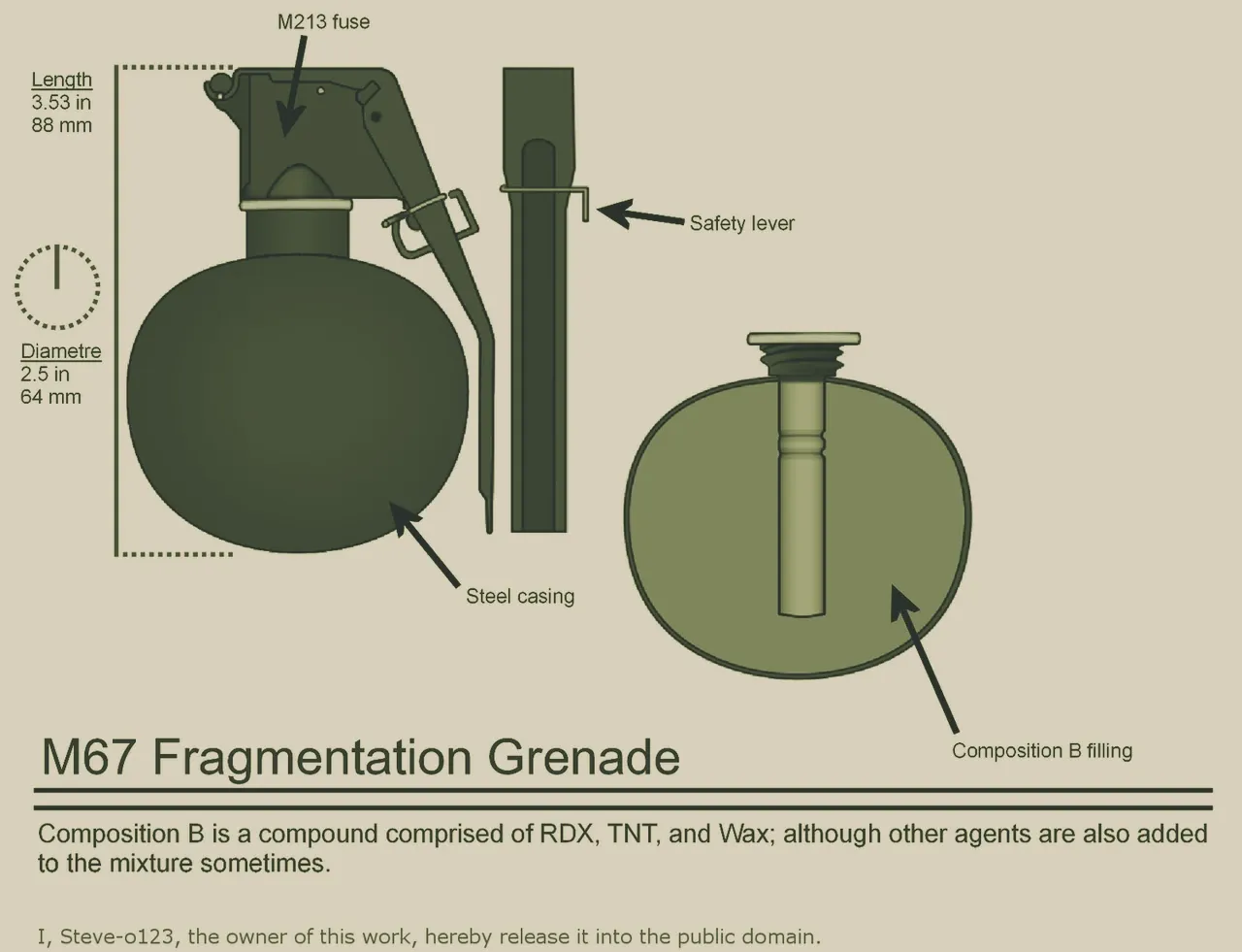
The standard US defensive fragmentation hand grenade since 1961 — a spherical, Composition-B-filled grenade with a 5-meter lethal radius and continuous combat use from Vietnam through Iraq and Afghanistan.
Overview
The M67, formally designated Grenade, Hand, Fragmentation, M67, is a defensive fragmentation hand grenade manufactured by Day & Zimmermann and Nammo for the United States military and its allies. It replaced the M26-series and the iconic Mk 2 “pineapple” in the early 1960s and remains the baseline fragmentation grenade of the NATO bloc. With a spherical steel body, a Composition B filler of approximately 0.18 kg, and the M213 pyrotechnic-delay fuze, the M67 delivers a lethal radius of about 5 metres and a wounding radius out to 15 metres. Over 43 million units have been produced, and current contract prices hover around $45 per grenade, according to Nammo and Day & Zimmermann.
Development
Development of the M67 began in the late 1950s as the US Army sought to replace the bulky, externally-grooved Mk 2 and the transitional M26-series with a more compact, uniform-fragmentation design. The result was a smooth-bodied steel sphere that entered service in 1961, as documented by Weaponsystems.net. The grenade was designed to produce a dense cloud of metal fragments upon detonation, improving lethality over earlier designs while reducing weight and bulk. By the mid-1960s the M67 was standard issue for all US combat forces, and it rapidly spread through NATO and allied nations; Canada adopted it directly as the C13 copy.
Design & capabilities
The M67 consists of a 64 mm-diameter seamless steel sphere filled with roughly 0.18 kg of Composition B explosive, according to the Day & Zimmermann product sheet. The M213 fuze, triggered by a pull-ring and spring-loaded safety lever, provides a pyrotechnic delay of 4–5 seconds. Upon detonation the body fragments into hundreds of small, high-velocity splinters, generating a lethal radius of approximately 5 metres and a wounding radius extending to 15 metres; individual fragments can travel as far as 230 metres, though the practical casualty zone is much smaller, as detailed by CAT-UXO. The grenade weighs about 0.39–0.40 kg and is classified as a defensive grenade — intended to be thrown from behind cover, not during an assault — because of its wide fragmentation footprint.
Combat record / operational use
The M67 entered combat during the Vietnam War and has been used in every major US ground operation since: Grenada, Panama, the Gulf War, Somalia, the Balkans, Iraq, and Afghanistan. It is the munition that infantry squad leaders routinely issue for bunker clearing, defensive perimeter denial, and room-to-room fighting in urban environments. The grenade’s longevity is underscored by continued large-scale procurement; a 2021 Defence Blog report confirmed that the US Army was awarding contracts to sustain stockpiles across both active and reserve components. Its NATO-standard role has made it a ubiquitous feature of Western-aligned infantry arsenals, with extensive documented use by Canadian, British, and other allied forces.
Advantages
- Proven lethality: The Composition B filler and steel sphere create a reliable 5 metre lethal zone with dense fragmentation.
- Standardised: The M213 fuze and ball-shaped body are well-understood; training and handling are embedded across all NATO armies.
- Compact: At roughly 91 mm length and 0.4 kg weight, it is easily carried in fighting load vests.
- Mass-produced: Over 43 million units manufactured keeps unit cost low (~$45 per grenade in 2021) and supply chains robust.
Drawbacks / limitations
- Defensive only: The large fragmentation radius makes it hazardous to the thrower in open terrain; it is not suitable for offensive assaults where troops advance behind the explosion.
- No modern fuzing: The M213 is a simple pyrotechnic delay with no electronic air-burst or impact-initiated option.
- Training burden: The 4–5 second delay demands careful “cook-off” discipline, and mishandling has caused fatal accidents over decades of service.
- Logistics weight: While light individually, bulk carriage of grenades for a dismounted squad still imposes a weight penalty.
Counterparts
Outlook
The M67 remains in serial production and shows no sign of being replaced. The US military continues to award multi-year orders, and the design is deeply embedded in NATO’s infantry doctrine. While advanced electronic-fuze grenades exist in some special-operations communities, the low-cost, high-reliability M67 will likely remain the standard-issue fragmentation grenade for American and allied forces well into the next decade. Any future replacement would need to match its proven safety, lethality, and logistical footprint — a high bar that no current programme is publicly addressing.
Key specifications
| Spec | Value |
|---|---|
| Crew | 1 (thrower) |
| Combat weight | ~0.39–0.40 kg |
| Length / width / height | ~91 mm (length, w/ fuze) / 64 mm (diameter) |
| Main armament | Composition B (~0.18 kg) |
| Secondary armament | N/A |
| Armor & protection | N/A (hand-thrown) |
| Engine & power | N/A |
| Power-to-weight | N/A |
| Road / cross-country speed | N/A |
| Operational range | ~30–40 m (hand-thrown effective) |
Sources
- Nammo — M67 Grenade product page. https://www.nammo.com/product/our-products/grenades-warheads-energetics/m67-grenade/
- Day & Zimmermann — M67 Hand Grenade product sheet. https://cdn2.hubspot.net/hubfs/208537/assets/PDF/Product%20Sheets/NewWebsite_Mun_CloseCombat_M67%20hand%20grenade.pdf
- Weaponsystems.net — M67. https://weaponsystems.net/system/1303-M67
- Wikipedia — M67 grenade. https://en.wikipedia.org/wiki/M67_grenade
- CAT-UXO — M67 hand grenade. https://cat-uxo.com/explosive-hazards/grenades/m67-hand-grenade
- Defence Blog — U.S. Army acquires more M67 fragmentation hand grenades. https://defence-blog.com/u-s-army-acquires-more-m67-fragmentation-hand-grenades/