Oreshnik
Russia’s road-mobile, MIRV-capable intermediate-range ballistic missile — a post-INF dual-use weapon employed sparingly for strategic messaging rather than battlefield effect.
Overview
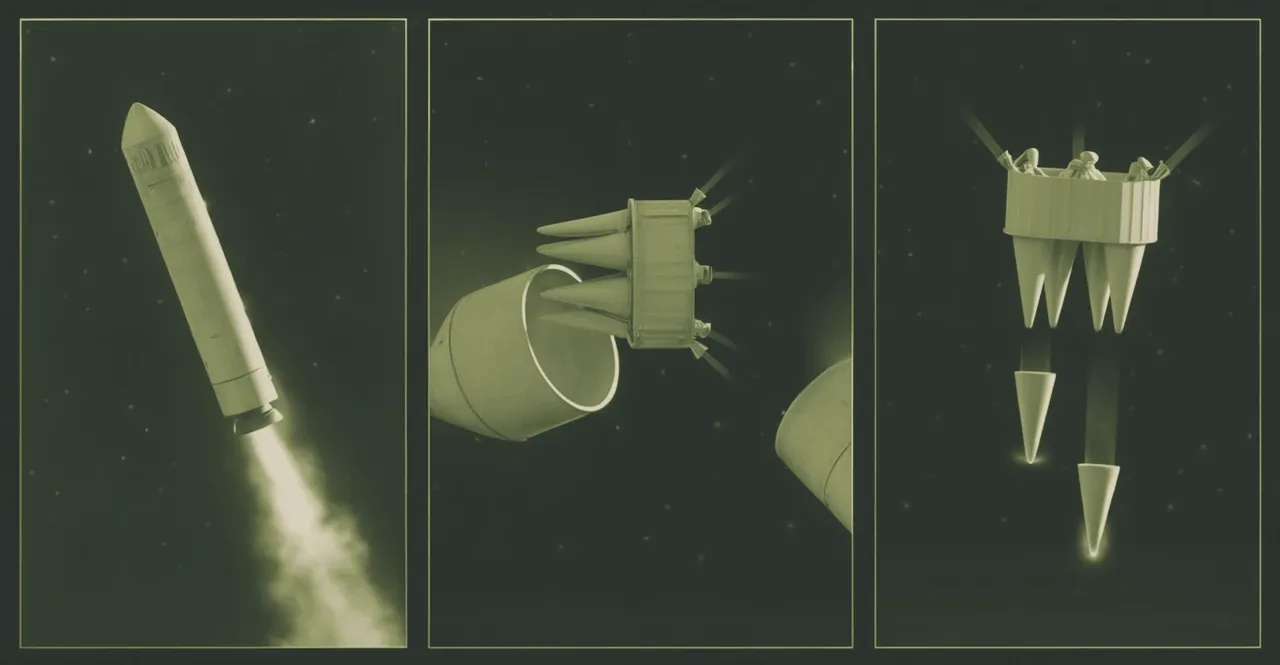
The Oreshnik (Russian: Орешник, “hazel tree”) is a Russian road-mobile, solid-fueled intermediate-range ballistic missile (IRBM) assessed as a derivative of the RS-26 Rubezh/Yars family. It carries a multiple independently targetable reentry vehicle (MIRV) payload, demonstrated with six warheads each dispensing up to six submunitions, and is declared by Moscow to be nuclear-capable. The weapon is used selectively—single or dual launches against high-profile targets—to send political signals rather than to achieve routine battlefield effect. Its limited inventory, high cost, and poor accuracy for conventional point targets reinforce that role.
Development
The U.S. intelligence community assesses the Oreshnik as a two-stage variant of the RS-26 Rubezh, itself a derivative of the Yars ICBM that was tested between 2012 and 2015 and shelved in 2018, according to CSIS. Development likely resumed after the collapse of the Intermediate-Range Nuclear Forces (INF) Treaty in 2019, producing a missile that bridges the gap between the short-range Iskander-M and Russia’s intercontinental arsenal. The first known flight—and combat use—occurred on 21 November 2024, when a single missile was launched from Kapustin Yar against Dnipro, Ukraine.
President Vladimir Putin announced on 1 August 2025 that the Oreshnik had entered serial production and received an initial batch. He later stated that the missile would be on combat duty before the end of the year, and on 18 December 2025 Gen. Valery Gerasimov confirmed a Strategic Rocket Forces brigade had been equipped during 2025, as reported by The Moscow Times. In parallel, Russia pursued basing in Belarus: site construction at the former Krichev-6 airbase in eastern Belarus was visible in satellite imagery from August 2025, and the Russian Ministry of Defence declared the forward-deployed systems on combat duty on 30 December 2025, according to TWZ.
Design & capabilities
The Oreshnik is a road-mobile, two-stage solid-fuel IRBM launched from a transporter-erector-launcher (TEL) assessed as the MZKT-79291 10×10 chassis—the same family used by the Yars and RS-26. Its MIRV payload comprises six reentry vehicles, each reportedly dispensing six submunitions; this configuration makes interception by Ukraine’s current point-defence systems effectively impossible, as detailed by CSIS. Terminal speeds are reported at Mach 10–11+ (~12,300–13,000 km/h), compressing defender reaction times, though such speeds are typical for the missile class (AP). Range estimates vary: U.S. assessments place it at roughly 3,500–5,470 km, while Belarusian officials claim 5,000 km, and Army Recognition notes an estimated bracket of 3,000–5,500 km depending on payload. Guidance is assessed as an inertial navigation system with GLONASS satellite correction, supplemented by penetration aids and decoys; accuracy against point targets is widely judged as poor.
The dual-capable design allows Moscow to load either conventional (inert kinetic) or nuclear MIRVs, creating deliberate ambiguity about the payload once launched. The first combat strikes, however, used inert warheads that inflicted only limited kinetic damage.
Variants
The baseline configuration is a dual-capable MIRV system. A nuclear-only MIRV variant is assessed to exist, and an improved model with refined terminal guidance has been reported but remains unconfirmed. The missile’s lineage directly connects to the RS-26 Rubezh and the RS-24 Yars ICBM.
Combat record / operational use
Oreshnik was first used in combat on 21 November 2024, when a single missile traveled roughly 800 km from Kapustin Yar on a lofted trajectory and struck the PA Pivdenmash plant in Dnipro, dispersing six MIRV payloads with inert submunitions; Putin publicly framed the strike as retaliation for Ukraine’s first ATACMS/Storm Shadow attacks inside Russia, though subsequent reporting indicated the operation had been planned well in advance, according to Wikipedia. A second confirmed use occurred on the night of 8–9 January 2026, when one Oreshnik flew approximately 1,448 km to hit the Lviv State Aviation Repair Plant as part of a larger salvo, again with inert warheads. On 24 May 2026, two missiles were fired within a mass attack of ~600 drones and ~90 missiles: one impacted garages in Bila Tserkva near Kyiv, and the other landed in Russian-held Donetsk region—Putin later described the launches as a live-fire test.
Separately, Ukraine claimed on 31 October 2025 that its services had previously destroyed one of Russia’s three Oreshnik systems at Kapustin Yar in a covert operation, with the Security Service of Ukraine (SBU) dating the incident to 8–9 July 2024, as reported by Ukrainska Pravda.
Advantages
- MIRV payload with multiple submunitions renders interception by current Ukrainian air defences extremely difficult; only exo-atmospheric interceptors such as Arrow-3 or SM-3 Block IIA are designed for this threat class (CSIS).
- Range (3,500–5,470 km) reaches every European NATO capital from Russian soil, with Russian state media citing flight times of ~11 minutes to Poland and ~17 to Brussels (AP).
- Terminal speeds of Mach 10+ and penetration aids compress defender reaction time; even inert warheads deliver meteorite-like kinetic damage.
- Road-mobile solid-fuel basing provides rapid launch readiness and survivability, leveraging existing Yars-era infrastructure and concealment tactics.
- Dual-capable design creates deliberate nuclear/conventional ambiguity, exploited for escalation signalling without immediate nuclear use.
Drawbacks / limitations
- Accuracy is assessed as inadequate for conventional point targets; the Dnipro strike caused only slight roof damage, and RUSI described it as “an expensive way to deliver not that much destruction.”
- Very small inventory (SBU claimed three systems, one destroyed) and high unit cost (estimated tens of millions of dollars each) limit the weapon to sporadic, signal-oriented use.
- Technology is largely derivative—U.S. experts assess it as repackaged RS-26/Yars hardware with perhaps 10% new components, undercutting Kremlin claims of a breakthrough weapon.
- Russia’s overall missile-production base (roughly 130 missiles per month across all types in 2024) makes scaling an expensive IRBM unlikely.
- Forward-basing in Belarus adds little military reach, as the missile already ranges all of Europe from Russia, and its likely minimum range may constrain use against nearby Ukrainian targets.
Counterparts
- DF-26 (China) — Chinese road-mobile IRBM with both conventional and nuclear strike roles, a direct peer in range and dual-capability.
- Kinzhal (Russia) — Russian air-launched hypersonic ballistic missile, Moscow’s other post-INF theater-strike instrument.
Outlook
The Oreshnik is expected to remain a sparingly used signalling tool, with occasional one- or two-missile launches against symbolic targets, rather than becoming a routine battlefield asset. Belarus basing (up to ten systems claimed) serves primarily political ends—cementing Minsk’s dependence and answering planned U.S. Typhon/Dark Eagle deployments to Germany. Serial-production claims remain unverified; Russia’s ability to mass-produce an expensive IRBM is doubted, and the weapon’s chief strategic effect is the post-INF precedent it sets and the pressure it places on European deep-strike and missile-defence responses.
Key specifications
| Spec | Value |
|---|---|
| Type | Road-mobile, solid-fueled IRBM; MIRV-capable; dual-capable (nuclear/conventional) |
| Range | ~3,500–5,470 km (U.S. est.); 5,000 km (Russian claim) |
| Speed (Mach / km·s⁻¹) | Mach 10–11+ (~12,300–13,000+ km/h) terminal |
| Warhead (type & weight) | Six MIRVs, each with up to six submunitions (inert/conventional or nuclear); total throw weight not publicly established |
| Guidance | INS with GLONASS correction; penetration aids and decoys (assessed) |
| Accuracy (CEP) | Not publicly established; assessed inadequate for conventional point targets |
| Launch platform(s) | Road-mobile TEL (assessed MZKT-79291 10×10) |
| Propulsion | Two-stage solid fuel |
| Length / diameter / launch weight | ~15–18.5 m (est.) / ~1.86 m (est.) / ~30,000–40,000 kg (est.) |
Sources
- CSIS Missile Threat — Oreshnik at a Glance — https://missilethreat.csis.org/missile/oreshnik/
- Wikipedia — Oreshnik (missile) — https://en.wikipedia.org/wiki/Oreshnik_%28missile%29
- The War Zone (TWZ) — Russia Claims Oreshnik Intermediate-Range Ballistic Missile Now “On Combat Duty” In Belarus — https://www.twz.com/land/russias-claims-oreshnik-ballistic-missile-now-on-combat-duty-in-belarus
- RUSI — The Oreshnik Ballistic Missile: From Russia with Love? — https://www.rusi.org/explore-our-research/publications/commentary/oreshnik-ballistic-missile-russia-love
- Associated Press — Russia has used its hypersonic Oreshnik missile for the first time. What are its capabilities? — https://www.ap.org/news-highlights/spotlights/2024/russia-has-used-its-hypersonic-oreshnik-missile-for-the-first-time-what-are-its-capabilities/
- Army Recognition — Oreshnik IRBM Intermediate-Range Ballistic Missile — https://armyrecognition.com/military-products/army/missiles/ballistic-missiles/oreshnik-irbm
- The Moscow Times — Putin Says Oreshnik Missile Will Be Deployed by End of 2025 — https://www.themoscowtimes.com/2025/12/17/putin-says-oreshnik-missile-will-be-deployed-by-end-of-2025-a91462
- Ukrainska Pravda — Up to 10 Oreshnik systems could be deployed in Belarus, Lukashenko says — https://www.pravda.com.ua/eng/news/2025/12/22/8012981/