GRID-REF 37°47′N 122°25′W
DISPATCH 02/26 · 9 Jun 2026
BATTLEPOLICY
Startup to front line. Strategy to consequence.
Lexicon · Russia

Orlan-10

Russia's most prolific tactical drone — a catapult-launched, parachute-recovered ISR workhorse that has become the eyes of its artillery in Ukraine and a node in the Leer-3 electronic-warfare system.
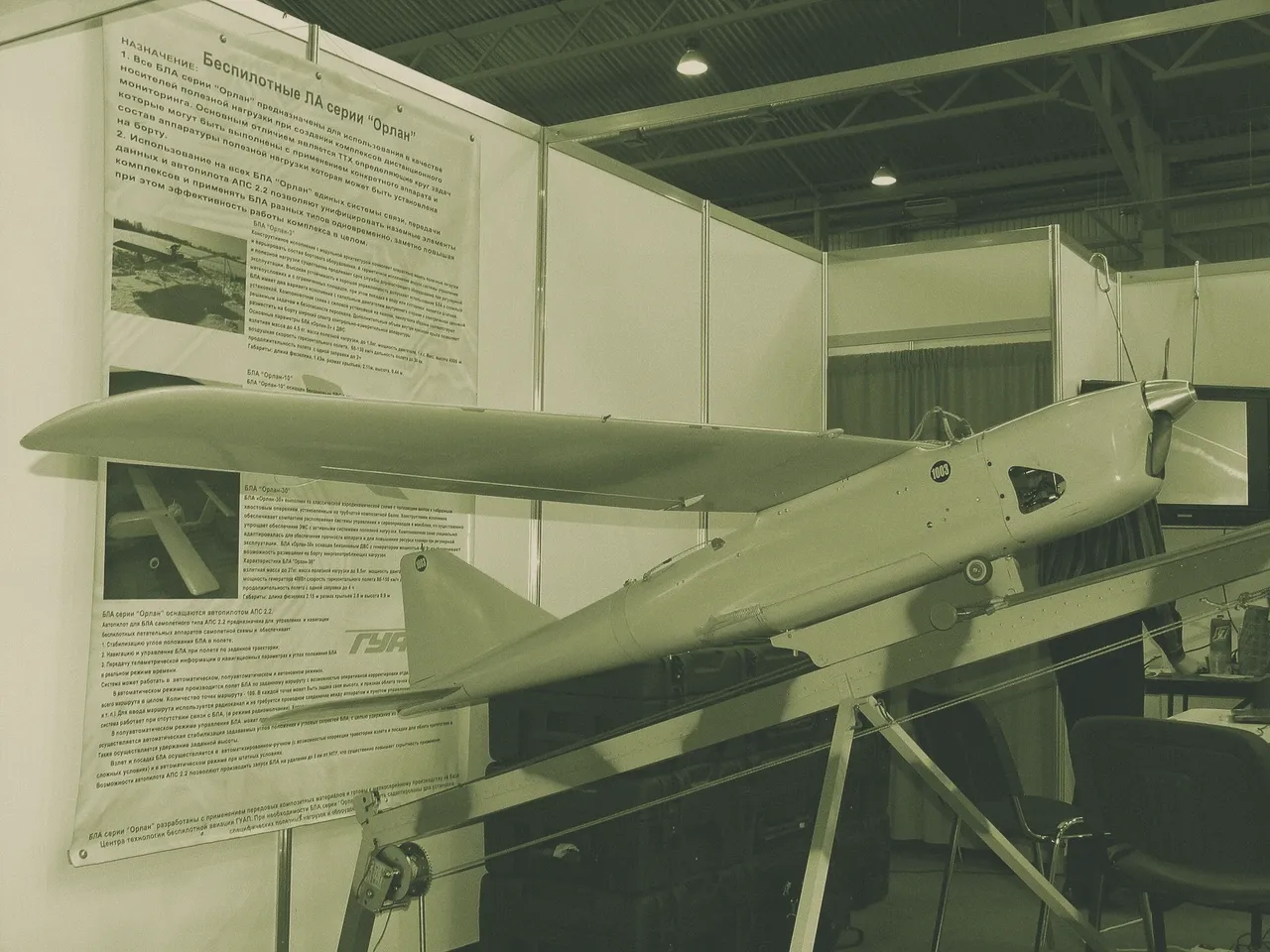
Orlan-10
FIG.01 · Russia Image - Orlan-10. Photo by Mike1979 Russia, CC BY-SA 3.0, via Wikimedia Commons.
Russia's most prolific tactical drone — a catapult-launched, parachute-recovered ISR workhorse that has become the eyes of its artillery in Ukraine and a node in the Leer-3 electronic-warfare system.

Overview

The Orlan-10 is a fixed-wing, twin-boom tactical reconnaissance unmanned aerial vehicle fielded by the Russian Ground Forces and airborne units. It is the principal short-range airborne ISR asset of the Russian military, produced at a scale of over one thousand airframes per year and used intensively for real-time artillery spotting, battle-damage assessment and signals intelligence. The same airframe also functions as a key component of the Leer-3 electronic-warfare complex, where it carries a cellular-network jamming payload that denies tactical communications over a wide area.

Development

The Orlan-10 was developed by the Saint Petersburg-based Special Technology Center (STC) and entered service with the Russian armed forces around 2010. It was designed to replace aging reconnaissance drones with a low-cost, high-endurance platform capable of being operated from unprepared forward positions. Mass production ramped steadily through the 2010s, and by 2024 the manufacturer claimed an annual output exceeding 1,000 units, making the Orlan-10 the most numerous tactical UAV in Russian service according to missilestrikes.com. An export derivative, the Orlan-10E, has been offered to foreign customers, and Belarus is known to operate the type.

Design & capabilities

The Orlan-10 is built around a twin-boom, high-wing layout with a single pusher propeller, giving it a modest radar cross-section and stable flight characteristics. It is launched from a portable catapult and recovered by parachute, enabling operations from short strips or even open fields without runway infrastructure. A typical mission endurance of about 16 hours and a flight range of 600 km give brigade-level commanders a persistent look deep behind the forward line of troops, though the real-time data-link is limited to roughly 120 km line-of-sight.

The standard payload is an electro-optical/infrared turret that streams video and target coordinates directly to artillery fire-direction centres. Additional interchangeable payloads include thermal imagers, radio-relay packages and ELINT/SIGINT modules that turn the drone into a tactical signals-intelligence collector. The same airframe is at the heart of the Leer-3 electronic-warfare system, where it carries a cellular-network jammer — effectively a flying cell-tower simulator that can intercept or block mobile communications across a broad footprint.

Variants

The Orlan-10 family encompasses airframes configured for different missions through swappable payloads rather than separate production variants. The principal sub-types are: - Baseline EO/IR reconnaissance — real-time optical and thermal video downlink for artillery correction. - SIGINT/ELINT — signals-intelligence payload for locating enemy emitters. - Relay — communications-relay payload extending the reach of frontline radios. - Leer-3 node — integrated EW payload for cellular-network jamming and intercept, operated from a separate ground-vehicle command post.

A dedicated export model, Orlan-10E, is marketed with a restricted sensor suite.

Combat record / operational use

The Orlan-10 became synonymous with Russian artillery operations during the war in Ukraine, where it is flown in large numbers to identify targets, adjust fire and record battle-damage assessment for long-range tube and rocket artillery. Ukrainian military intelligence maintains a detailed registry of the drone’s components and operational patterns, underscoring its central role in the Russian kill chain. Beyond spotting, the Leer-3 configuration has been employed to jam cellular networks in contested areas, severing civilian and tactical communications.

Advantages

  • High production volume — the drone can be treated as a consumable, allowing saturation of the tactical ISR layer.
  • Long endurance (up to 16 h) and decent range (600 km flight) give brigade-level forces a persistent sensor.
  • Catapult launch and parachute recovery remove the need for runways; the system is highly mobile.
  • Modular payloads allow a single airframe to switch between optical, thermal, SIGINT and EW roles.
  • Tight integration with the Russian artillery fire-control loop — it shortens the sensor-to-shooter timeline.

Drawbacks / limitations

  • Relies on line-of-sight radio control out to ~120 km; no satellite-communications link means a forward ground-control station is always required.
  • Small payload (~5.5 kg) limits sensor capability compared with larger MALE platforms.
  • Vulnerable to jamming, small-arms fire and man-portable air-defence systems when operating at moderate altitudes.
  • Export-oriented Orlan-10E is reportedly downgraded in sensor and datalink performance.
  • As a mass-produced tactical asset, its survivability drops sharply in contested airspace — attrition rates in Ukraine are high.

Counterparts

  • RQ-4 Global Hawk (USA) — high-altitude strategic ISR; the Orlan-10 occupies the opposite end of the altitude/scale spectrum.
  • WZ-7 Soaring Dragon (China) — HALE ISR drone; unrelated in size but a Chinese analogue to the Global Hawk.

Outlook

The Orlan-10 will remain the backbone of Russia’s tactical drone fleet for the foreseeable future. Production at scale and field-level repairability ensure a steady supply even under sanctions, and the drone’s role as a flying sensor for massed artillery is unlikely to be replaced. Electronic-warfare employment via Leer-3 will likely deepen as cellular-denial becomes a standard tool of peer conflict.

Key specifications

Spec Value
Type Fixed-wing twin-boom pusher ISR UAV
Endurance ~16 h
Range 600 km flight / ~120 km data-link radius
Cruise / max speed 90–150 km/h
Payload ~5.5 kg (EO/IR, thermal, SIGINT/ELINT, relay)
Datalink / control LOS radio (~120 km), group-operated; compatible with Leer-3 EW complex
Autonomy level Remote / waypoint navigation
Dimensions / MTOW Wingspan 3.1 m, length 1.8 m; MTOW ~15–18 kg
Launch & recovery Catapult launch, parachute recovery

Sources

  1. War & Sanctions registry (Ukraine HUR) — Orlan-10. https://war-sanctions.gur.gov.ua/en/uav/207
  2. US Army ODIN/T2COM — Leer-3 Russian 6x6 Mobile Drone-Based EW System. https://odin.t2com.army.mil/WEG/Asset/Leer-3_Russian_6x6_Mobile_Drone-Based_Electronic_Warfare_(EW)_System
  3. Wikipedia — STC Orlan-10. https://en.wikipedia.org/wiki/STC_Orlan-10
  4. missilestrikes.com — Orlan-10: Tactical reconnaissance UAV. https://missilestrikes.com/weapons/orlan-10/
  5. TheDefenseWatch — Russian Orlan-10 drone specifications. https://thedefensewatch.com/product/russian-orlan-10-drone/
FIELD DISPATCH · WEEKLY

BattlePolicy Weekly — free.

Defense tech, startups, and security — weekly. No paywall.

Related
Ukraine · Russia · Policy · Chornobyl · Energoatom · shahed

Russia strikes Ukraine's central spent-fuel store at Chornobyl with a Shahed

A Russian drone hit the receiving building of the Holtec-built dry-cask site that freed Ukraine from shipping its nuclear waste to Russia, metres from where spent fuel sits.

Ukraine · Russia · Policy · Chornobyl · Energoatom · shahed