Pantsir-S1
Russia's mobile short-range gun-and-missile point defense system — designed to shield high-value assets from aircraft, cruise missiles, and drones, and both heavily used and increasingly targeted in Ukraine.
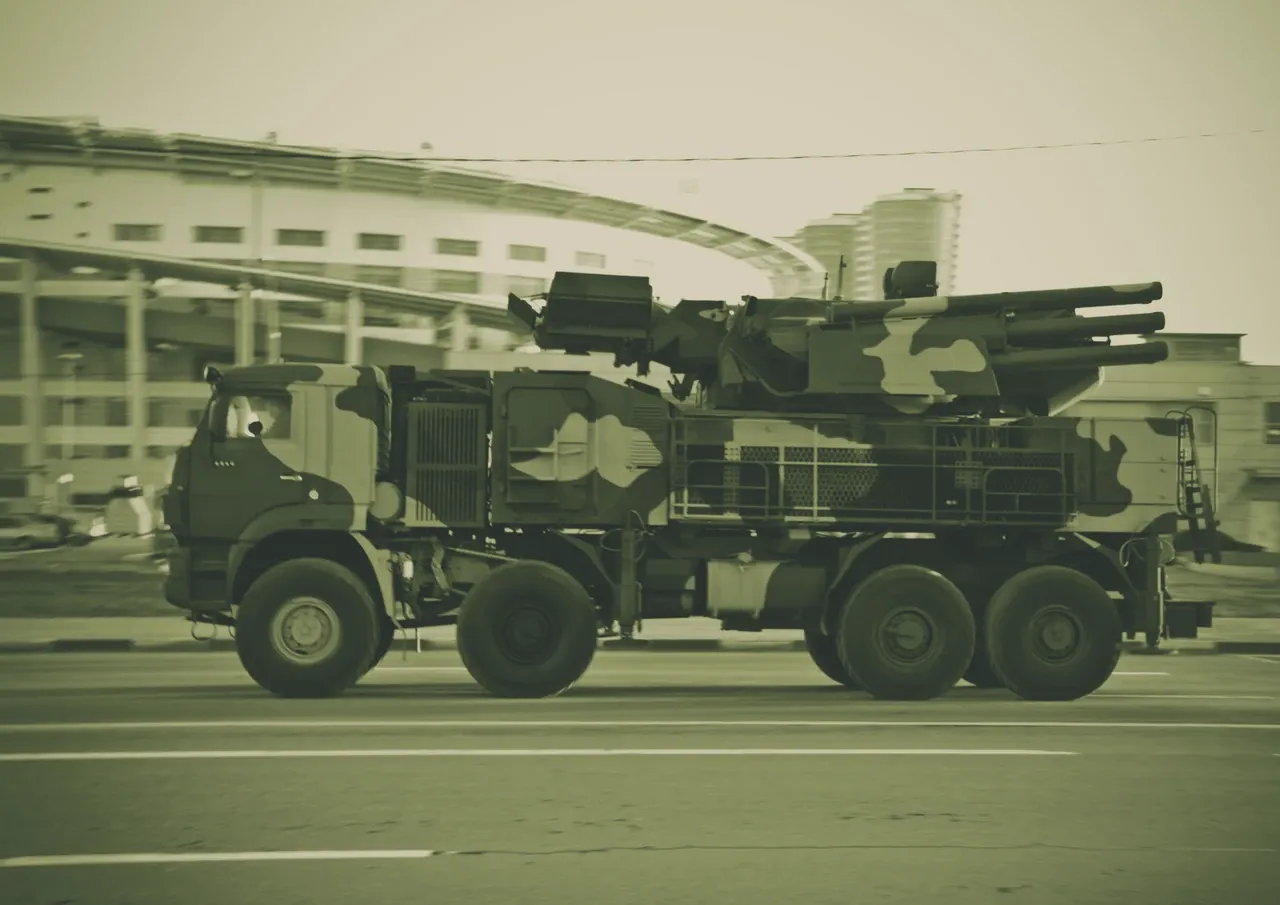
Russia's road-mobile short-range gun-missile air defense system, designed to protect high-value assets against aircraft, cruise missiles, and drones.
Overview
The Pantsir-S1 (NATO reporting name SA-22 Greyhound) is a self-propelled, short-range air defense system that merges a battery of radio-command guided missiles with twin 30 mm automatic cannons on a single wheeled platform. Its primary role is terminal defense of high-value point targets — S-400 batteries, command posts, and airfields — against fixed- and rotary-wing aircraft, cruise missiles, precision-guided munitions, and unmanned aerial systems. Because all sensors and effectors are loaded onto one vehicle, a single Pantsir can autonomously detect, track, and engage multiple threats with either missiles or guns.
Development
KBP Instrument Design Bureau (Tula) developed the Pantsir as a replacement for the aging tracked 2K22 Tunguska gun-missile system. The Pantsir-S1, the first full-production version, was officially adopted by the Russian military in 2012, according to CSIS Missile Threat. The design moved the transporter-erector-launcher from tracks to a wheeled 8×8 chassis (KamAZ or MZKT) to improve strategic mobility, reduce procurement and lifecycle costs, while incorporating a phased-array fire-control radar capable of handling multiple concurrent engagements.
Design & capabilities
A single Pantsir-S1 combat vehicle carries 12 ready-to-fire 57E6-series two-stage radio-command missiles in sealed transport-launch containers, with an additional 12 reload stowed underneath. Each missile uses a proximity-fuzed continuous-rod warhead and is credited with a maximum engagement range of approximately 20 km (some export variants are restricted to ~15 km) and an altitude envelope from 10 m up to 15 km. The CSIS profile notes that the missile layer is supplemented by a pair of 2A38M 30 mm automatic cannon with a combined cyclic rate of about 5,000 rounds per minute and an effective gun range of roughly 4 km and altitude of 3 km.
The fire-control system integrates a PESA radar that can detect targets out to a range of 32–36 km, track approximately 20 contacts, and engage up to four targets simultaneously, according to Wikipedia. On-board electro-optical sensors provide a passive backup when the radar is jammed or silent. The system can react in a claimed 4–6 seconds from initial detection to first missile launch, and the 8×8 chassis allows a top road speed of roughly 90 km/h with a range of about 800 km, making it strategically relocatable.
Variants
Since the baseline Pantsir-S1, the design has branched into a family: Pantsir-S2 (improved radar, greater detection range), Pantsir-SM (new RPS-2 phased-array radar, smaller 57E6M-E missile, increased simultaneous engagement count), and the Pantsir-SA Arctic variant on a tracked all-terrain carrier. A further export-oriented Pantsir-SMD-E appeared with a more compact fire-control suite.
Combat record / operational use
Russia has deployed Pantsir-S1 extensively in Ukraine to protect forward operating bases and strategic rear areas. The manufacturer KBP claimed in 2023 that the system had successfully intercepted HIMARS rockets and large numbers of drones; Technology.org relayed KBP’s assertion but highlighted the system’s difficulty in detecting small, low-flying unmanned aircraft. Open-source analysts and military-affiliated outlets have documented numerous Pantsir-S1 vehicles destroyed or captured by Ukrainian forces using cheap first-person-view (FPV) drones and stand-off weapons. Ukrinform recorded Pantsir units among the Russian air-defense losses during early 2025. Outside Ukraine, several Pantsir-S1s were destroyed by Turkish Bayraktar TB2 drones in Libya in 2020, exposing a vulnerability to low-observable unmanned systems that had already surfaced in Syria.
Advantages
- Combines missile and gun effectors in a single, autonomous vehicle, reducing the logistic footprint.
- Very short claimed reaction time (~4–6 s) enables rapid engagement of pop-up threats.
- Twin 30 mm cannon provide a comparatively cost-effective layer against mass drone attacks, supplementing the limited missile magazine.
- Wheeled 8×8 mobility allows road speeds of ~90 km/h and rapid relocation to protect critical nodes.
- Integrated search and fire-control radar plus electro-optical backup maintain operation in degraded electronic-warfare environments.
Drawbacks / limitations
- Vulnerable to low-flying, slow-moving drones that exploit radar blind zones; the system has a documented record of losses to FPV drones and TB2s.
- Limited simultaneous engagement capacity (four targets) can be saturated by coordinated drone swarms.
- Per-engagement cost of missile intercepts is high relative to cheap decoy or massed drone threats.
- Gun effective range is short, restricting close-in defense to the final seconds of an inbound attack.
- PESA radar, while adequate, is less resilient to modern electronic countermeasures than the active electronically scanned arrays now appearing on newer SHORAD systems.
Counterparts
Outlook
Pantsir-S1 remains a central element of Russia’s layered point-defense network, but its performance in Ukraine has exposed a classic air-defense dilemma: a system designed primarily to defeat high-end aerial threats struggles against the low-cost, high-volume drone threat that now defines modern battlefields. The subsequent Pantsir-SM upgrade attempts to address these shortfalls with improved radar and a smaller, more numerous 57E6M-E missile, while the gun layer is gaining renewed emphasis across all nations as an affordable counter-drone tool. The type will likely remain in production and frontline use for years, but its reputation as an impenetrable point-defense shield has been eroded by cheap unmanned systems.
Key specifications
| Spec | Value |
|---|---|
| Type | Self-propelled gun-missile short-range air defense (SPAAGM) |
| Engagement range | missile ~20 km (57E6); gun ~4 km |
| Engagement altitude | missile ~10–15 km; gun ~3 km |
| Target set | aircraft, helicopters, cruise missiles, PGMs, UAS |
| Interceptor(s) | 57E6/57E6-E radio-command missile (12 ready) + twin 2A38M 30 mm autocannons |
| Radar / fire control | PESA fire-control radar; acquisition detection ~32–36 km, tracks ~20 targets |
| Reaction time | ~4–6 seconds (claimed) |
| Simultaneous engagements | ~4 |
| Mobility | wheeled 8×8 (KamAZ/MZKT); road speed ~90 km/h, range ~800 km |
Sources
- Missile Threat (CSIS) — “Pantsir S-1 (SA-22 Greyhound)” — https://missilethreat.csis.org/defsys/pantsir-s-1/
- Wikipedia — “Pantsir missile system” — https://en.wikipedia.org/wiki/Pantsir_missile_system
- Technology.org — “Pantsir-S1 shoots all HIMARS but not drones” — https://www.technology.org/2023/05/08/pantsir-s1-shoots-all-himars-but-not-drones/
- Ukrinform — “January’s attrition of Russia’s air defense hardware” — https://www.ukrinform.net/rubric-ato/4092159-januarys-attrition-of-russias-air-defense-hardware.html