GRID-REF 37°47′N 122°25′W
DISPATCH 02/26 · 9 Jun 2026
BATTLEPOLICY
Startup to front line. Strategy to consequence.
Lexicon · Russia

RPK-74

The RPK-74, the squad-level light machine gun of the AK-74 family, has provided sustained automatic fire for Russian and allied infantry since the 1970s. Featuring a heavier barrel, bipod, and 45-round magazine, it remains in widespread front-line service.
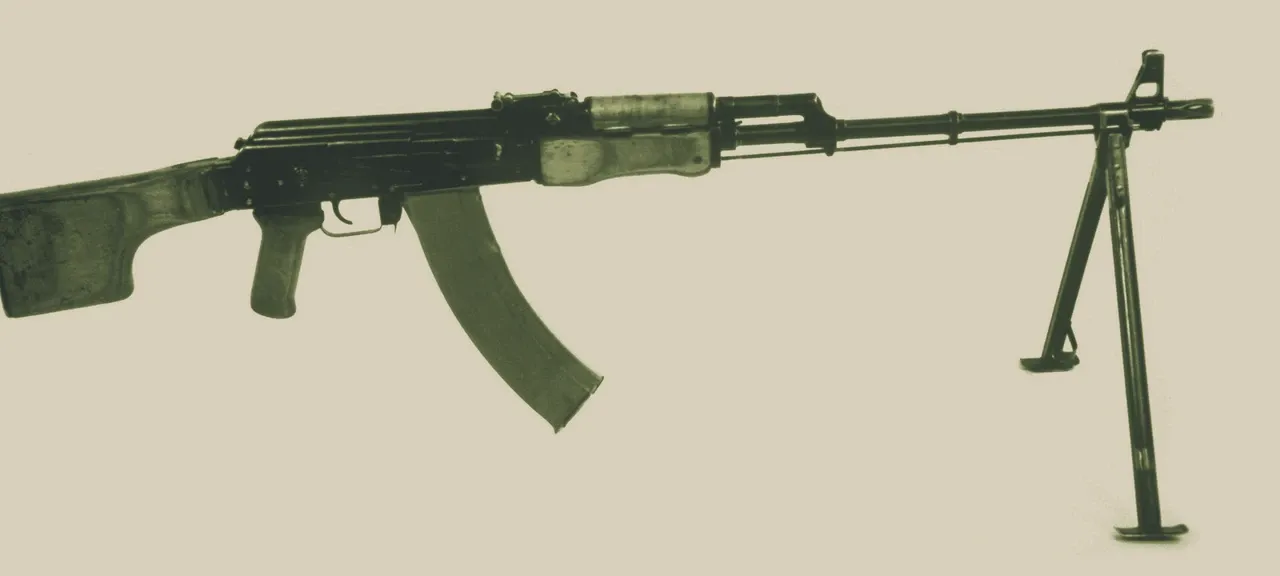
RPK-74
FIG.01 · Russia Image - RPK-74. Photo by Unknown author, Public domain, via Wikimedia Commons.
The standard Soviet/Russian 5.45×39mm light machine gun, derived from the AK-74 assault rifle, providing squad-level sustained automatic fire since 1974.

Overview

The RPK-74 (GRAU index 6P18) is the standard squad automatic weapon of the Soviet and Russian infantry, chambered for the 5.45×39mm intermediate cartridge. It is a magazine-fed, gas-operated light machine gun built on the AK-74 receiver, equipped with a heavier, fixed barrel and an integral bipod. The weapon entered service alongside the AK-74 in 1974 and has since become one of the most widely proliferated light machine guns in the world, remaining in front-line use by Russian and numerous former Soviet-aligned forces.

Development

The RPK-74 was developed by Izhmash (now Kalashnikov Concern) to complement the AK-74 rifle during the Soviet Union’s transition to the new 5.45×39mm cartridge in the early 1970s. It replaced the 7.62×39mm RPK in the squad automatic role, sharing the ammunition, magazines and operating mechanism of the new rifle, but with a heavier barrel and bipod to deliver sustained fire. The type was adopted in 1974 and quickly became ubiquitous within Soviet motor-rifle squads, as documented by Modern Firearms and GunRF. A modernized variant, the RPK-74M (6P39), followed in the 1990s with plastic furniture and a side-folding stock, and an ambitious redesign, the RPK-16, was revealed in 2016 as a more modular platform.

Design & capabilities

The RPK-74 is a gas-operated, long-stroke piston weapon with a rotating bolt, derived directly from the AK-74. It feeds from a reinforced 45-round box magazine and is fully compatible with standard 30-round AK-74 magazines. According to Modern Firearms, the barrel is 590 mm long — significantly longer than that of the rifle — and is fixed in place, lacking a quick-change capability. The weapon’s integral bipod, larger magazine capacity and heavier barrel allow it to deliver prolonged automatic fire from a bipod or a light tripod, with a cyclic rate of approximately 600 rounds per minute and a muzzle velocity of about 960 m/s. Sights are graduated out to 1,000 meters, though effective fire is typically in the 600–800 meter band. The later RPK-74M added a side-folding polymer stock and a standard accessory rail, improving portability in mechanised and airborne units, as detailed by GunRF.

Variants

  • RPK-74 (6P18): The original fixed-stock model, fielded from 1974.
  • RPK-74M (6P39): A modernized pattern with a side-folding polymer stock, plastic handguard, and a dovetail rail for optics; it has been the principal production version since the 1990s.
  • RPK-16: A lightweight, modular development introduced in 2016, featuring a quick-change barrel system, a shorter forward grip, a full-length top rail, a suppressor option, a higher cyclic rate of approximately 700 rpm, and a 95-round drum, as covered by all4shooters and Laststandonzombieisland. The RPK-16 saw very limited adoption and has not replaced the RPK-74M at scale.

Combat record / operational use

The RPK-74 family has served through almost every major conflict involving Soviet or Russian forces since the late 1970s. It was widely used in Afghanistan, the Chechen wars and the Syrian civil war, and has been one of the most common light machine guns on both sides of the war in Ukraine. Its rugged AK-74 derivative design and ammunition commonality have made it a mainstay of prolonged infantry engagements; the weapon’s deployment history is charted by GunRF. The modern RPK-74M remains in active front-line service, while the RPK-16 has been observed in Spetsnaz configurations on a limited basis.

Advantages

  • Extreme reliability inherited from the AK-74 pattern, functioning in extreme cold, mud, and poor maintenance.
  • Longer 590 mm barrel and a robust bipod provide superior sustained-fire capability compared to standard rifles.
  • Magazine commonality with the AK-74 simplifies squad logistics.
  • The RPK-74M’s side-folding stock makes it compact in vehicles and during dismounted movement.
  • Light weight (~4.7 kg empty) allows the gunner to carry the weapon without an assistant in most situations.

Drawbacks / limitations

  • Fixed, non-quick-change barrel limits sustained fire duration and can lead to overheating in prolonged engagements.
  • Limited to box and drum magazines — no belt-feed option reduces sustained firepower relative to true belt-fed LMGs.
  • The 5.45×39mm cartridge has less barrier penetration and terminal effect at extended ranges compared to 7.62mm rounds.
  • The lack of standardised optical sights on older variants hampers first-round hit probability at longer ranges.
  • The RPK-16’s limited adoption means the Russian squad still relies on a 1970s-vintage weapon with few modernisation features.

Counterparts

Outlook

The RPK-74 family will remain in service for years to come due to its sheer numbers and proven reliability. The RPK-16’s modular, quick-change barrel configuration points to the direction Russian designers would like to take the squad automatic weapon, but constrained procurement budgets and the immense existing stockpile of RPK-74M variants have kept the RPK-16 a niche weapon. The war in Ukraine has reinforced the RPK-74’s dependable if basic performance, while also highlighting the limitations of a non-belt-fed, non-QCB squad automatic. A broader replacement will likely await a future generation of Russian small arms.

Key specifications

Spec Value
Crew 1 (gunner); typically part of a 2-man team
Combat weight ~4.7 kg (empty, without magazine)
Length / width / height 1,060 mm / not publicly established / not publicly established
Main armament 5.45×39mm
Secondary armament None
Armor & protection None
Engine & power Gas-operated, long-stroke piston (no motor)
Power-to-weight Not applicable
Road / cross-country speed Not applicable
Operational range ~600–800 m effective (sights to 1,000 m)

Sources

  1. Modern Firearms — Kalashnikov RPK-74 light machine gun. https://modernfirearms.net/en/machineguns/russia-machineguns/rpk-74-eng/
  2. GunRF — RPK-74 Kalashnikov light machine gun. https://gunrf.ru/rg_pulemet_rpk74_eng.html
  3. all4shooters — RPK-16 light machine gun. https://www.all4shooters.com/en/shooting/rifles/rpk-16-light-machine-gun/
  4. Laststandonzombieisland — Meet the RPK-16. https://laststandonzombieisland.com/2017/03/20/meet-the-rpk-16/
FIELD DISPATCH · WEEKLY

BattlePolicy Weekly — free.

Defense tech, startups, and security — weekly. No paywall.

Related
Ukraine · Russia · Policy · Chornobyl · Energoatom · shahed

Russia strikes Ukraine's central spent-fuel store at Chornobyl with a Shahed

A Russian drone hit the receiving building of the Holtec-built dry-cask site that freed Ukraine from shipping its nuclear waste to Russia, metres from where spent fuel sits.

Ukraine · Russia · Policy · Chornobyl · Energoatom · shahed