Stryker
The Stryker family of wheeled 8×8 armored vehicles — the backbone of US Army Stryker Brigade Combat Teams, fielded since 2002 and exported to Ukraine, with variants from base troop carrier to 30 mm Dragoon and counter-drone directed-energy platforms.
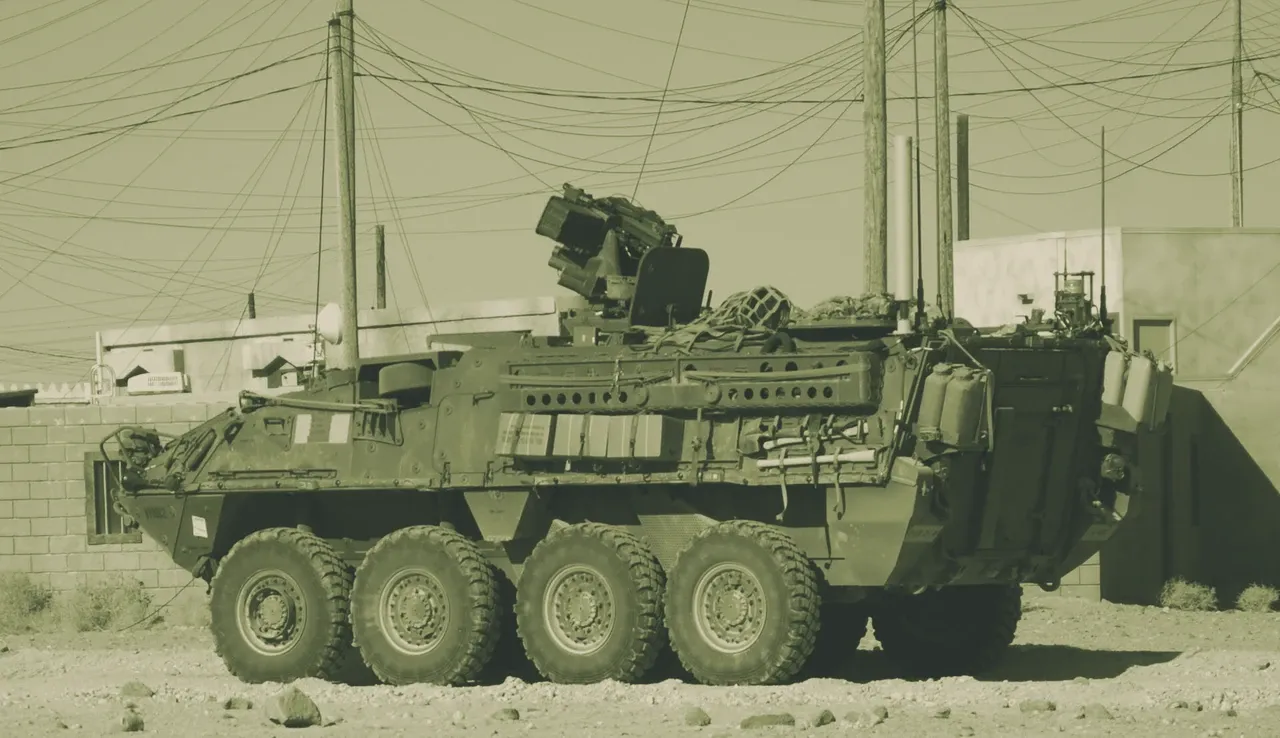
The Stryker family of wheeled 8×8 armored vehicles — the US Army's medium-weight mobility backbone, fielded since 2002 and combat-proven in Iraq, Afghanistan, and Ukraine, and increasingly armed with anti-armor and counter-drone directed-energy systems.
Overview
The Stryker is an 8×8 wheeled armored vehicle family manufactured by General Dynamics Land Systems, derived from the Canadian LAV III (itself a Piranha III variant). It entered service in 2002 as the standard combat platform of the US Army’s Stryker Brigade Combat Teams, providing a rapidly deployable, C-130-transportable vehicle capable of bridging the gap between light infantry and heavy armored forces. Today the family spans more than 18 variants, from the baseline troop carrier to up-gunned infantry carriers, air-defense vehicles and experimental directed-energy weapon carriers. Ukraine has received over 150 Strykers and employed them in both counteroffensive and cross-border operations.
Development
The Stryker was born from the Army’s Interim Armored Vehicle requirement, which sought a wheeled platform lighter and more deployable than the M2 Bradley yet more survivable than a HMMWV. Based on the General Dynamics LAV III, the first Stryker prototype rolled out in 2000 and the vehicle was fielded from 2002 as the M1126 Infantry Carrier Vehicle. Early combat experience in Iraq drove a series of survivability upgrades, including slat (bar) armor against RPGs and, later, a double-V-hull (DVH) to protect against roadside bombs. An upgraded A1 configuration, introduced in the 2010s, added a 450-hp engine and improved electrical architecture.
Design & capabilities
The baseline M1126 ICV accommodates a crew of two and nine dismounts. Protection rests on an all-welded steel hull with ceramic appliqué armor; add-on slat/cage armor counters RPG threats, while a DVH deflects mine and IED blasts away from the crew compartment, as detailed by Military.com. Armament comes from a remotely operated weapon station hosting either an M2 .50-caliber machine gun or a Mk 19 40 mm automatic grenade launcher, supplemented by a coaxial 7.62 mm M240 machine gun.
The most significant firepower upgrade is the M1296 Dragoon, which mounts a 30 mm XM813 Bushmaster II cannon in a remotely operated turret, giving the vehicle a lethality closer to that of a tracked IFV. For air-defense, the M-SHORAD variant pairs a 30 mm cannon with Stinger and Hellfire missiles plus an on-board radar. Two counter-drone directed-energy variants are in experimentation: the Leonidas Stryker, which carries a high-power-microwave array designed to disable drone swarms The Defense Post, and the DE M-SHORAD, a 50 kW-class laser that has faced user criticism for limited effectiveness in early trials, according to Breaking Defense. The A1 upgrade provides 450 hp and a higher gross vehicle weight rating, while the DVH fleet incorporates blast-attenuating seats and improved under-body protection.
Variants
The Stryker family includes numerous mission-specific variants, notably: - M1126 ICV – baseline infantry carrier, 2+9, .50-cal or Mk 19. - M1127 Reconnaissance Vehicle – sensor-equipped scout variant. - M1296 Dragoon – 30 mm cannon-armed ICV, fielded from 2018. - M-SHORAD (IM-SHORAD) – short-range air defense with 30 mm, Stinger, Hellfire, and radar. - Leonidas Stryker – high-power-microwave counter-drone prototype. - DE M-SHORAD – 50 kW laser weapon demonstrator. - Stryker A1 – upgraded powerpack, electrical system, and DVH. - Stryker NBC RV – nuclear, biological, chemical reconnaissance. - Other variants cover medical evacuation, command, mortar carrier, engineer squad vehicle, and anti-tank guided missile platforms.
The M1128 Mobile Gun System (105 mm) was retired due to persistent operational shortfalls.
Combat record / operational use
Strykers first saw combat in Iraq in 2003 and subsequently in Afghanistan, where slat armor and DVH helped reduce casualties from RPGs and IEDs. Following Russia’s full-scale invasion, the United States transferred over 150 Strykers to Ukraine, beginning in early 2023. Ukrainian forces employed them in the 2023 counteroffensive and, later, in the August 2024 Kursk incursion into Russian territory. During the Kursk operation, Ukrainian troops praised the Stryker’s high road speed and cross-country mobility, reporting that even the baseline M1126 proved effective in a fast-moving, fluid battlespace. The vehicles were also used for casualty evacuation and as ambulance platforms. Detailed after-action analysis carried by Army Recognition highlighted the Stryker’s ability to keep pace with maneuver elements while offering significantly more protection than legacy Soviet-era wheeled APCs.
Advantages
- Rapid deployability: fits inside a C-130 transport and moves at ~96–100 km/h on roads, enabling rapid brigade-level maneuver.
- Modular 18-variant family covers troop transport, cavalry scout, command, medical, engineer, mortar, ATGM, and air-defense roles within a single logistical footprint.
- Up-gunned Dragoon variant closes the firepower gap with tracked IFVs while retaining wheeled mobility.
- DVH and slat armor provide proven defense against under-belly IEDs and RPGs, validated in Iraq, Afghanistan, and Ukraine.
- Directed-energy counter-drone variants (Leonidas HPM, DE M-SHORAD) test a path to low-cost-per-engagement drone defense.
Drawbacks / limitations
- Light armor cannot stop modern anti-tank guided missiles or large IEDs without stand-off measures; no active protection system is fielded.
- The 105 mm MGS variant was retired after poor reliability, sluggish fire-rate, and vulnerability to RPG fire.
- M-SHORAD laser output, rated at 50 kW, proved insufficient in early operational assessments; soldiers reported it “wasn’t impressive,” per Breaking Defense.
- Wheeled chassis limits cross-country performance in deep mud or extremely rough terrain compared to tracked platforms.
- High center of gravity with add-on armor can reduce stability on side slopes.
Counterparts
Outlook
The Stryker remains the backbone of US Army medium-weight brigades and will persist in production and modernization through at least the 2030s. Continued upgrades — wider fielding of the Dragoon, maturation of directed-energy counter-drone capabilities, and integration of active protection systems — aim to keep the fleet relevant in a drone-saturated battlespace. Lessons from Ukraine, where the platform proved its worth in rapid offensive operations, are feeding back into US Army training and concept development. Ongoing work on the DE M-SHORAD and Leonidas will determine whether a Stryker-borne directed-energy weapon becomes a production item or remains an experimental niche.
Key specifications
| Spec | Value |
|---|---|
| Crew | 2 + 9 (M1126 ICV); varies by variant |
| Combat weight | ~16.5–18.2 t (M1126 baseline); up to ~27 t GVW (A1) |
| Length / width / height | 6.95 m × 2.72 m × 2.64 m (M1126 ICV) |
| Main armament | .50-cal M2 or Mk 19 40 mm AGL on RWS; Dragoon: 30 mm XM813; M-SHORAD: 30 mm + Stinger & Hellfire |
| Secondary armament | 7.62 mm M240 coaxial; 8×76 mm smoke grenade launchers |
| Armor & protection | Welded steel hull with ceramic appliqué; slat/cage armor; double-V hull (DVH); spall liner |
| Engine & power | Caterpillar C7 6-cylinder diesel; 350 hp / 261 kW (A1: 450 hp / 336 kW) |
| Power-to-weight | ~20.6 hp/t (baseline M1126 at 17 t) |
| Road / cross-country speed | ~96–100 km/h road; ~60 km/h cross-country (est.) |
| Operational range | ~500–530 km |
Dimensions per Army Technology.
Sources
- Army Technology — Stryker Armoured Combat Vehicle Family. https://www.army-technology.com/projects/stryker-armoured-combat-vehicle/
- General Dynamics Land Systems — Stryker. https://www.gdls.com/stryker/
- Military.com — M1126 Stryker Combat Vehicle. https://www.military.com/equipment/m1126-stryker-combat-vehicle
- The Defense Post — Stryker to Receive Microwave Counter Drone Swarm Weapon (Epirus Leonidas). https://thedefensepost.com/2021/10/27/stryker-microwave-counter-drone/
- Breaking Defense — Army soldiers not impressed with Strykers outfitted with 50-kilowatt lasers, service official says. https://breakingdefense.com/2024/05/army-soldiers-not-impressed-with-strykers-outfitted-with-50-kilowatt-lasers-service-official-says/
- Army Recognition — Ukrainian US-donated Stryker armored vehicles show high combat effectiveness in Kursk operation. https://armyrecognition.com/focus-analysis-conflicts/army/conflicts-in-the-world/russia-ukraine-war-2022/ukrainian-us-donated-stryker-armored-vehicles-show-high-combat-effectiveness-in-kursk-operation