GRID-REF 37°47′N 122°25′W
DISPATCH 02/26 · 9 Jun 2026
BATTLEPOLICY
Startup to front line. Strategy to consequence.
Lexicon · Russia

Admiral Gorshkov

Russia's most modern surface combatant — a multirole frigate built around long-range precision strike with Kalibr and Zircon hypersonic missiles, and the anchor of its future surface fleet.
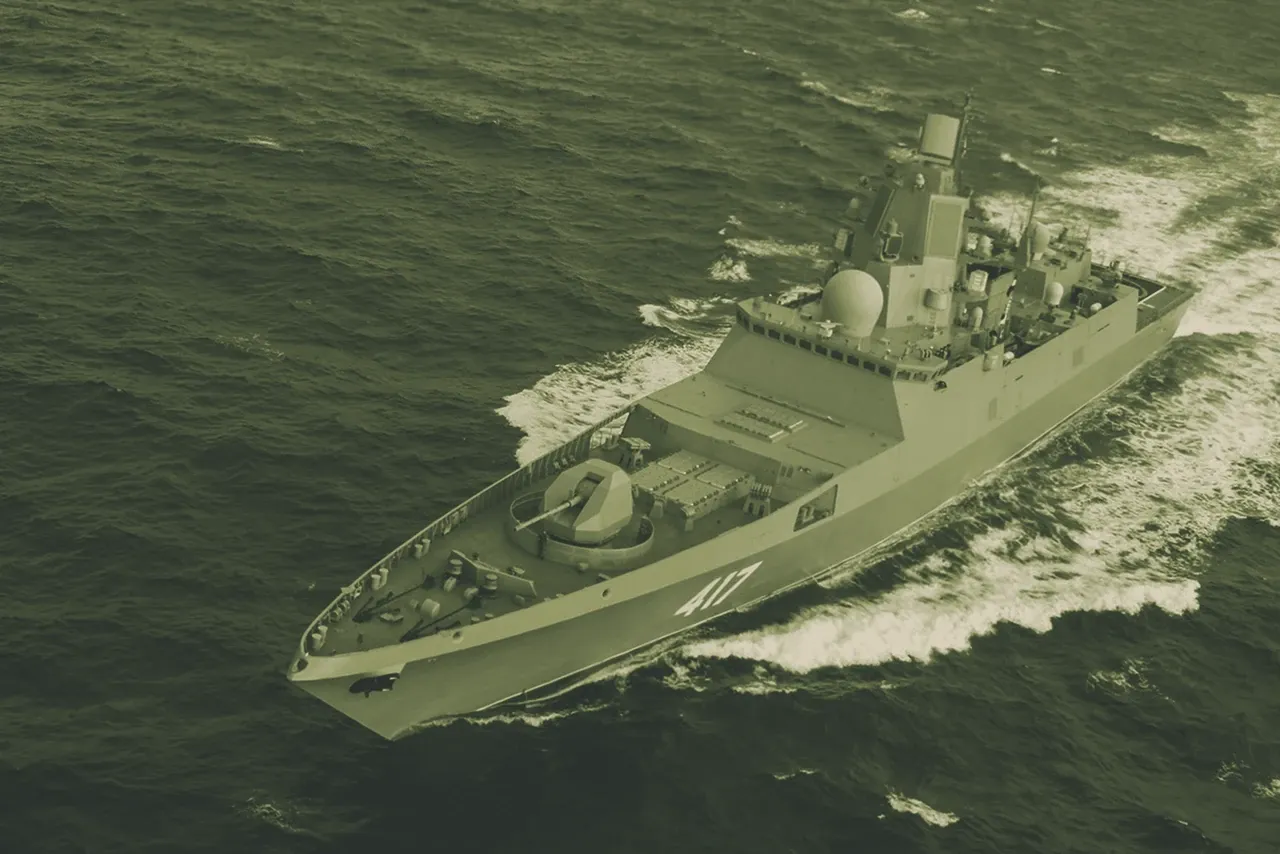
Admiral Gorshkov
FIG.01 · Russia Image - The Russian frigate Admiral Gorshkov. Photo by Ministry of Defence of the Russian Federation, CC BY 4.0, via Wikimedia Commons.
Russia's most modern multirole frigate — a compact, ocean-going warship designed for long-range precision strike with Kalibr and Zircon hypersonic missiles, and the centerpiece of the Russian Navy's bid to recapitalize its surface fleet after decades of Soviet-era reliance.

Overview

The Admiral Gorshkov-class (Project 22350) is a multirole guided-missile frigate designed and built by Severnaya Verf for the Russian Navy. It is Russia's first post-Soviet surface combatant to carry a multi-function phased-array radar and a vertical launch system for long-range land-attack and anti-ship missiles, marking a generational leap from the legacy Soviet destroyer and cruiser fleet. The class is intended to replace the aging Udaloy and Sovremenny destroyers and form the core of Russia's future ocean-going surface fleet.

Development

The lead ship, Admiral Gorshkov, was laid down in 2006, launched in 2010, and endured a protracted fitting-out period before entering service on 28 July 2018, according to Army Recognition. The program was severely disrupted by Russia's 2014 annexation of Crimea, which cut off the supply of Ukrainian Zorya-Mashproekt gas turbines that powered the first two ships. Russia was forced to develop an indigenous replacement, the NPO Saturn M90FR turbine, delaying subsequent hulls; this supply-chain vulnerability is documented by Naval Technology. By 2025, about three to four ships had been commissioned, with additional hulls under construction and a follow-on larger variant, Project 22350M, in design.

Design & capabilities

The Gorshkov-class displaces approximately 5,400 tonnes at full load (est.) and uses a CODAG propulsion system combining two 10D49 diesel engines with two M90FR gas turbines for a sprint speed of 29–30 knots. Its offensive armament centers on two eight-cell UKSK 3S14 universal vertical launchers capable of firing the Kalibr-NK land-attack cruise missile, the P-800 Oniks anti-ship missile, and the hypersonic 3M22 Zircon, as described by Naval Technology. For air defense, the ship carries 32 Poliment-Redut vertical-launch cells for the 9M96 (medium-range) and 9M100 (short-range) interceptor families, providing area and point defense. The sensor suite is built around the Poliment four-faced active electronically scanned array (AESA) radar, supported by Furke-4 volume-search radar, Monolit surface-search radar, Zarya-M hull-mounted sonar, and a Vinyetka towed-array sonar, a configuration detailed by GlobalSecurity. Additional armament includes a 130 mm A-192 naval gun, two Pantsir-M/Palash close-in weapon systems, and 533 mm torpedo tubes for anti-submarine warfare. A Ka-27 helicopter is carried for ASW and over-the-horizon targeting.

Variants

A follow-on Project 22350M is in development, envisioned as a larger hull displacing around 7,000–8,000 tonnes with an expanded VLS battery of up to 48–64 cells for strike missiles, significantly boosting magazine depth. No hulls of this variant have yet been laid down.

Combat record / operational use

The class has not yet seen combat, but its operational significance has grown rapidly. In January 2023, the lead ship Admiral Gorshkov embarked on an ocean deployment to the Atlantic and Indian Ocean that the Russian Ministry of Defence stated was the first operational voyage carrying Zircon hypersonic missiles, as reported by Naval News and The War Zone. The Russian Navy has indicated that all hulls will eventually be armed with Zircon, transforming the class into a strategic strike asset, a plan covered by Defense News. Since 2023, Gorshkov-class frigates have conducted regular long-range patrols in the Mediterranean, the North Atlantic, and the Arctic, demonstrating the Russian Navy’s ambition to project power with a modern surface force.

Advantages

  • Hypersonic strike capability (Zircon) introduces a high-speed, hard-to-intercept threat to enemy surface groups and land targets.
  • Universal UKSK launcher allows a mix of land-attack, anti-ship, and future hypersonic weapons, providing mission flexibility.
  • Poliment AESA radar offers modern air-surveillance and fire-control performance in a hull half the displacement of Western Aegis destroyers.
  • Compact but capable: the class delivers blue-water range (4,000–4,500 nm) with a helicopter and a layered air-defense system, at an estimated cost of around US$250 million — significantly cheaper than comparable Western frigates.
  • Quiet CODAG diesel-electric propulsion and a modern sonar suite give it useful anti-submarine escort capability.

Drawbacks / limitations

  • Limited strike VLS magazine: only 16 UKSK cells constrain sustained firepower; for comparison, an Arleigh Burke-class destroyer carries 96 Mk 41 cells.
  • The 32-cell Poliment-Redut SAM magazine is adequate but not deep, potentially leaving the ship vulnerable to saturation attacks, especially in the absence of a robust battle-group air defense umbrella.
  • Gas-turbine engine localization after 2014 delayed the program by years, and the initial hulls suffered from a protracted fitting-out and testing period, raising doubts about industrial capacity to deliver ships on schedule.
  • As of 2026, only a handful of hulls operational, leaving the Russian Navy reliant on a small number of high-value units that would be prime targets in a conflict with a peer adversary.
  • No combat experience; the Zircon deployment remains unverified by independent analysis, and the missile's true reliability and shipboard integration are not publicly established.

Counterparts

  • Arleigh Burke-class (USA) — multi-mission Aegis destroyer with a much larger VLS magazine and proven combat record.
  • Type 055 Renhai (China) — a 12,000-tonne cruiser-sized combatant with 112 universal VLS cells, representing the upper end of contemporary surface combatant design.

Outlook

The Admiral Gorshkov-class is the sole modern frigate design Russia can produce in series, and the Ministry of Defence has signaled an intention to build at least 10–12 hulls, with the upgraded Project 22350M potentially adding a larger strike-cruiser variant. Engine production is now domestic, but the shipyards’ capacity remains constrained by sanctions and industrial bottlenecks. While the class cannot match the numerical scale of Chinese or American production, it provides the Russian Navy with a platform that can credibly threaten high-value enemy assets from a safe distance, especially when equipped with Zircon. The class will likely remain the backbone of Russian blue-water surface power through the 2030s, supplemented by modernized legacy ships and a new generation of nuclear-powered cruisers if the Nakhimov refit proves successful.

Key specifications

Spec Value
Type Guided-missile frigate (multirole)
Full-load displacement ~5,400 t (est.)
Length / beam / draft 135 m / 16 m / ~4.5 m
Propulsion CODAG — 2 × 10D49 diesels + 2 × M90FR gas turbines (~65,000 shp), 2 shafts
Max speed (kts) ~29–30 kts
Range / endurance ~4,000–4,500 nm
Complement ~170–210
Armament 16 × UKSK VLS (Kalibr-NK / Oniks / Zircon); 32 × Poliment-Redut SAM; 130 mm A-192 gun; 2 × Pantsir-M/Palash CIWS; 533 mm torpedoes; Paket-NK
Sensors / combat system Poliment AESA (4-faced); Furke-4; Monolit; Zarya-M hull sonar; Vinyetka towed sonar
Aviation facilities Helicopter deck and hangar for 1 × Ka-27

Sources

  1. Army Recognition — "Admiral Gorshkov-class Frigate Project 22350" — https://armyrecognition.com/military-products/navy/frigates/admiral-gorshkov-class-frigate-project-22350
  2. Naval Technology — "Admiral Gorshkov Class Frigates" — https://www.naval-technology.com/projects/admiral-gorshkov/
  3. GlobalSecurity.org — "Project 22350 Admiral Sergei Gorshkov – Design" — https://www.globalsecurity.org/military/world/russia/22350-design.htm
  4. Naval News — "Russian frigate sails to the Atlantic with hypersonic missiles" — https://www.navalnews.com/naval-news/2023/01/russian-frigate-sails-to-the-atlantic-with-hypersonic-missiles/
  5. The War Zone — "Russia's Zircon Hypersonic Missiles Now Deployed On Frigate, Officials Claim" — https://www.twz.com/russias-zircon-hypersonic-missiles-now-deployed-on-frigate-officials-claim
  6. Defense News — "Russian frigate enters service, with plans for hypersonic armaments" — https://www.defensenews.com/naval/2023/12/27/russian-frigate-enters-service-with-plans-for-hypersonic-armaments/
FIELD DISPATCH · WEEKLY

BattlePolicy Weekly — free.

Defense tech, startups, and security — weekly. No paywall.

Related
Ukraine · Russia · Policy · Chornobyl · Energoatom · shahed

Russia strikes Ukraine's central spent-fuel store at Chornobyl with a Shahed

A Russian drone hit the receiving building of the Holtec-built dry-cask site that freed Ukraine from shipping its nuclear waste to Russia, metres from where spent fuel sits.

Ukraine · Russia · Policy · Chornobyl · Energoatom · shahed