Asia-PacificPro
ASEV (Aegis System Equipped Vessel)
ASEV is Japan's two-ship Aegis missile-defense program, pairing SPY-7 radar with 128 launch cells to take persistent ballistic missile-defense duties off existing destroyers.
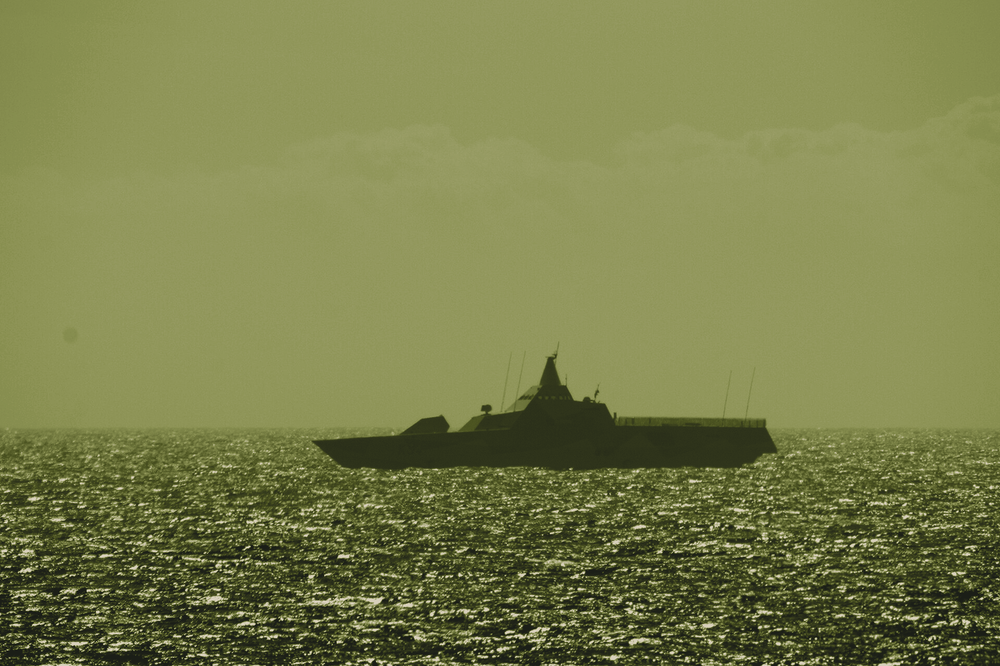
The Visby class comprises five Swedish composite-hulled corvettes for surface warfare, submarine warfare, mine countermeasures and patrol, with Sea Ceptor air defence being integrated through modernisation.
ASEV is Japan's two-ship Aegis missile-defense program, pairing SPY-7 radar with 128 launch cells to take persistent ballistic missile-defense duties off existing destroyers.
Type 095 is the unofficial designation for China's next-generation nuclear-powered attack submarine, identified at Bohai in 2026 with a pumpjet and X-tail.
Type 004 is the analysts' designation for China's fourth aircraft carrier, under construction at Dalian. Satellite imagery suggests a hull comparable in length to the US Ford class and possible nuclear propulsion.
China's Type 022 Houbei is a fast, waterjet-driven catamaran missile boat built to launch coordinated YJ-83 salvoes in coastal and near-littoral waters.
An Iranian class of four aluminium catamaran missile corvettes built for the IRGC Navy, combining vertical-launch cells, anti-ship missiles, fast boats and a helicopter deck on a 600-tonne hull.
Iran's Moudge class is a family of domestically built light frigates, officially designated as destroyers by Tehran, that combined anti-ship missiles, short-range air defense and helicopter facilities on a roughly 1,500-tonne hull.
China's first area-air-defence destroyer class, combining a four-face Type 346 AESA radar with 48 vertically launched HHQ-9 missiles and serving as the technological bridge to the Type 052D.
The Queen Elizabeth class comprises the Royal Navy's two conventionally powered STOVL aircraft carriers, built around the F-35B Lightning and intended to sustain UK carrier strike through alternating ship availability.
North Korea's first approximately 5,000-tonne guided-missile destroyer class, combining a dense vertical-launch battery, phased-array radar and multi-mission armament in the Korean People's Navy's largest surface combatant.
The Type 056 Jiangdao is China's mass-produced light corvette, built for coastal patrol, escort and anti-submarine warfare and adapted for coast-guard and export service.
China's 25,000-tonne amphibious transport dock, combining marine, vehicle, landing-craft and helicopter lift for regional assault, logistics and far-seas operations.
The Kirov class is a Soviet-designed family of nuclear-powered heavy missile cruisers, combining long-range strike weapons, fleet air defense and anti-submarine systems in the largest surface combatant hulls outside carriers and amphibious ships.
Russia's Project 22160 is a modular offshore patrol-ship class built for maritime security and endurance, but its Black Sea service exposed weak air defense and vulnerability to Ukrainian uncrewed surface vessels.
Iran's first dedicated drone carrier — a converted Panamax container ship fitted with an angled flight deck, aviation facilities and missile armament for forward operations by the IRGC Navy.
Liaoning and Shandong are China's first two operational aircraft carriers: conventionally powered, ski-jump ships derived from the Soviet Kuznetsov design and used to build the PLA Navy's carrier-aviation capability.
The Ropucha class is a Soviet-designed tank landing ship built in Poland, combining beach-landing ramps and heavy vehicle lift with a secondary role as an armed military transport.
Germany's planned next-generation air-defence frigate, designed to replace the Sachsen class and provide a mobile sea-based layer for NATO air and ballistic-missile defence.
China's new-generation general-purpose frigate, enlarging and modernising the Type 054A formula with improved stealth shaping, sensors and combat-system integration while retaining a 32-cell vertical-launch battery.
MILDEN is Turkey's first indigenously designed submarine — the ~2,700-tonne Atılay class, in block construction at Gölcük since January 2025 with a methanol-reformer AIP and Turkish weapons. Delivery is promised for the early 2030s; nothing is yet in the water.
The Columbia class is the US Navy's next ballistic-missile submarine — 12 boats replacing 14 Ohios, with electric drive, an X-stern and a life-of-ship reactor. The $126B+ program is the Navy's top priority, running ~a year late with lead-boat delivery now targeted for 2028.
TCG Anadolu is Turkey's flagship — a Juan Carlos I-derived LHD reinvented as the "world's first drone carrier" after the F-35B expulsion. Bayraktar TB3 drones fly from its ski-jump deck, struck sea targets in NATO's Baltic exercise in 2026, and Kizilelma is meant to follow.
The submarine that "disappears" — Germany's Type 212/214 pioneered near-silent hydrogen fuel-cell propulsion, letting a non-nuclear boat stay submerged for weeks and slip past sonar so well it has "sunk" carriers in NATO war games. The world's benchmark export AIP submarine.
Taiwan's home-built deterrent — the Hai Kun ("Narwhal") is the island's first indigenous submarine, built with quiet foreign help to give Taipei a stealthy weapon that could threaten any Chinese invasion fleet. After decades unable to buy submarines abroad, Taiwan built its own.
Japan's stealth frigate — and its first big arms export — the Mogami-class packs firepower, mine warfare and unmanned systems into a low-signature hull run by a small, automated crew. In 2025 Australia picked the upgraded version over Germany's — Japan's first major overseas defence contract.
The conventional submarine that carries ballistic missiles — South Korea's KSS-III is a large, indigenous AIP boat with a vertical launch system for submarine-launched ballistic missiles, a strike capability almost unheard of outside nuclear-powered navies. Later boats add lithium-ion power.
Italy's shape-shifting warship — a Fincantieri ship that scales from a lightly-armed patrol vessel to a full FREMM-class combatant by configuration, and can be up-gunned over its life. The "Multipurpose Combat Ship" that bets one hull can be many warships.
Spain's AIP submarine — a large Navantia boat with a bioethanol fuel-cell air-independent power plant and a Tomahawk-class land-attack option. Famous as much for its troubles: an early design came out too heavy to surface, forcing a costly redesign before the first boat sailed in 2023.
Spain's new Aegis frigate — a Navantia-built warship pairing Lockheed Martin's SPY-7 radar and the Aegis combat system with a Spanish-designed integrated mast and a digital-twin "Shipyard 4.0" build. The high-end ASW-and-air-defence successor to the F100.
Britain's cheap, fast-build frigate — a 5,700-tonne general-purpose warship designed to a fixed ~£250m price on a proven Danish hull, lightly armed at first but built with the space and power to grow. The Royal Navy's bet that hull numbers and flexibility beat gold-plating.
France's "digital-native" frigate — a 4,500-tonne multi-mission warship with a fixed four-panel AESA radar, Aster air-defence and Exocet anti-ship missiles, and a cyber-hardened combat system designed from the keel up. Built for France and Greece, where it has already fought drones in the Red Sea.
China's 40,000-ton amphibious "light carrier" — a helicopter assault ship that lands troops, vehicles and air assault forces over the horizon, built in numbers as the maritime spearhead of any future move on Taiwan. The PLAN's amphibious apex.
Russia's small, stealthy "missiles-with-a-hull" corvette — an 860-ton Project 22800 ship that carries eight Kalibr or Oniks cruise missiles, the more seaworthy sibling of the Buyan-M. Cheap, heavily armed, and a recurring Ukrainian target.
Russia's small, shallow-draft Kalibr-armed missile corvette — a ~950-tonne hull that can transit inland rivers between fleets and lob land-attack cruise missiles 1,500 km. It fired the first combat Kalibr at Syria in 2015 and has been a principal platform for strikes on Ukraine.
Israel's Dolphin-class submarines — German-built diesel-electric attack boats with air-independent propulsion, a reported nuclear second-strike role, and a history wrapped in operational secrecy that only occasionally lifts.
The Sa'ar 6 Magen class consists of four multi-mission corvettes built for the Israeli Navy to defend offshore gas fields and shipping lanes, armed with Barak-8 area-defense missiles and the shipborne C-Dome point-defense system, and recently employed in long-range strikes against the Houthis.
The PLAN's next-generation amphibious assault ship and the world's first purpose-built drone carrier — combining a full-length flight deck, electromagnetic catapult, arresting gear, and a floodable well deck for a hybrid amphibious/UCAV strike capability.
Spain's Álvaro de Bazán-class frigate — the first European Aegis air-defence combatant, carrying 48 Mk 41 VLS cells and shaping a generation of allied frigate designs.
The People's Liberation Army Navy's most numerous modern surface combatant — a 4,000-tonne multi-role frigate with a 32-cell VLS, YJ-83 anti-ship missiles, and a global operational footprint built on Gulf of Aden anti-piracy deployments.
The People’s Liberation Army Navy’s most numerous modern destroyer — a multirole air-defence combatant with 64 universal VLS cells, an AESA radar, and over 35 hulls in service, forming the backbone of China’s carrier escort and blue-water surface force.
The Soviet-built Slava-class guided-missile cruiser — a Cold War "carrier-killer" anchored around 16 deck-mounted P-1000 Vulkan anti-ship missiles and an S-300F area air-defence system, now reduced to two active hulls after the sinking of the Black Sea flagship Moskva.
Russia's principal modern multirole corvette family — compact littoral combatants evolved from a simple anti-surface/ASW design into a Kalibr-carrying strike platform, forming the coastal backbone of the Baltic, Northern, and Pacific Fleets.
A Russian Black Sea Fleet frigate class, the Admiral Grigorovich (Project 11356R/Krivak V) delivers Kalibr cruise-missile land-attack strikes and provides multirole escort — a workhorse of Moscow's naval strike from the Black Sea.
The Royal Navy’s next-generation ASW frigate — a quiet, acoustically optimized design that became one of the most successful Western surface-combatant exports of its era, selected by Australia, Canada, and Norway, and building for the UK as the City-class.
The US Navy's FREMM-derived next-generation frigate — intended as a 20-hull class to close the force-structure gap, cut to 2 half-built hulls when the program was canceled in November 2025 amid runaway redesign and cost growth.
The Franco-Italian FREMM multimission frigate — combining anti-submarine warfare excellence with long-range land-attack and air defence, and the design parent of the US Constellation class.
The Royal Navy's specialist area air-defence destroyer — built around the SAMPSON AESA radar and the Sea Viper missile system, with a 48-cell Sylver VLS, a symbol of high-end European naval capability, and in April 2024 the first Royal Navy ship to shoot down a ballistic missile.
China's first indigenously designed CATOBAR carrier, the Type 003 Fujian, is conventionally powered yet launches aircraft via electromagnetic catapults—a first for any non-US navy.
Russia's sole aircraft carrier — a heavy, conventionally powered STOBAR ship designed in the 1980s, now crippled by repeated accidents and likely headed for the scrapyard.
The world's largest warship — a nuclear-powered supercarrier with electromagnetic catapults, built to sustain a ~75-aircraft air wing and project power globally, and the centerpiece of the US Navy's 11-carrier fleet.
China's primary conventional attack submarine with indigenous Stirling air-independent propulsion — a quiet, multi-week-endurance boat built for regional sea denial, and the platform behind Beijing's push into the submarine export market.
China's first credible sea-based nuclear deterrent — a nuclear-powered ballistic-missile submarine carrying up to 12 JL-2 or JL-3 SLBMs, fielding six boats for near-continuous patrols.
China's second-generation nuclear attack submarine, the Type 093 Shang family, from initial torpedo-armed boats to the VLS-equipped Type 093B, forms the backbone of the PLAN's undersea force.
Russia's troubled Project 677 diesel-electric attack submarine — a mono-hull design intended to replace the Improved Kilo with Kalibr capability and planned air-independent propulsion, but plagued by decades of delays and an absent AIP system.
Russia's diesel-electric Kalibr-capable attack submarine — the "Black Hole" of the Black Sea, a widely exported SSK and the platform behind the only documented submarine-launched cruise-missile strikes in combat.
Russia's latest nuclear ballistic-missile submarine, the cornerstone of its sea-based nuclear deterrent, carrying 16 Bulava SLBMs and featuring a pump-jet propulsor for enhanced stealth.
Russia's most modern nuclear attack submarine — a multirole SSGN carrying Kalibr, Oniks, and Zircon cruise missiles in vertical silos, and the quietest Russian submarine design to date, assessed as comparable to US Seawolf/Virginia generation.
A Franco-Spanish diesel-electric attack submarine family with optional MESMA air-independent propulsion, exported to Chile, Malaysia, India, and Brazil, and the backbone of India's Kalvari and Brazil's Riachuelo classes.
Germany's pioneering fuel-cell AIP attack submarine — the ultra-quiet Type 212A, now evolving into the larger Type 212CD for North Atlantic/Arctic operations, operated by Germany, Italy and (on order) Norway.
The United States Navy’s sea-based strategic deterrent — 14 nuclear-powered ballistic-missile submarines carry
France's next-generation nuclear attack submarine — the Barracuda-class Suffren boats carry the MdCN cruise missile, F21 torpedoes, and a special-forces lock-out, replacing the Rubis-class SSNs one-for-one.
The Royal Navy’s stealthy nuclear-powered attack submarine — armed with Spearfish torpedoes and Tomahawk cruise missiles, sheathed in 39,000 anechoic tiles and driven by a pump-jet for silent patrols world-wide.
The US Navy’s premier nuclear-powered fast-attack submarine, blending advanced quieting, a large Tomahawk strike payload, and special-operations support; the platform at the center of the AUKUS submarine pathway.
Russia's most modern surface combatant — a multirole frigate built around long-range precision strike with Kalibr and Zircon hypersonic missiles, and the anchor of its future surface fleet.
China's largest and most powerful surface combatant — the Type 055 Renhai combines a 12,000-ton displacement with 112 universal VLS cells, serving as the PLAN's carrier-strike-group escort and flagship.
The backbone of the U.S. surface fleet — a 9,500-ton multirole Aegis destroyer with 96 vertical launch cells, evolving from the SPY-1 to the SPY-6 radar, and the platform that fought the heaviest air-defense battles since World War II in the Red Sea.