Type 076 Sichuan
The PLAN's next-generation amphibious assault ship and the world's first purpose-built drone carrier — combining a full-length flight deck, electromagnetic catapult, arresting gear, and a floodable well deck for a hybrid amphibious/UCAV strike capability.
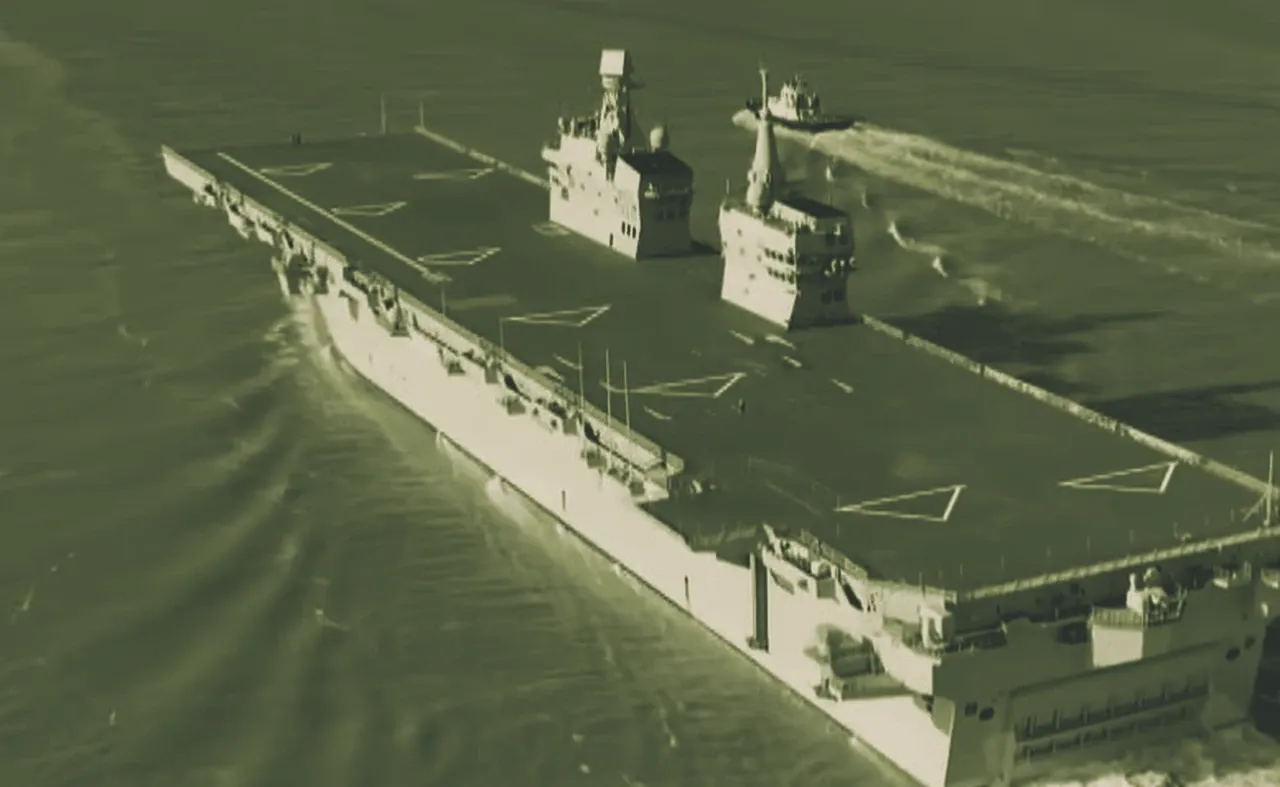
The world's first amphibious assault ship designed from the keel up as a drone carrier — combining an electromagnetic catapult and arresting gear for fixed-wing UCAVs with a floodable well deck and the capacity to embark over 1,000 marines.
Overview
The Type 076 Sichuan (pennant 51) is a next-generation amphibious assault ship under construction for the People's Liberation Army Navy (PLAN). Designated the Yulan class by the U.S. Office of Naval Intelligence, it represents a novel warship category: a landing helicopter assault (LHA) platform fused with a catapult-assisted take-off but arrested recovery (CATOBAR) system for fixed-wing uncrewed combat aerial vehicles (UCAVs). The single bow electromagnetic catapult, arresting gear, and full-length flight deck — approximately 260 meters long — give it a small-carrier aviation capability, while its stern well dock retains traditional amphibious lift. Analysts at CSIS have documented the ship's unprecedented scale, noting the flight deck alone is larger than that of the U.S. America class and the Japanese Izumo class. No other navy fields a comparable drone-carrier amphibious hybrid.
Development
The Type 076's defining features trace back to mid-2020, when Chinese defense contractors published requests for proposals (RFPs) calling for a ship with 21 MW gas turbines, medium-voltage DC integrated power, a 30-ton elevator, and an electromagnetic CATOBAR system for light aircraft, as outlined on Wikipedia. Construction began by October 2023 at a new dry dock at Hudong-Zhonghua Shipbuilding on Shanghai's Changxing Island. By August 2024, CSIS satellite imagery analysis revealed a flight deck measuring approximately 260 meters by 52 meters, twin deck-edge elevators, and a catapult trench around 130 meters long — longer than the system on the carrier Fujian. The ship was officially named Sichuan and launched with a formal ceremony on 27 December 2024, during which Xinhua confirmed the vessel's displacement as "over 40,000 tonnes," its twin-island arrangement, and the presence of its bow electromagnetic catapult and arresting wires, according to USNI News. What follows is an unusually compressed trials timeline: dead-load catapult testing commenced in October 2025, the first sea trial was conducted in November 2025, and a first cross-regional deployment to the South China Sea was announced in April 2026, per The Aviationist. Multiple analysts have noted the pace has outpaced typical PLAN surface combatant programs.
Design & capabilities
Sichuan's design revolves around the marriage of a traditional amphibious assault well deck with a fixed-wing UCAV launch-and-recovery system. The ship features a twin-island superstructure — one island for navigation and ship control, the other for flight operations — and two large deck-edge elevators plus a smaller forward elevator to move aircraft between the hangar and the massive flight deck. The flight deck itself is approximately 260 meters long and 52 meters wide, yielding a deck area of roughly 13,500 square meters, a footprint CSIS notes exceeds the U.S. America class. A single electromagnetic catapult sits in the bow; its trench length of roughly 130 meters, as measured by CSIS from satellite imagery, provides a longer acceleration path than the catapults on the PLAN carrier Fujian. Arresting wires aft recover fixed-wing UCAVs.
Propulsion is derived from an integrated power system combining two 21 MW gas turbines and six 6 MW diesel generators, delivering a total of approximately 78 MW on a medium-voltage DC architecture, according to RFP documents cited by Wikipedia. The Pentagon has assessed it as a hybrid-electric arrangement. This power surplus is designed specifically to service the energy-intensive catapult.
The intended air wing is the ship's most closely watched feature. The PLAN envisions a mix of helicopters and fixed-wing uncrewed platforms including stealth UCAVs derived from the GJ-11 Sharp Sword, navalized "Type C" collaborative combat aircraft (CCA)-like drones, and potentially a Wing Loong-type medium-altitude long-endurance (MALE) UAV. GlobalData analysts estimate a total air wing of around 30 aircraft, per Naval Technology. A mockup of the catapult-capable GJ-21 naval UCAV was photographed aboard in January 2026, as reported by The Aviationist.
The ship retains a stern well dock capable of operating Type 726 LCAC hovercraft, enabling the transport of heavy vehicles and marines ashore. Troop capacity is variably reported but is estimated at over 1,000 marines, with Naval Technology suggesting around 1,500 if configured similarly to U.S. counterparts. Self-defense is heavy for an amphibious ship: three Type 1130 30 mm close-in weapon systems (CIWS), three 24-round HQ-10 short-range surface-to-air missile launchers, and approximately four decoy/countermeasure launchers, as cataloged by The War Zone.
Combat record / operational use
Sichuan has no combat record; its operational timeline is defined by a compressed trials program. Following its 27 December 2024 launch ceremony at Hudong-Zhonghua, the ship completed fitting out and mooring tests through 2025. In late October 2025, a maritime exclusion zone was declared off the shipyard, and open-source analysts assessed that a red test vehicle was used for the first electromagnetic catapult dead-load tests, covered by The War Zone and The Aviationist. Sichuan sailed on its maiden three-day sea trial from 14 to 16 November 2025, which China's Ministry of National Defense stated validated the "reliability and stability of the power, electrical, and other systems." A second two-week trial followed in December 2025, after which the ship entered dry dock. Planet Labs imagery from 25 December 2025 showed six "Type C" drones and a Wing Loong-type drone staged dockside, though these were assessed as mockups, according to The War Zone.
On 31 January 2026, as tugs moved Sichuan out of dry dock, a covered airframe matching the shape of a GJ-21 naval UCAV mockup was photographed near the ship's stern, per The Aviationist. The PLAN announced on 21 April 2026 that Sichuan had departed Shanghai for South China Sea waters to conduct "scientific research, testing and training tasks" — its first cross-regional deployment and what the PLAN characterized as the eighth round of sea trials. The Global Times quoted Chinese experts describing the milestone as evidence of "rapid and efficient progress" toward commissioning. As of mid-2026, no fixed-wing launch or recovery from the ship has been publicly documented in open sources.
Advantages
- Unique drone-carrier capability: the world's first amphibious assault ship with an electromagnetic catapult and arresting gear, enabling fixed-wing UCAV operations at full payload — a capability that CSIS notes exists on no other navy's LHA.
- Sheer scale: flight deck of approximately 260 m × 52 m provides a larger aviation footprint than the U.S. America class, with twin islands and large deck-edge elevators optimized for sortie generation.
- Dual-role flexibility: retains a floodable well deck for hovercraft and heavy vehicle amphibious lift alongside the organic drone air wing, providing ISR and strike cover for landings without relying on carrier or land-based aviation.
- Power margin: approximately 78 MW integrated power system provides ample energy for the demanding catapult and leaves headroom for future directed-energy or sensor growth.
- Layered self-defense: three CIWS, three HQ-10 RAM launchers, and multiple decoy launchers form a heavy close-in defense suite for a big-deck amphib.
Drawbacks / limitations
- Unproven operational concept: EMALS reliability under continuous operational stress and the survivability of UCAV strike packages in a contested electromagnetic environment have no public performance data; Defence Security Asia notes this remains a core analyst caveat.
- Air wing immaturity: the intended UCAV complement is still in development; GJ-21 has appeared only as mockups, the six dockside CCA-type drones in December 2025 were assessed as mockups, and no fixed-wing launch or recovery from the ship has been documented.
- Single-catapult bottleneck: only one bow catapult and one angled recovery path constrain fixed-wing sortie generation rates compared with a full-deck carrier.
- No crewed fast-jet option: China lacks a V/STOL fighter, and analysts assess the flight deck is too narrow for navalized fighters like the J-15T, leaving the ship fully dependent on still-maturing uncrewed systems.
- Commissioning timeline ambiguous: USNI Proceedings argues the ship is unlikely to commission before early 2027, tempering Chinese state-media talk of a 2026 delivery.
Counterparts
- Type 003 Fujian (China) — the PLAN's full-deck CATOBAR supercarrier, from which Sichuan derives its catapult technology in a smaller, amphibious-focused hull.
- Gerald R. Ford class (USA) — the U.S. Navy's electromagnetic catapult carrier; Sichuan is a conceptually different platform but shares the EMALS/CATOBAR paradigm, and U.S. analysts at CSIS use the Ford as a reference point for catapult trench and system comparisons.
Outlook
Sichuan represents a high-stakes test case for whether an amphibious hull can serve as a working drone carrier. Sea trials are projected to continue through 2026, with integration and launch-and-recovery testing of the GJ-21 and other fixed-wing UCAVs the critical milestone to watch. External commissioning estimates cluster between late 2026 — aligned with Chinese-media reporting and an SCMP projection of "delivery by end of 2026" — and early 2027, the latter argued by USNI News and USNI Proceedings based on Type 075 precedents. If the concept is validated, analysts anticipate a small class of perhaps two to four ships that would equip PLAN amphibious ready groups with organic stealth-UCAV ISR and precision strike for contingencies in the Taiwan Strait and South China Sea — a lower-tier naval aviation capability that frees the Fujian-led carrier force for higher-end tasks.
Key specifications
| Spec | Value |
|---|---|
| Type | Amphibious assault ship / drone carrier (LHA with CATOBAR) |
| Full-load displacement | "over 40,000 t" (PLAN official); ~50,000 t (CSIS/Naval Technology est.) |
| Length / beam / draft | ~252–263 m length; ~43 m hull beam; ~52 m flight deck beam; draft not publicly established (external estimates) |
| Propulsion | Integrated power system — 2 × 21 MW gas turbines + 6 × 6 MW diesels, ~78 MW total, medium-voltage DC (RFP-derived estimate) |
| Max speed (kts) | Not publicly established |
| Range / endurance | Not publicly established |
| Complement | Crew size not publicly established; troop capacity est. over 1,000 marines (est. ~1,500 per Naval Technology) |
| Armament | 3 × Type 1130 30 mm CIWS; 3 × 24-round HQ-10 short-range SAM; ~4 × 32-tube decoy/countermeasure launchers |
| Sensors / combat system | Not publicly established in detail; multi-array radars on both islands |
| Aviation facilities | 1 × bow electromagnetic catapult (~130 m trench); arresting gear; flight deck ~260 m × 52 m; 2 large deck-edge elevators + 1 small forward elevator; internal hangar |
Sources
- Wikipedia — "Type 076 landing helicopter dock" — https://en.wikipedia.org/wiki/Type_076_landing_helicopter_dock
- The War Zone — "China's Type 076 Supersized Amphibious Assault Ship Heads To Sea On Its Maiden Voyage" — https://www.twz.com/sea/chinas-type-076-supersized-amphibious-assault-ship-heads-to-sea-on-its-maiden-voyage
- The War Zone — "China's Monster Type 076 Amphibious Assault Ship Seen Like Never Before At Launch Ceremony" — https://www.twz.com/sea/chinas-monster-type-076-amphibious-assault-ship-seen-like-never-before-at-launch-ceremony
- The War Zone — "Loyal Wingman Drone Appears On China's Supersized Type 076 Amphibious Assault Ship" — https://www.twz.com/news-features/loyal-wingman-drone-appears-on-chinas-supersized-type-076-amphibious-assault-ship
- The Aviationist — "China's Type 076 LHD Sichuan Believed to Have Tested EMALS Catapult for the First Time" — https://theaviationist.com/2025/10/26/chinas-type-076-lhd-sichuan-tested-emals/
- The Aviationist — "Mockup of China's GJ-21 Naval UCAV Spotted on Type 076 LHD Sichuan" — https://theaviationist.com/2026/01/31/gj-21-ucav-spotted-type-076-lhd-sichuan/
- CSIS — "China's Massive Next-Generation Amphibious Assault Ship Takes Shape" — https://www.csis.org/analysis/chinas-massive-next-generation-amphibious-assault-ship-takes-shape
- USNI News — "Japanese Cabinet Approves Record Defense Budget; China Launches New Amphibious Warship" — https://news.usni.org/2024/12/27/japanese-cabinet-approves-record-defense-budget-china-launches-new-amphibious-warship
- US Naval Institute Proceedings — "Going Nuclear, Getting Bigger, and Going Beyond" — https://www.usni.org/magazines/proceedings/2026/may/going-nuclear-getting-bigger-and-going-beyond
- Naval Technology — "Analysis: what we know about the Sichuan, China's drone carrier hybrid" — https://www.naval-technology.com/news/analysis-what-we-know-about-the-sichuan-chinas-drone-carrier-hybrid/
- Global Times — "China's first Type 076 amphibious assault ship Sichuan heads to S.China Sea for trials and training" — https://www.globaltimes.cn/page/202604/1359526.shtml
- Defence Security Asia — "China Deploys Revolutionary Type 076 'Drone Carrier' to South China Sea" — https://defencesecurityasia.com/en/china-type-076-drone-carrier-south-china-sea-emals-naval-power-balance/
- The Aviationist — "New Images Show China's GJ-21 Naval UCAV with Landing Gear Extended" — https://theaviationist.com/2026/05/01/new-images-china-gj-21-naval-ucav/