GRID-REF 37°47′N 122°25′W
DISPATCH 02/26 · 9 Jun 2026
BATTLEPOLICY
Startup to front line. Strategy to consequence.
Lexicon · Russia

Improved Kilo

Russia's diesel-electric Kalibr-capable attack submarine — the "Black Hole" of the Black Sea, a widely exported SSK and the platform behind the only documented submarine-launched cruise-missile strikes in combat.
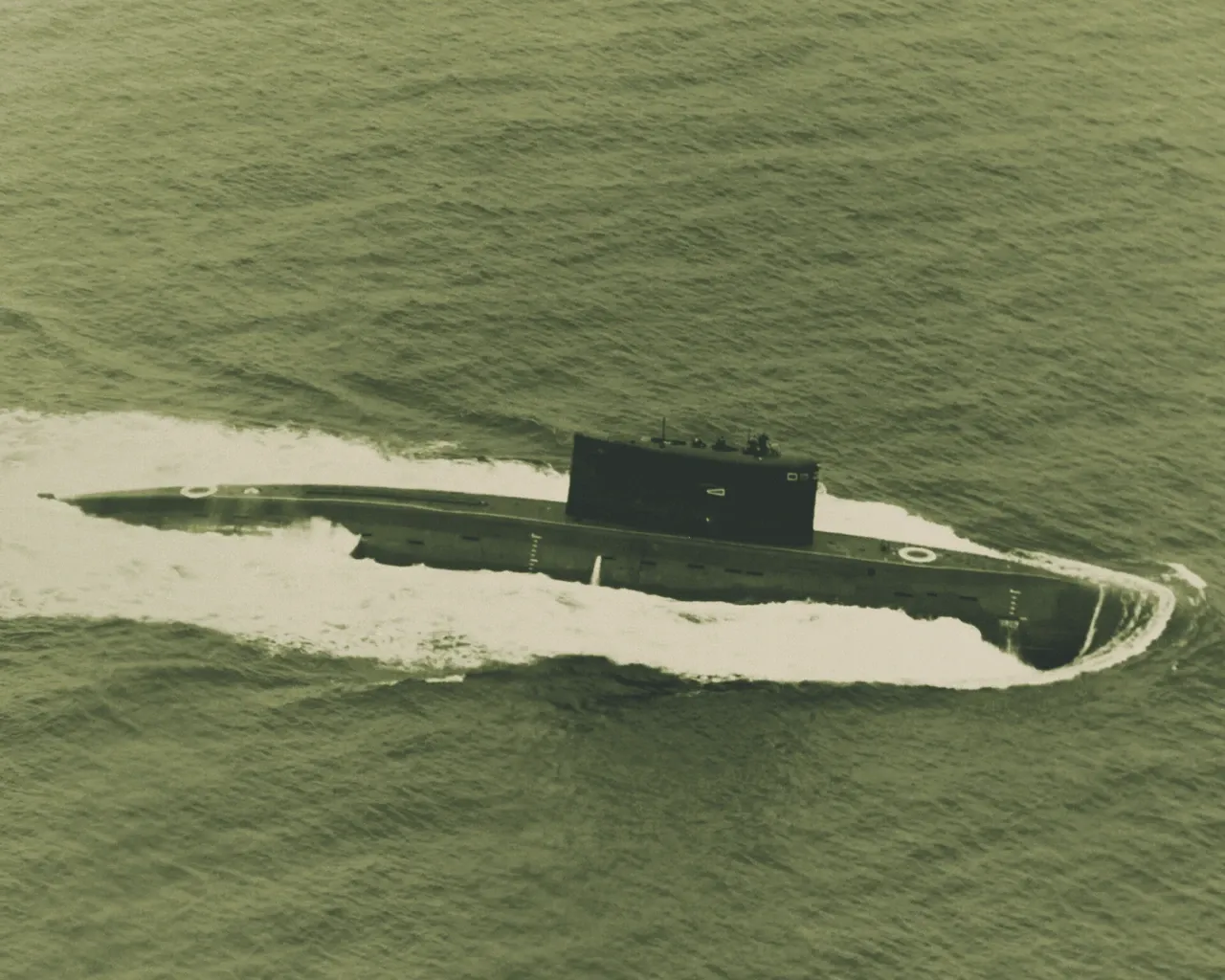
Improved Kilo
FIG.01 · Russia Image - Improved Kilo. Photo by Unknown authorUnknown author, Public domain, via Wikimedia Commons.
Russia's diesel-electric Kalibr-capable attack submarine — the "Black Hole" of the Black Sea, a widely exported SSK and the platform behind the only documented submarine-launched cruise-missile strikes in combat.

Overview

The Improved Kilo (Project 636.3 "Varshavyanka") is the pinnacle of the Russian Kilo-class diesel-electric attack submarine (SSK) lineage, distinguished by its integration of the Kalibr family of cruise missiles and its reputation for extreme acoustic discretion — earning it the Western sobriquet "Black Hole." Built by Admiralty Shipyards in St. Petersburg, the first Project 636.3 boat entered service with the Black Sea Fleet in 2014, and the class has since become the workhorse of Russia's conventional submarine force and a global export bestseller, with more than seventy Kilo-family boats built and over sixty in service worldwide, according to USNI Proceedings. The Improved Kilo provides a layered capability — anti-surface and anti-submarine warfare from six 533 mm torpedo tubes, plus the ability to strike inland targets with Kalibr land-attack cruise missiles, a feature it has used in combat more than any other submarine class.

Development

The Kilo family originated with the Project 877 Paltus design in the early 1980s, a double-hulled diesel-electric boat intended for coastal and near-sea operations. The follow-on Project 636, and especially the 636.3 Varshavyanka iteration launched in the 2010s, incorporated a redesigned combat information-management system, improved quieting measures, and the crucial addition of the 3R14N integration system enabling tube-launched Kalibr cruise missiles. As detailed by GlobalSecurity.org, the first Russian Navy Improved Kilo, B-261 Novorossiysk, was laid down in 2010, launched in 2013, and commissioned in 2014, followed by five sister boats for the Black Sea Fleet through 2016. A second batch of six was ordered for the Pacific Fleet (delivered 2019–2025), and a third batch of six was contracted in 2022 for the Northern Fleet, reflecting the design’s resilience despite the parallel, troubled Lada-class program. The export line, meanwhile, has seen the Project 636 and 636M variants delivered to China, India, Algeria, Vietnam, Iran, and Myanmar, making the Kilo the most widely exported Russian submarine since the diesel-electric Foxtrot.

Design & capabilities

The Improved Kilo retains the teardrop-shaped, double-hulled form of its predecessors, with anechoic rubber tiles covering the pressure hull and a hydrodynamically optimized outer casing that contributes to its celebrated quietness. Propulsion is pure diesel-electric — two diesel generators feeding a single seven-bladed propeller — with no air-independent propulsion (AIP). Submerged endurance depends on battery capacity, and the boat must periodically snorkel to recharge, limiting its silent loiter time compared to AIP-equipped competitors. A combat load of up to eighteen heavy torpedoes or twenty-four mines can be carried, but the signature improvement is the ability to carry and fire the Kalibr (Klub) family from the forward tubes: a mixed loadout can include up to four 3M-14 land-attack or 3M-54 anti-ship cruise missiles. The sonar suite is a modernized MGK-400EM hull-mounted array; unlike Russia’s nuclear attack submarines, the Improved Kilo lacks a towed-array sonar, a limitation for long-range passive detection. Complement is 52 crew, and the boat’s stated operational endurance is approximately forty-five days, with a snorkel range of roughly 7,500 nautical miles, according to GlobalSecurity.org.

Variants

  • Project 877 / 877EKM: the baseline Kilo, exported widely from the 1980s onward, with no Kalibr capability.
  • Project 636 / 636M: improved quieting and the Klub (Kalibr export) missile system; delivered to China, Algeria, Vietnam, and India.
  • Project 636.3 Varshavyanka: the latest Russian Navy standard, with the improved MGK-400EM sonar, Kalibr integration, and a modern combat management system. All Russian Black Sea, Pacific, and planned Northern Fleet boats are to this standard.

Combat record / operational use

The Improved Kilo is the only submarine class to have fired cruise missiles in anger on multiple occasions. On 17 November 2015, the Black Sea Fleet boats B-261 Novorossiysk and B-237 Rostov-on-Don launched a volley of 3M-14 Kalibr land-attack missiles at Islamic State positions near Raqqa, Syria, marking the combat debut of Russian submarine-launched cruise missiles. During the full-scale invasion of Ukraine from 2022, Black Sea Fleet Kilos conducted repeated Kalibr strikes against Ukrainian infrastructure from the relative safety of the eastern Black Sea. The fighting also delivered the first recorded loss of a Russian submarine to enemy action in decades: on 13 September 2023, Rostov-on-Don was struck in Sevastopol’s dry dock by a Ukrainian Storm Shadow cruise missile, causing catastrophic damage that Ukrainian and Western analysts assess effectively wrote off the hull, as reported by Defence-UA. A Ukrainian source later claimed that a “Sea Baby” unmanned underwater drone struck the already-damaged boat again in December 2025, sinking it — though independent confirmation remains limited, per The Insider. These incidents underscore the vulnerability of conventionally powered submarines in port against modern stand-off precision fires.

Advantages

  • One of the quietest diesel-electric submarines afloat, earning the enduring “Black Hole” nickname.
  • Kalibr cruise-missile capability on a relatively low-cost, small-crew platform gives a potent land-attack punch.
  • Proven combat track record: the only submarine to fire cruise missiles in both Syria and Ukraine.
  • Mature, well-understood design with extensive export uptake and established maintenance pipelines.
  • Cost-effective — roughly US$300 million per boat (est.) — making it attractive for navies that cannot afford nuclear submarines.

Drawbacks / limitations

  • No AIP, meaning the boat must snorkel frequently and cannot loiter submerged for weeks; Russia’s failure to field AIP on the Kilo leaves it behind Western and Chinese conventional designs.
  • Lacks a towed-array sonar, reducing passive detection range compared to boats so equipped.
  • Vulnerable in port and while snorkeling, as demonstrated by the loss of Rostov-on-Don.
  • The legacy double-hull design limits internal volume growth and personnel amenities.
  • Diving depth is modest (~240 m operational / ~300 m max, est.) compared to some modern SSKs.

Counterparts

  • Type 212 (Europe) — fuel-cell AIP SSK with extreme submerged endurance and low signatures.
  • Type 039 Yuan (China) — Stirling AIP SSK with a faceted stealth sail and comparable missile capability, representative of China’s lead over Russia in fielding AIP conventional submarines.

Outlook

Despite the combat loss in the Black Sea, the Improved Kilo remains in serial production for both domestic and export customers. The Russian Navy continues to order Project 636.3 boats for its Pacific and Northern Fleets even as the Lada-class program struggles to field a credible AIP alternative, underscoring the Kilo’s role as the reliable backbone of the conventional submarine force. Export demand persists — Myanmar took delivery of two 636 boats and others have expressed interest — but the Kilo’s operational vulnerabilities against modern stand-off precision strike and uncrewed underwater systems have been laid bare. The design will likely see incremental rather than radical upgrades, while the eventual, and still uncertain, arrival of an AIP-equipped Amur-class successor will determine the family’s long-term future.

Key specifications

Spec Value
Type Diesel-electric attack submarine (SSK)
Full-load displacement ~3,100 t submerged (up to ~3,950 t est.)
Length / beam / draft 73.8 m / 9.9 m / 6.1 m
Propulsion 2 diesel generators, single 7-bladed prop; diesel-electric (no AIP)
Max speed (kts) ~17 surfaced / ~20 submerged
Range / endurance ~45-day endurance; snorkel range ~7,500 nm (est.)
Complement 52
Armament 6 × 533 mm torpedo tubes; up to 18 torpedoes / 24 mines; Kalibr (3M-14 / 3M-54), ~4 in mixed loadout
Sensors / combat system MGK-400EM hull-mounted sonar; no towed array; optronic mast
Aviation facilities None

Sources

  1. USNI Proceedings — “Russia’s Kilo-class Submarine: Improved And More Deadly Than Ever.” https://www.usni.org/magazines/proceedings/2023/august/russias-kilo-class-submarine-improved-and-more-deadly-ever
  2. GlobalSecurity.org — Kilo Project 636-M / 636.3 Varshavyanka. https://www.globalsecurity.org/military/world/russia/636m.htm
  3. Militarnyi — “Improved Kilo-Class Submarines: An Export Project That Has Become a Mainstay of the Russian Navy.” https://militarnyi.com/en/articles/improved-kilo-class-submarines-an-export-project-that-has-become-a-mainstay-of-the-russian-navy/
  4. Defence-UA — “Why Damaged Russian Kilo-Class Submarine Is Effectively a Total Loss.” https://en.defence-ua.com/news/why_damaged_russian_kilo_class_submarine_is_effectively_a_total_loss-16829.html
  5. The Insider — “Ukraine claims first Sea Baby underwater drone strike on Russian submarine.” https://theins.press/en/news/287783
FIELD DISPATCH · WEEKLY

BattlePolicy Weekly — free.

Defense tech, startups, and security — weekly. No paywall.

Related
Ukraine · Russia · Policy · Chornobyl · Energoatom · shahed

Russia strikes Ukraine's central spent-fuel store at Chornobyl with a Shahed

A Russian drone hit the receiving building of the Holtec-built dry-cask site that freed Ukraine from shipping its nuclear waste to Russia, metres from where spent fuel sits.

Ukraine · Russia · Policy · Chornobyl · Energoatom · shahed