Type 055 Renhai
China's largest and most powerful surface combatant — the Type 055 Renhai combines a 12,000-ton displacement with 112 universal VLS cells, serving as the PLAN's carrier-strike-group escort and flagship.
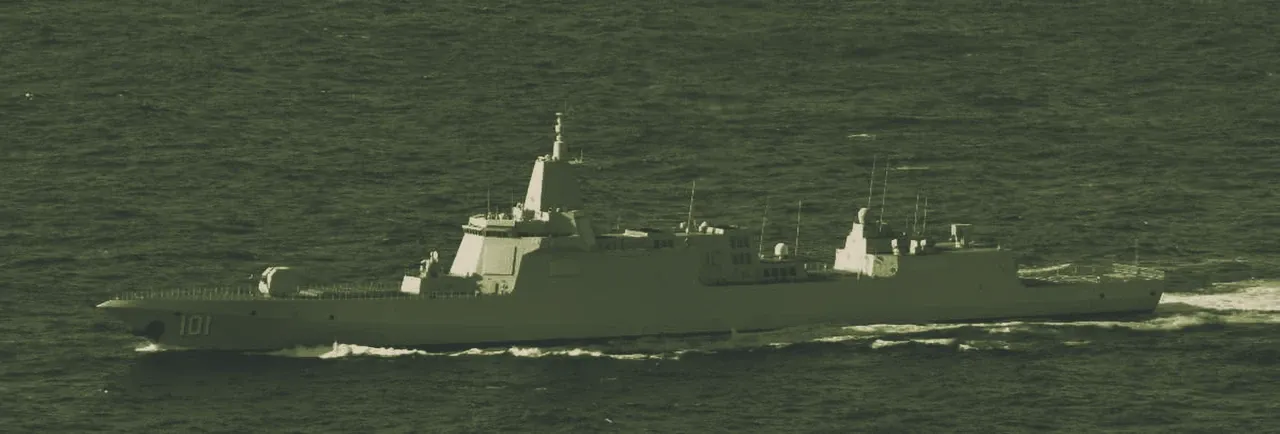
China's largest and most powerful surface combatant — a 12,000-ton multi-mission destroyer with 112 universal VLS cells, built as the PLAN's carrier-strike-group escort flagship.
Overview
The Type 055 (PLAN designation; Western reporting name Renhai-class) is a large guided-missile destroyer that the US Department of Defense and Office of Naval Intelligence classify as a cruiser because of its displacement, which exceeds that of the Russian Slava-class and US Ticonderoga-class cruisers. Armed with 112 universal vertical-launch cells, an advanced dual-band AESA radar suite, and space for two helicopters, it is the People’s Liberation Army Navy’s premier surface combatant — built to escort aircraft carriers, conduct long-range strike, and project power across the Western Pacific and Indian Ocean. Naval Technology and Business Insider both describe it as the most potent warship China has ever produced.
Development
The Type 055 was designed and built by a collaborative effort between Jiangnan Shipyard (Shanghai) and Dalian Shipbuilding (DSIC). The lead ship, Nanchang (pennant number 101), was commissioned in January 2020, after a construction program that reportedly began around 2014. The US Department of Defense noted the Type 055’s rapid fielding as a “step change” in PLAN surface warfare capability. By early 2026, approximately eight hulls were in service, with additional units under construction, according to USNI News. The program remains a high-priority part of China’s naval modernization, with serial production continuing across both shipyards.
Design & capabilities
Displacing an estimated 12,000–13,000 tonnes at full load, the Type 055 is heavier than a Ticonderoga-class cruiser, though the PLAN classifies it as a destroyer. Its COGAG propulsion (four QC-280 gas turbines, about 28 MW each) drives two shafts for a top speed in excess of 30 knots and a range of roughly 5,000 nautical miles at 18 knots. The centerpiece of its combat power is a 112-cell universal VLS — 64 cells forward and 48 aft — that can hot-launch a mix of area-defence SAMs (HHQ-9B), anti-ship/land-attack cruise missiles (YJ-18, YJ-100, CJ-10 family), and rocket-boosted torpedoes (Yu-8). A 130 mm H/PJ-38 gun, a Type 1130 close-in weapon system, an HHQ-10 rolling-airframe missile launcher, and 324 mm torpedo tubes round out the close-in and anti-submarine layers.
The class is built around a Type 346B “Dragon Eye” dual-band AESA radar mounted in four fixed-face arrays, providing simultaneous volume-search, tracking, and fire-control functions. A comprehensive hull, towed, and variable-depth sonar suite, coupled with ESM/ECM sensors, gives the ship robust ASW and electronic warfare capability. Aviation facilities include a large flight deck and a hangar that can accommodate up to two medium-lift helicopters (Z-9, Z-20F, or Z-18). Detailed specifications are compiled by the US Army’s ODIN WEG.
Variants
No formally designated sub-variants exist. Later-batch ships incorporate incremental upgrades to sensors, electronic warfare suites, and combat-management software, but the baseline design remains consistent.
Combat record / operational use
The Type 055 has no combat experience. It has conducted out-of-area presence missions — including Western Pacific transits and Indian Ocean deployments — as part of carrier-strike groups centered on the Liaoning or Shandong carriers. In March 2026, two newly commissioned Type 055s were assigned to a Taiwan-focused command, signalling the class’s central role in possible conflict scenarios across the Taiwan Strait, as reported by USNI News.
Advantages
- Magazine depth: 112 universal VLS cells — more than any active Western destroyer and comparable to the retiring US Ticonderoga cruisers — allow a large mix of SAMs, cruise missiles, and anti-submarine weapons.
- Sensor power: The Type 346B dual-band AESA provides four-panel coverage, reducing reaction time and enabling simultaneous air-defense and strike operations.
- Multimission flexibility: A single VLS cell type can host area-defence, land-attack, anti-ship, and ASROC family rounds, giving commanders tactical flexibility that few other navies can match.
- Heavy displacement: At ~13,000 tonnes, the ship can absorb modular upgrades, carry a large helicopter detachment, and sustain long-range deployments without immediate replenishment.
- Serial production pace: With two yards building hulls concurrently, the PLAN is growing its Type 055 fleet faster than any other large combatant program outside the United States.
Drawbacks / limitations
- No combat record: All assessments of sensor and missile performance rely on manufacturer or PLAN claims; the system remains unvalidated in a high-end shooting war.
- Vulnerable like any large surface combatant: Its size, radar signature, and magazine make it a high-value target for anti-ship missiles, submarines, and long-range strike.
- Unit cost: At an estimated ~US$900 million per ship, the Type 055 is an expensive asset — a loss would carry outsized fiscal and political consequences.
- Dependence on unverified propulsion: The QC-280 gas turbines are Chinese-built, but their reliability and time-between-overhaul figures are not publicly established.
- Still maturing: Early hulls likely lack the sensor and combat-system upgrades of later batches, meaning the fleet is not a uniform capability set.
Counterparts
- Arleigh Burke-class (USA)
- Admiral Gorshkov (Russia)
Outlook
The Type 055 is the backbone of China’s ambition for a blue-water surface fleet and will remain in serial production for the foreseeable future. Its growing numbers allow the PLAN to field carrier-strike groups that can contest sea control far from the mainland, though the class’s lack of combat experience leaves significant uncertainty about its real-world lethality and survivability. The US Department of Defense’s annual report to Congress continues to highlight the Type 055 as the most advanced indigenous Chinese surface combatant, and the class is expected to anchor future PLAN task forces in the Western Pacific and beyond. USNI News
Key specifications
| Spec | Value |
|---|---|
| Type | Large guided-missile destroyer (US classifies as cruiser) |
| Full-load displacement | ~12,000–13,000 t (est.) |
| Length / beam / draft | 180 m / 20 m / 6.6 m |
| Propulsion | COGAG — 4 × QC-280 gas turbines (~28 MW each), 2 shafts |
| Max speed (kts) | >30 kts |
| Range / endurance | ~5,000 nm at 18 kts |
| Complement | >300 (est.) |
| Armament | 112 universal VLS (HHQ-9B, YJ-18, YJ-100, CJ-10, Yu-8); 1 × 130 mm H/PJ-38 gun; H/PJ-11 (Type 1130) CIWS + HHQ-10 RAM; 324 mm Yu-7 torpedoes |
| Sensors / combat system | 4 × Type 346B “Dragon Eye” dual-band AESA; hull + towed + variable-depth sonar; ESM/ECM |
| Aviation facilities | Flight deck and hangar for up to 2 × Z-9, Z-20F, or Z-18 helicopters |
Sources
- Naval Technology — Type 055 Class Destroyers. https://www.naval-technology.com/projects/type-055-class-destroyers/
- USNI Proceedings — Type 055 Renhai-class Cruiser: China’s Premier Surface Combatant. https://www.usni.org/magazines/proceedings/2023/march/type-055-renhai-class-cruiser-chinas-premier-surface-combatant
- Business Insider — Inside China’s Largest Destroyer, the $920 Million Type 055. https://www.businessinsider.com/china-largest-destroyer-most-powerful-055-lhasa-renhai-nanchang-zumwalt-2022-6
- USNI News — Chinese Navy’s New Type 055 Destroyers Join Taiwan-focused Command. https://news.usni.org/2026/03/11/chinese-navys-new-type-055-destroyers-join-taiwan-focused-command
- US Army ODIN WEG — Type 055 Class (Renhai Class) Chinese Guided Missile Cruiser. https://odin.t2com.army.mil/WEG/Asset/Type_055-Class_(Renhai_Class)_Chinese_Guided_Missile_Cruiser
- USNI News — Report to Congress on Chinese Naval Modernization. https://news.usni.org/2025/05/01/report-to-congress-on-chinese-naval-modernization-21