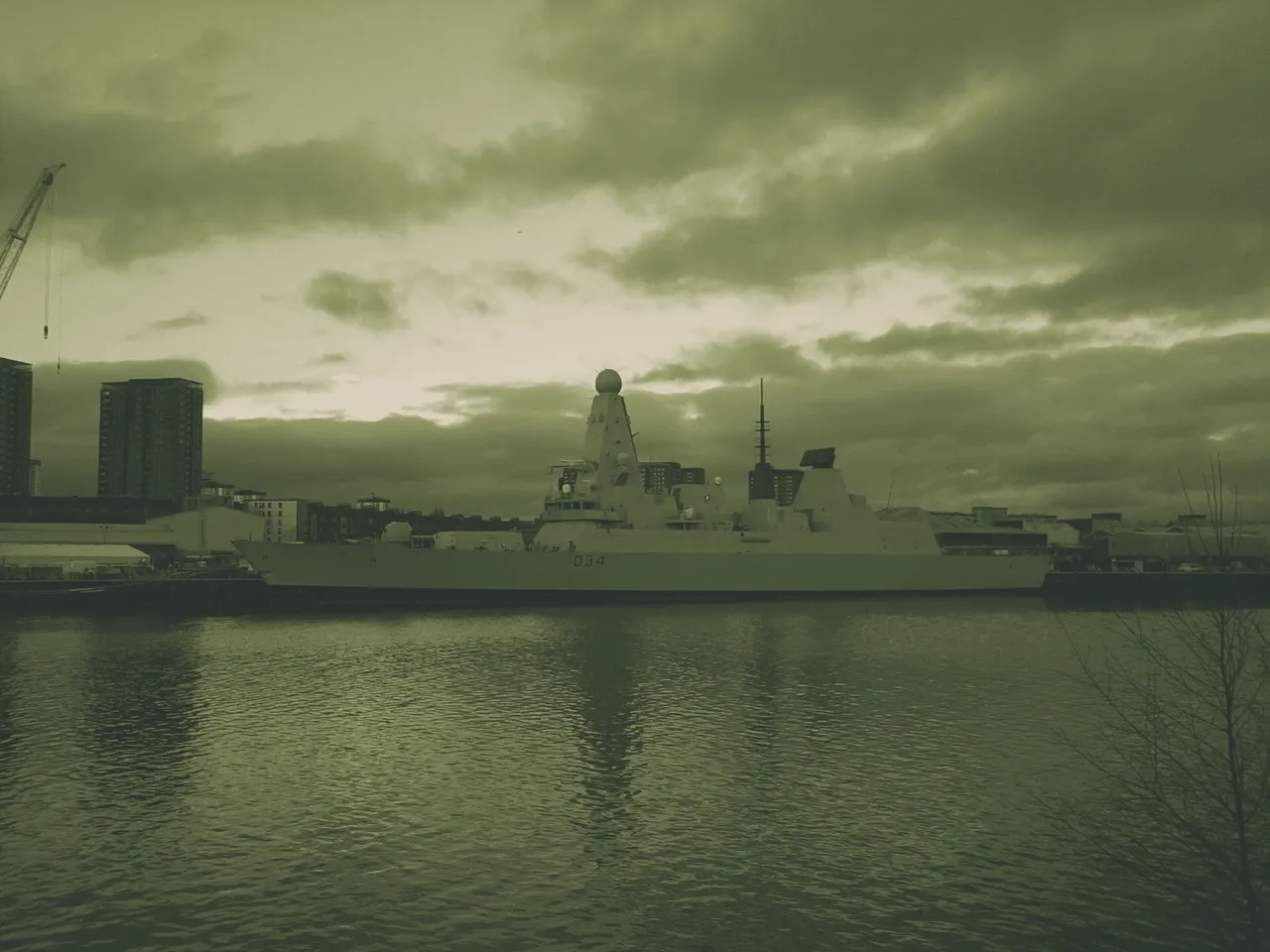
Type 45 Daring
The Royal Navy's specialist area air-defence destroyer — built around the SAMPSON AESA radar and the Sea Viper missile system, with a 48-cell Sylver VLS, a symbol of high-end European naval capability and the first RN ship to intercept a ballistic missile since the Gulf War.
Overview
The Type 45, also referred to as the Daring class, is a guided-missile destroyer designed and built for the United Kingdom's Royal Navy. Its primary mission is area air defence — protecting a task group against saturation attacks by anti-ship missiles and aircraft — although it has operated increasingly in a general-purpose multirole capacity. Six ships were built between the mid-2000s and 2013, and the class remains the Royal Navy's most capable surface combatant, undergoing a rolling programme of propulsion remediation, sensor evolution, and missile integration.
Development
The Type 45 emerged from the trilateral Horizon Common New Generation Frigate project, which the UK left in 1999, choosing to develop a bespoke national air-defence platform. BAE Systems was contracted to build six hulls at its Clyde shipyards, the first of which, HMS Daring, entered service in 2009, according to BAE Systems. The class was completed in 2013 with the commissioning of HMS Duncan. The programme was not exported, but its sensor and missile architecture — combining the SAMPSON radar and the PAAMS-derived Sea Viper system — gave the Royal Navy a capability leap over its Cold War-era air-defence ships.
Design & capabilities
The Type 45's architecture is built around the SAMPSON multifunction active electronically scanned array (AESA) radar, housed in a distinctive spherical masthead dome, and the long-range S1850M search radar. Together they feed the Sea Viper weapon system, which controls a 48-cell Sylver A50 vertical launch system able to fire Aster 15 and Aster 30 missiles. The arrangement allows the destroyer to track hundreds of air targets and engage the most dangerous simultaneously. As detailed by USNI Proceedings, the Type 45's integrated full-electric propulsion (IFEP) uses two Rolls-Royce WR-21 gas turbines and diesel generators to drive electric motors, giving a top speed of about 27–30 knots and a range of around 7,000 nautical miles. Displacement is 7,500–8,500 tonnes at full load, and the complement is approximately 190 personnel.
Close-in defence is provided by two Phalanx CIWS mounts, and the class was built with space for but initially without anti-ship missiles; a programme to add the Naval Strike Missile (NSM) or Harpoon is underway. The introduction of CAMM / Sea Ceptor in a quad-packed fit will expand the missile load beyond the existing Sylver cells. The flight deck can operate a single Wildcat HMA2 or Merlin HM2 helicopter. These specifications are corroborated by Wikipedia.
Variants
No distinct variants exist. The class is being upgraded in place through the Power Improvement Project, which addresses chronic WR-21 gas-turbine failures by adding additional diesel generating capacity, and through the Sea Viper Evolution programme, which expands the missile inventory with CAMM and upgraded Asters.
Combat record / operational use
HMS Diamond became the first Royal Navy warship to use Sea Viper in combat in December 2023, shooting down a Houthi one-way attack drone in the Red Sea. On 24 April 2024, the same ship destroyed a Houthi ballistic missile with a single Aster 30 — the Navy's first ballistic-missile intercept since the 1991 Gulf War, as recorded by Wikipedia. The class has sustained a persistent Red Sea presence during the 2023–2025 Houthi crisis, demonstrating real-world anti-air and anti-ballistic-missile capability that had for years existed only on paper. Earlier, the class had been dogged by propulsion reliability problems that limited operational availability, a shortfall the Power Improvement Project is now rectifying.
Advantages
- SAMPSON AESA radar and Sea Viper provide one of the highest-fidelity air-defence pictures in any surface combatant.
- 48 Sylver A50 cells carrying Aster 15/30 give layered area defence and a proven ballistic-missile intercept capability.
- Integrated full-electric propulsion permits quiet, efficient cruising and flexible power management.
- Small complement (~190) compared with similar-sized destroyers, lowering personnel costs.
- Endurance of ~7,000 nm enables sustained task-group escort without frequent replenishment.
Drawbacks / limitations
- A 48-cell VLS magazine is relatively small for a modern air-defence destroyer, limiting the missile load before reload is required.
- The WR-21 gas-turbine intercooler-recuperator design led to repeated propulsion failures, requiring an expensive fleet-wide fix.
- Until the CAMM upgrade, the ship lacked a point-defence missile layer between the CIWS and the Aster family.
- No indigenous anti-ship missile fit has been fielded, leaving the class reliant on helicopter-borne weapons or allied assets for surface warfare.
- The class size of six ships constrains the Royal Navy's ability to sustain task-group air defence across multiple commitments simultaneously.
Counterparts
- Arleigh Burke-class (USA)
- Type 052D (China)
Outlook
The Type 45 will remain the backbone of Royal Navy air defence into the 2030s. The Power Improvement Project is restoring propulsion reliability, while Sea Viper Evolution and the addition of CAMM will increase both magazine depth and close-range lethality. Its combat debut in the Red Sea has validated the destroyer's design premise, shifting the conversation from propulsion troubles to operational success, and ensuring the class will continue to escort the Queen Elizabeth-class carriers on global deployments.
Key specifications
| Spec | Value |
|---|---|
| Type | Guided-missile air-defence destroyer |
| Full-load displacement | 7,500–8,500 t |
| Length / beam / draft | 152.4 m / 21.2 m / ~5.7 m |
| Propulsion | Integrated Full Electric Propulsion (IFEP): 2 × Rolls-Royce WR-21 gas turbines + diesel generators, electric drive |
| Max speed (kts) | 27–30 |
| Range / endurance | ~7,000 nm |
| Complement | ~190 |
| Armament | 48 × Sylver A50 VLS (Aster 15/30); CAMM/Sea Ceptor (being added); 1 × 4.5-in Mk 8 gun; 2 × Phalanx CIWS; fitted-for NSM/Harpoon |
| Sensors / combat system | SAMPSON multifunction AESA, S1850M long-range radar, CMS-1 |
| Aviation facilities | Flight deck and hangar for 1 × Wildcat HMA2 or Merlin HM2 |
Sources
- BAE Systems — Destroyers (Type 45). https://www.baesystems.com/en/product/destroyers
- USNI Proceedings — "The Impressive Type 45 Air-Defense Destroyer." https://www.usni.org/magazines/proceedings/2021/july/impressive-type-45-air-defense-destroyer
- Wikipedia — Type 45 destroyer. https://en.wikipedia.org/wiki/Type_45_destroyer