A 160-year-old engine maker in Ulm is building Germany's newest battlefield robot
Helsing, Quantum Systems and Stark raised $3.5 billion between them this summer. The deal terms underneath show all three scaling on production capacity they do not own.
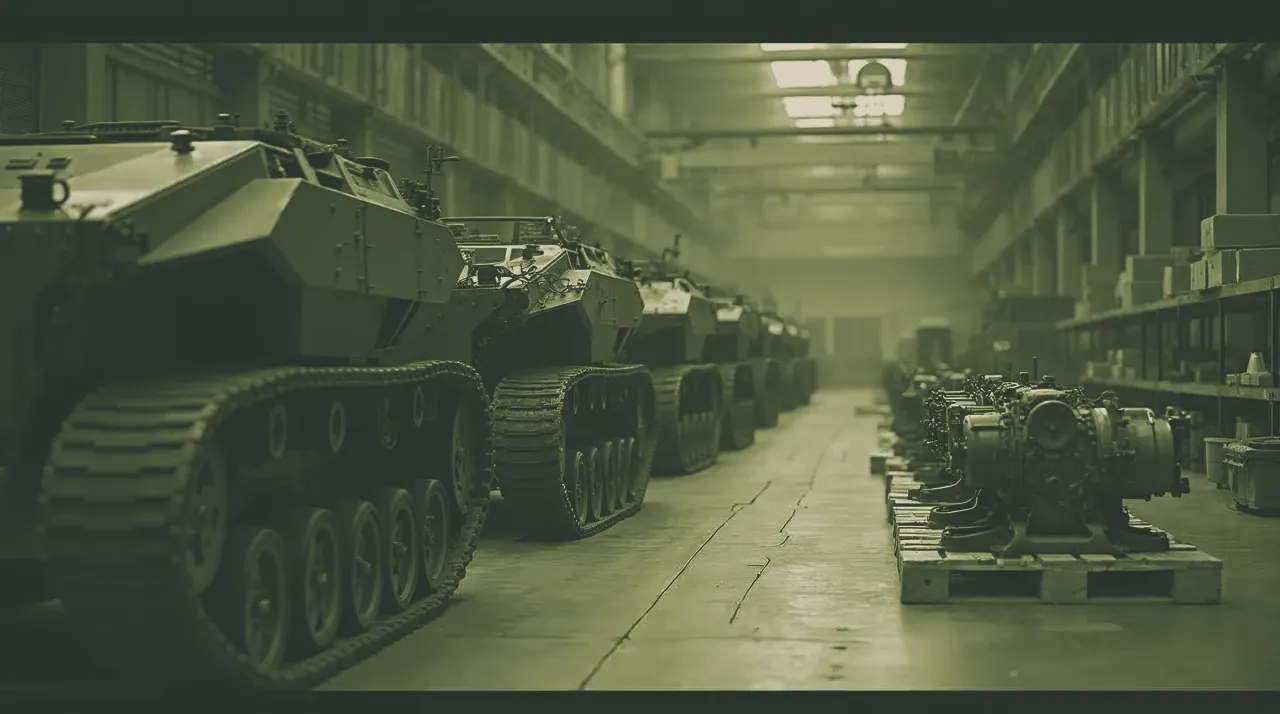
Helsing, Quantum Systems and Stark raised $3.5 billion between them this summer. The deal terms underneath show all three scaling on production capacity they do not own.
What happened
DEUTZ AG has been building engines in Cologne since 1864. On 7 July the company said series production of the GEREON unmanned ground system had begun on a line at its Ulm plant, with the first units due in Ukraine from late summer. GEREON is designed by ARX Robotics, a Munich firm founded in 2022 by former Bundeswehr officers.
Three German defense-technology companies raised money at scale over the same stretch. Helsing closed a $1.8 billion Series E on 13 July at an $18 billion valuation, the largest private round yet raised by a European defense-technology company, per Defense News. Quantum Systems signed $1.2 billion on 2 July at about $8 billion post-money. Stark took €500 million in June at a reported €3.2 billion.
The valuations describe software companies. The contracts underneath them describe something else. Each of these firms is scaling on production capacity it does not own.
DEUTZ builds the robot, ARX writes the software
Under the published terms, the two companies are building an interface between ARX's Mithra OS and DEUTZ drivetrains, battery-electric first, smaller combustion and hybrid units later. DEUTZ supplies field energy infrastructure: generators, storage, swappable batteries. It also opens its global production and service network, which is what decides whether a vehicle several hundred kilometres east of Ulm gets repaired or written off.
Marco Herre, who runs the DEUTZ defense unit, called his company's contribution "industrial scaling potential." Marc Wietfeld, ARX co-founder and chief executive, named the dependency directly. "Europe's defense capability depends not only on innovation, but also on industrial scaling," he said.
Airbus made the same bet with capital. It co-led Quantum Systems' $1.2 billion round alongside Blackstone, Noteus and Advent, and Airbus Defence and Space agreed at the same time to deepen a strategic collaboration. Chief executive Michael Schoellhorn described a shift in what a prime does: "Airbus' role as a large defence prime is evolving into that of an architect and ecosystem builder." Helsing shares the FCAS AI backbone with Rohde & Schwarz and builds satellites with OHB through their KIRK venture. Rheinmetall runs a satellite-manufacturing venture with ICEYE. Dassault Aviation led Harmattan AI's $200 million round. ARX works with Daimler and RENK, according to Deeptech.build.
Alpine Eagle does not build its own airframe. The Munich counter-drone company integrates the DeltaQuad Evo from a Dutch manufacturer, and co-founder Jan-Hendrik Boelens gave Tech.eu an industrial rather than technical reason. "The facilities, permits, and production processes are already in place in the Netherlands," he said. "As a result, we can scale output rapidly, from several hundred units to more than a thousand per month."
Ukraine went from 7,495 robot missions in January to 16,676 in June
Monthly missions flown by Ukrainian unmanned ground vehicles rose from 7,495 in January to 16,676 in June, an increase of roughly 122 percent, with more than 66,000 logged across the first half of 2026, United24 Media reported, citing defense ministry figures. The number of units operating UGVs grew from 117 at the end of 2025 to 230 by mid-2026.
Ukraine took delivery of about 2,000 ground systems in 2024 and roughly 15,000 in 2025. Zelensky set a target in April of at least 50,000 fielded during 2026. Ihor Shmyryov, who heads the UGV department at the Brave1 platform, told Forbes that 25,000 were contracted in the first half of this year alone, twice the total for all of 2025. A study by the KSE Institute, Brave1 and Defense Builder found the market grew 488 percent in 2025.
The constraint that emerged is industrial. Shmyryov counts around 270 Ukrainian manufacturers turning out some 550 models, and Yuliia Trybushna of NUMO Robotics told ASPI's The Strategist that only 20 to 25 of them produce at any scale. Ukrainian officers describe fleets running different motors, different parts and different power connectors.
Trinity Robotics is doubling output to around 2,200 units this year and looking for a European partner. Co-founder Oleksii Konik told Defense News what he needs: "manufacturers from Europe that manufacture trucks, vehicles, military parts." ARX formed ARX Industries with Ukraine's Roboneers in June to build the Rys Pro across German and Ukrainian sites, targeting thousands of units in the first year.
Quantum Systems has been assembling the same kind of position. Its systems flew more than 19,000 missions in Ukraine during 2025, the company said, and in March it contracted to supply 15,000 Strila interceptor drones to Ukraine's National Guard under German government funding, alongside a strategic investment in the Ukrainian manufacturer WIY Drones, per Deeptech.build. The Bundeswehr separately ordered 520 Falke surveillance systems for €210 million.
Where the joint ventures break
Milko Pavlov and Anita Bucanac value these deals for a living at Houlihan Lokey, and their verdict in Defense News on 25 June was that most of them underdeliver. European incumbents, they wrote, are "pairing 21st-century software with 20th-century instincts," and the joint ventures meant to turn ideas into mass-produced capability "too often stall before they deliver."
Three of the failure modes they identify apply directly to the July deals. Lengthy approval processes may be routine for large companies, but they can exhaust a startup's cash. ARX faces that risk by tying GEREON production to the factory schedule of a listed engine manufacturer. The authors also warn that hardware-focused valuations can overlook the software partner's contribution, a particularly stark mismatch in Helsing's case: the company is valued at $18 billion despite holding few tangible assets. Vague intellectual-property terms pose a further danger. They can lock an innovator into one partnership and prevent it from serving other customers later.
Germany's procurement system remains the slower-moving part of the equation. In Bitkom's DefTech Report 2026, 76 percent of surveyed German defense-tech founders rated the country's defense capabilities as weak, despite a defense budget of €108.2 billion, up from €50.3 billion in 2022. Many pointed to the slow pace of procurement. GovRadar's KI-PROcure tool illustrates the problem: several areas of the Bundeswehr tested it successfully, yet it has still not entered the planned operational phase, according to Xpert.digital. A CDU/CSU parliamentary paper proposes 71 procurement reforms and acknowledges that agencies often fail to use simplifications already permitted under the 2022 acceleration law.
Who ends up owning the stack
Quantum Systems deliberately sought international investors for the round, chief financial officer Jonas Jarosch said, as part of its ambition to become "the international neoprime based in Europe." Schoellhorn describes a different hierarchy: Airbus at the center, surrounded by startups in an ecosystem it brings together.
DEUTZ's Ulm production line and global service network rest on 160 years of industrial experience. Airbus brings the certifications and established program relationships of a prime contractor. Such assets take far longer to build than an autonomy stack and, judging by the July deals, are now the scarcer part of the equation.
Munich defense-tech companies raised $1.7 billion in venture capital in 2025, more than those in London or Cambridge, which attracted $1.2 billion each, according to Dealroom and NATO Innovation Fund data cited by the McLean Partnership. The same analysis, drawing on Russell Investments, estimates that US and Asian investors provide 40 to 65 percent of the capital for European defense-tech companies at later funding stages. Europe's bid for technological sovereignty still relies heavily on money from outside the continent.
Florian Seibel, who co-founded Quantum Systems and Stark both, says the winners "already do exist and already have a certain size," and that Quantum now has the money to buy. On merging his two companies he has stayed noncommittal: "maybe one day we will add those two together, maybe not." A Stark spokesperson said there are no plans to.
What to watch
- Whether GEREON units built at Ulm reach Ukrainian brigades by late summer, as DEUTZ committed.
- Whether ARX Industries delivers the thousands of Rys Pro vehicles it targeted in year one, and how much of that output comes from the German sites rather than the Ukrainian ones.
- Whether the Bundeswehr converts Helsing's initial €269 million HX-2 contract toward the €1.46 billion framework ceiling. That would be the first test of German procurement running at software speed.
- Whether any German defense-tech pilot crosses into planned operational use this year. GovRadar's has not, after rollout across several Bundeswehr areas and a positive evaluation.
Frequently Asked Questions
What exactly did DEUTZ agree to build for ARX Robotics?
DEUTZ said on 7 July that it had started series production of the GEREON unmanned ground system at its plant in Ulm, with first units due in Ukraine from late summer. Per the company's announcement, the two firms are also building an interface between ARX's Mithra OS and DEUTZ drivetrains, and DEUTZ is supplying field energy infrastructure plus access to its global production and service network.
How much did German defense-tech companies raise this summer?
Roughly $3.5 billion across three rounds. Helsing closed $1.8 billion on 13 July at an $18 billion valuation, which Defense News called the largest private round yet raised by a European defense-technology company. Quantum Systems signed $1.2 billion on 2 July at about $8 billion post-money, and Stark took €500 million in June at a reported €3.2 billion.
Why does Ukraine's demand for ground robots matter to German startups?
Because it is a volume problem, not a software problem. Ukrainian UGV missions rose from 7,495 in January to 16,676 in June, United24 Media reported citing defense ministry figures, and Zelensky set a target in April of at least 50,000 vehicles fielded during 2026. Brave1's Ihor Shmyryov counts around 270 Ukrainian manufacturers but told ASPI's The Strategist, alongside NUMO Robotics' Yuliia Trybushna, that only 20 to 25 produce at any scale.
Is Airbus a partner or an investor in Quantum Systems?
Both. Airbus co-led the $1.2 billion Series D alongside Blackstone, Noteus and Advent, and Airbus Defence and Space agreed at the same time to deepen a strategic collaboration. Chief executive Michael Schoellhorn described the arrangement as evidence that "Airbus' role as a large defence prime is evolving into that of an architect and ecosystem builder."
What is the main risk to this model?
That the joint ventures stall. Milko Pavlov and Anita Bucanac of Houlihan Lokey argued in Defense News on 25 June that European incumbents are "pairing 21st-century software with 20th-century instincts," and that such ventures "too often stall before they deliver," citing approval cycles, control over technical decisions, valuation mismatches and unresolved IP terms.
Is German procurement keeping up with the money?
Not yet. The Bitkom DefTech Report 2026 found 76 percent of surveyed German defense-tech founders still rate national defense capability weak, blaming procurement speed, in a year when the defense budget reached €108.2 billion against €50.3 billion in 2022. GovRadar's KI-PROcure tool was piloted across several Bundeswehr areas and evaluated positively but has still not crossed into planned operational use, according to Xpert.digital.
AI-generated summary, reviewed by an editor. More on our AI guidelines.

Marcus Schuler
Marcus Schuler edits BattlePolicy, a daily defense-technology brief connecting the companies and capabilities behind modern war to the contest among Europe, the US, Russia, and China.