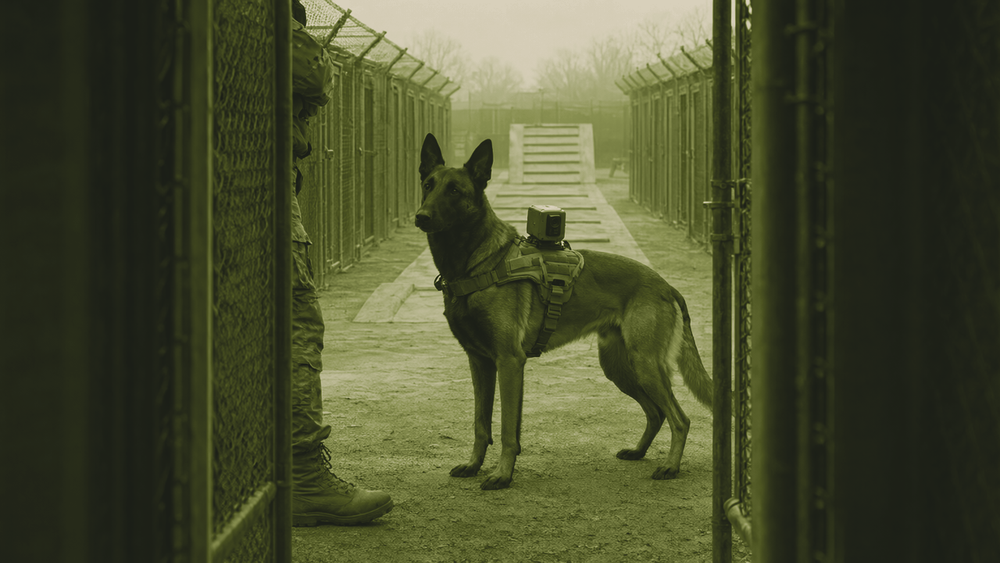
A Sequoia-led seed round values a company with no dogs yet at $1.2 billion, betting that cloned, gene-edited working dogs wired into Anduril's kit can replace the Pentagon's European supply.
Europe's most valuable defense startup is buying into the Dutch maker of the Ruta cruise missile, and Bloomberg puts its minority stake at a roughly €6 billion valuation.
Kyiv says money, not factory space, caps its drone output, and EU loan money already pays for Ukrainian drones. The extra €70 billion it wants for 2027 has no source yet.
Dealroom forecasts a record $10.5B for European defence startups in 2026, but mega-rounds are over 85% of it and US investors supply 47%. Russia's jet drones set the test.
Blackstone has combined TSC and ASEI into Falcata, a company built to expand output of the seekers, guidance electronics and navigation systems inside the cheaper interceptors needed against mass drone and missile threats.
The Portuguese-founded drone maker is now valued at $6.4 billion, roughly five times its 2025 mark, and plans to spend part of the round buying rivals.
The next funding phase moves Avalon Holographics toward an OLED flat panel, the cost cut that decides whether its mission-planning display ever leaves the operations center.
Anthem pairs a heavy payload with commercial parts, four-deep supplier lines and three factories, a manufacturing answer to thin Western missile stocks.
Russia's budget law called for a cut in military spending this year. Instead outlays rose 30 percent to a record 43.8 percent of federal spending, and two-thirds of that budget is now hidden.
The ousted defense minister has found American capital for his procurement-and-data model while Kyiv's own export channel has issued no permits and charges 20% to 30% up front.
Quantum Systems' co-CEO says In-Q-Tel's Washington connections, not its capital, built the $8 billion German drone maker's first US government business.
The Nigerian drone maker raised $52 million on a pitch about defense sovereignty, then aimed its expansion at Western capital and procurement institutions.
Castelion's $1 billion Series C at a $13 billion valuation puts private money behind a Pentagon production plan that still depends on successful tests, a procurement contract and Congress.
Heaviside's $60 million Series B came with a warhead-supply agreement from Nammo, the Norwegian maker with 27 production sites. The startup still has no named program and no delivery date.
Lyntris priced below range, cut its IPO by seven million shares and fell 11.4% on debut. Public investors now want GAAP profit, lower leverage and core growth from defense tech, while private capital still entertains an Anduril valuation near $100 billion.
Prime contractors have joined a record $4.1 billion of venture rounds in 2026, per Dealroom. PitchBook's segment data shows the capital concentrating in autonomy software and systems integration rather than in platforms.
Reuters says investors are weighing a two-stage deal that would price the nine-year-old drone maker near Lockheed Martin's market value, a day after Bloomberg reported its Rheinmetall partnership shrank.
Helsing, Quantum Systems and Stark raised $3.5 billion between them this summer. The deal terms underneath show all three scaling on production capacity they do not own.
Forbes puts named contracts on a $1.2 billion startup whose only customer is the Pentagon and whose software runs offensive cyber campaigns hundreds at a time.
The largest round a European defense startup has ever raised lands with a heavily American investor syndicate, even as Helsing insists it stays European-owned and keeps arming Ukraine's front.
Ukraine's Brave1 pulled the months-old YC startup to Kyiv before it even held an export license, a measure of how much front-line demand now rides on the counter-drone integration layer.
The Munich reconnaissance-drone maker more than doubled its valuation in under a year, and its co-CEO says the cash is for acquiring rivals in a crowded European market.
The €3.9 billion is the first defense payout of the EU's €90 billion Ukraine Support Loan, and it is walled off to one thing: buying Ukrainian-made drones.
A year-old Ottawa startup whose sensor network already rode with the Canadian Rangers raised $139M, the largest Series A in Canadian defense history, as Ottawa rearms the north.
A two-year-old Berlin loitering-munition maker is now one of Europe's best-funded defense startups, with US capital and the NATO Innovation Fund underwriting factories over software.
UVision wants up to $4 billion on Nasdaq, Shield AI just closed a deal at a $12.7 billion valuation, and Stark's round swelled to €500 million, even as public defense stocks fall and the war the money keeps citing is being won by $500 drones.
STARK is reported in talks to raise €300M at €2.5B. Its German contract carries qualification gates and a cap, and its Virtus drone has both struck targets in Ukraine and missed them in Western trials.
Twenty becomes a unicorn selling AI systems built to carry out US cyber attacks, a corner of national security that venture capital has mostly stayed out of.
Venture funding for defense-tech startups hit $14.6 billion in five months of 2026, beating all of last year, with Anduril, Shield AI and Saronic taking most of it.
ICEYE closed a Series F worth over €1bn at a €10bn-plus valuation, a record European spacetech round, to scale the radar constellation Ukraine already uses to find Russian targets.
Swarmer's Nasdaq debut, a wave of Western venture money and a Pentagon FPV contract show Ukrainian defense tech crossing from battlefield to balance sheet, at a valuation that has outrun the revenue.
A bipartisan House forced through $8 billion in military loans and USAI funding to 2027, but the package still has to clear a Republican Senate and an opposed White House before it buys a single interceptor.
A rising share of UK defence companies are being refused overdrafts and working capital, Make UK Defence told the Treasury Committee, blaming the stalled Defence Investment Plan.
Defense-tech venture funding hit a record $14.6 billion in the first five months of 2026, per Crunchbase. The companies drawing the biggest checks build what Ukraine's front increasingly runs on: cheap, mass-produced autonomy.
Mach Industries raised a $300M Series C at a $1.8B valuation to expand its Forge factory network, the latest sign that defense-tech money is moving from prototypes to mass production.
Motorola is paying $1.5 billion for a counter-drone firm whose RF takeover seizes a drone's control link, the same link Ukraine's fiber-optic drones are built to fly without.
Defense Minister Mykhailo Fedorov has put about $113 million behind a campaign of mid-range drone strikes on Russian supply lines. ISW links the pressure to Russia's first monthly territorial loss since 2024.