Record Defense-Tech Funding Is a Bet on Ukraine's Cheap-Drone Lesson
Defense-tech venture funding hit a record $14.6 billion in the first five months of 2026, per Crunchbase. The companies drawing the biggest checks build what Ukraine's front increasingly runs on: cheap, mass-produced autonomy.
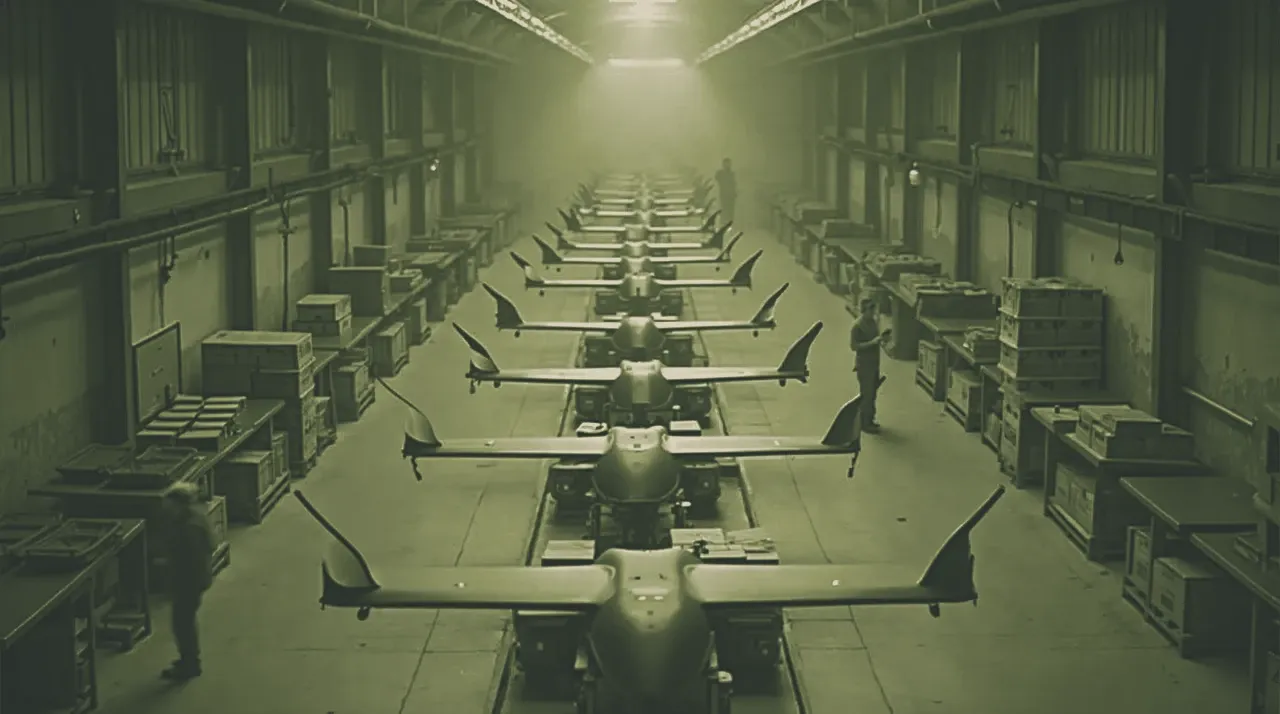
Defense-tech venture funding hit a record $14.6 billion in the first five months of 2026, per Crunchbase. The companies drawing the biggest checks build what Ukraine's front increasingly runs on: cheap, mass-produced autonomy.
Defense startups have taken in more than $14.6 billion in venture funding in the first five months of 2026, already past the sector's previous full-year record of $9.6 billion set in 2025, according to Crunchbase data published June 2. The sector raised $1.6 billion in all of 2020 and held between roughly $2.8 billion and $3.8 billion from 2022 through 2024 before the jump to $9.6 billion last year, Crunchbase wrote. A decade ago, defense tech was a niche and even controversial corner of venture capital, according to Crunchbase, with few investors willing to back companies working with the military. Five months into this year, the field has already cleared the 2025 record.
The checks are concentrating in a short list of companies that build autonomous systems and promise to produce them at volume, Crunchbase's data shows. The same logic is playing out on the Russia-Ukraine front, where uncrewed systems have started to decide who holds ground, Defense One noted June 1, citing the Institute for the Study of War. Investors and front-line commanders are now pointing at the same variable: how many cheap autonomous systems a side can build and field.
Anduril, Shield AI and Saronic take the biggest checks
The largest single contributor to the surge is Anduril Industries, according to Crunchbase. The Costa Mesa company raised a $5 billion Series H in May that doubled its valuation to $61 billion from $30.5 billion a year earlier, TechCrunch and CNBC wrote. Anduril said the money would go to manufacturing capacity and research, and Washington Technology noted it was not raised as a fund for acquisitions.
Shield AI, an autonomous-aviation firm, raised a $2 billion Series G in March led by Advent International and JPMorgan Chase, per Crunchbase, and Saronic, which builds unmanned surface vessels, secured a $1.75 billion Series D led by Kleiner Perkins the same month. The US Air Force had earlier picked Shield AI's software to fly with Anduril's "Fury" autonomous jet, a deal that lifted the company's valuation to $12.7 billion, per TechCrunch. So far in 2026 the sector has done fewer deals than last year but moved far more money, with 107 venture rounds announced against 206 in all of 2025, per Crunchbase, a sign the capital is concentrating in the largest companies.
The money is not only American. Germany's Helsing is closing a $1.2 billion round at roughly an $18 billion valuation, led by Dragoneer and Lightspeed, the Financial Times wrote, which would rank the AI-and-drone maker among Europe's most valuable startups. US venture firms that avoided military work for years are now "voracious," Axios noted June 3, and space startups with defense uses, among them True Anomaly, Sierra Space and Vast, rank among 2026's largest defense-related recipients, according to Crunchbase.
What Mach Industries spent its $300 million on
Mach Industries, a three-year-old startup run by 22-year-old founder Ethan Thornton, raised a $300 million Series C at a $1.8 billion valuation on June 1, roughly four times its mark a year earlier, per TechCrunch. The round was co-led by Infinite Capital and Ribbit Capital, and the Los Angeles Times confirmed the valuation the next day.
Mach is developing five autonomous systems, including the Viper vertical-takeoff strike aircraft and the Dart drone interceptor, and counts the US Army and Air Force among its customers, per TechCrunch. The company has grown from about a dozen employees to roughly 350, runs a 115,000-square-foot plant in Huntington Beach, and plans to open four more production facilities by the end of 2026. In April it paid $50 million for solid-rocket-motor maker Exquadrum, beating more than eight other bidders, TechCrunch detailed. That acquisition secured a supply of rocket motors, a component bottleneck for any company trying to mass-produce strike munitions.
The battlefield and the startup story — free in your inbox every week. No paywall.
Subscribe Free →What the front is proving
Ukraine is now "talking about winning, not just surviving," Defense One wrote June 1, citing Institute for the Study of War analysts who say drones are killing attacking Russian infantry faster than Moscow can replace them, which has blunted the human-wave assaults Russia leaned on for most of the war. ISW treats the shift as durable, the outlet added, tied to how many attacking troops drones can now kill in the open before they reach Ukrainian lines.
Ukraine has used unmanned ground vehicles alongside aerial drones to retake up to 600 square kilometers of territory this year, The National wrote May 30, and Kyiv's commanders plan to replace 30 percent of manpower in the most kinetic frontline zones by buying 25,000 ground robots for attack, logistics and casualty evacuation. Small drone teams have built what soldiers call a "kill zone" reaching well beyond the nominal front, Ynetnews noted, using fiber-optic control links that the jamming meant to stop them cannot break. Ukrainian units also field new drone variants within weeks as Russian countermeasures change, a cycle far shorter than the months Western procurement still takes.
Production volume is something investors can price, and that is where the money is going. Anduril earmarked its $5 billion round for manufacturing capacity and research, per Washington Technology, and Mach is spending its raise to open four plants by the end of 2026, per TechCrunch.
The barrage Ukraine could not fully stop
Russia answered with mass of its own on the night of June 1 to 2, firing 73 missiles and 656 drones in one of its largest aerial attacks of the war, which killed at least 22 civilians and wounded more than 100, according to ISW's June 2 assessment and CBS News. Ukraine downed most of the incoming fire but could not stop all of it, in part because it is short of the US-made Patriot interceptors that knock down ballistic missiles. President Volodymyr Zelensky again tied the civilian deaths to that shortage.
A single Patriot interceptor costs millions of dollars and comes in scarce, export-controlled batches. A long-range attack drone of the kind Ukraine now builds costs a small fraction of that and is launched in the hundreds. Ukraine pressed that advantage on June 3, striking a St. Petersburg oil terminal and a warship with long-range drones as Putin's flagship economic forum opened, per the BBC, even as it absorbed the costlier barrage coming the other way.
The lesson China is studying
The People's Liberation Army would likely have to shift its procurement priorities significantly to produce drones at the scale seen in Ukraine, the Institute for the Study of War concluded in a late-May report on Chinese military adaptation. China is already investing in swarm autonomy. ISW cites a Chinese system able to launch 48 drones from one launcher and coordinate 96 from a single command node, drawing on a commercial drone industry that Beijing's military-civil fusion policy can redirect to defense.
The Center for European Policy Analysis argued in a May report that allied defense-industrial bases are too slow and too tied to legacy programs for a fight built on attritable mass, and that loosening China's grip on the commercial drone supply chain is harder than commonly assumed. Western drone makers still source components such as flight controllers, motors and sensors from China, a dependence CEPA says capital alone cannot quickly resolve.
What to watch
Anduril and Mach now have to convert their record rounds into output, and Mach has said it will bring four more production facilities online by the end of 2026, per TechCrunch. Investors are also watching for exits. AI drone maker Swarmer went public this year with shares up more than 500 percent on its first day, per Crunchbase, which lists Anduril among the most likely defense IPOs still to come. Ukraine, for its part, still depends on scarce Patriot interceptors rather than cheap counters made in volume, and its renewed appeal for more, which Zelensky pressed after the June 2 strikes, remains unanswered.
Frequently Asked Questions
How much venture funding has defense tech raised in 2026?
More than $14.6 billion in the first five months of 2026, already past the sector's previous full-year record of $9.6 billion set in 2025, according to Crunchbase data published June 2.
Which companies are driving the record?
A short list of megarounds. Anduril raised a $5 billion Series H in May at a $61 billion valuation (TechCrunch, CNBC); Shield AI raised $2 billion and Saronic $1.75 billion in March; and Mach Industries raised a $300 million Series C at a $1.8 billion valuation announced June 1, per Crunchbase and TechCrunch.
What is the link between the funding and the war in Ukraine?
The capital is concentrating on companies that build autonomous systems at scale, the same factor deciding ground on the front, where Ukraine has used drones and ground robots to retake up to 600 square kilometers this year and plans to buy 25,000 unmanned ground vehicles, per The National.
Why does Ukraine still suffer heavy strikes if its drones are working?
The war has split into two arms races. Ukraine's cheap attack drones impose attrition going out, but it is short of scarce, expensive US-made Patriot interceptors and could not stop all of Russia's June 1-2 barrage of 73 missiles and 656 drones, which killed at least 22 civilians, per ISW and CBS News.
What does this mean for China?
The PLA would likely have to shift procurement priorities significantly to produce drones at Ukraine's scale, the Institute for the Study of War concluded in a late-May report, even as China invests in swarm autonomy and leans on a large commercial drone base.
AI-generated summary, reviewed by an editor. More on our AI guidelines.

Marcus Schuler
Marcus Schuler edits BattlePolicy, a daily defense-technology brief connecting the companies and capabilities behind modern war to the contest among Europe, the US, Russia, and China.