STARK's €2.5 Billion Valuation Hinges on Bundeswehr Deliveries
STARK is reported in talks to raise €300M at €2.5B. Its German contract carries qualification gates and a cap, and its Virtus drone has both struck targets in Ukraine and missed them in Western trials.
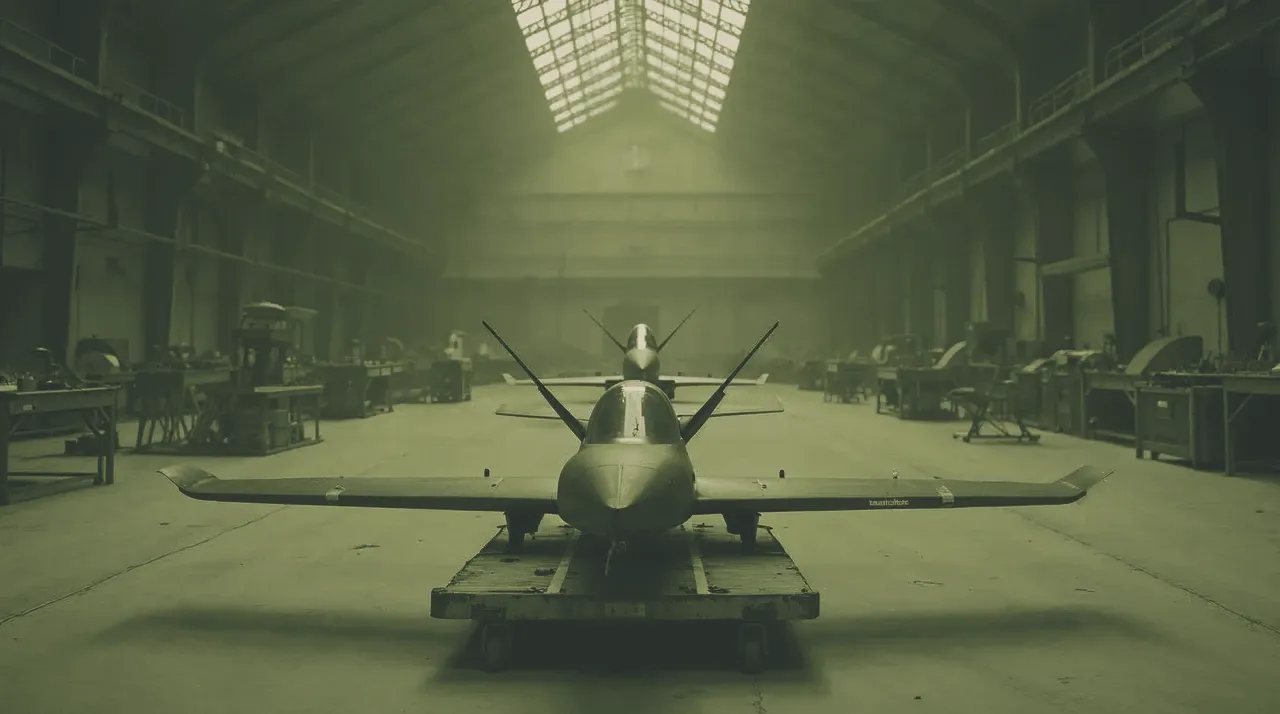
The Berlin loitering-munition maker is reported in talks to raise at least €300 million at about €2.5 billion. Its German contract carries qualification gates and a parliamentary cap, and its Virtus drone has both struck targets in Ukraine and missed them in Western trials.
What happened
STARK, the Berlin loitering-munition maker registered as SKD SE, is in talks to raise at least €300 million at a valuation of about €2.5 billion, the Financial Times reported in late May, a figure The Next Web and Tech Funding News relayed the same week. The round would more than double a valuation that crossed €1 billion only in February. As of this week it is still described as discussions, not a signed close. That price rests above all on one asset: a Bundeswehr framework contract for STARK's Virtus drone, whose future volumes the German parliament has deliberately kept conditional.
The climb to €2.5 billion has been quick. Sequoia led a $62 million round at a $500 million valuation in August 2025, per Tech Funding News, which then tracked fresh funding above €1 billion in February 2026 and the €2.5 billion talks by late May, roughly a fivefold move in nine months. STARK said it agreed a Bundeswehr framework for Virtus after the Bundestag Budget Committee cleared the money on 25 February, with deliveries starting in 2026. Defense News put the initial award at about €268 million split between STARK's Virtus and Helsing's HX-2, with options that could add as much as €1 billion to each should the systems mature and lawmakers sign off. STARK tied the capability to Brigade 45 in Lithuania, which Deutsche Welle reported should be operational by 2027.
The Zaporizhzhia strike and the Kenya trials
In Ukraine, Virtus has hit targets; on British and German trial ranges, it has missed them. UNITED24 Media said Virtus made its combat debut in Ukraine on 23 August, striking a Russian position in Zaporizhzhia after a Quantum Systems Vector reconnaissance drone identified it and passed the coordinates. Ukrainian forces have flown Virtus since summer 2025 across several successful strikes, according to Militarnyi. Against that account, Militarnyi and ClashReport relayed Financial Times reporting that Virtus failed to hit a single target in British and German exercises, including the Haraka Storm drill in Kenya, where one drone crashed into woodland and a battery caught fire on impact.
STARK did not dispute the misses. A spokesperson told Militarnyi the trial events were experimental, and that the Ukraine system uses a different concept of operation, with a separate reconnaissance drone handling targeting rather than one airframe finding and finishing on its own. "We did not crash once or twice, we have crashed a hundred times. That is how we test, develop, and deliver," the company told ClashReport.
The performance figures are STARK's own. The company lists Virtus at more than 130 km of range, up to 90 minutes aloft and a 250 km/h terminal dive carrying a payload of up to 5 kg, none of it independently verified in the public record.
In Ukraine the recce-strike pairing has worked in the field; in the British and German exercises the evaluators did not see it perform on demand. Neither set of reports gives a hit rate, a loss rate or jamming performance, so the public record shows Virtus has been used in combat but not how reliably it works at the volume a national army fields.
Abort milestones, innovation clauses, a €1 billion cap
The Bundeswehr built its loitering-munition contracts to release volume slowly. It describes the model as iterative, with framework agreements, abort milestones and innovation clauses, because software-defined weapons change faster than a standard multi-year program can absorb. Augen Geradeaus published the Budget Committee wording: call-offs beyond the first firm order need renewed parliamentary approval, and framework volume is capped at €1 billion gross per contractor unless the ministry supplies extra justification, a market analysis and performance evidence. Resilience Media, citing FT-obtained procurement documents, had earlier put STARK's theoretical ceiling as high as €2.86 billion. The €1 billion cap overrides that figure unless the ministry goes back to parliament for more.
None of those option ceilings is committed revenue; each is a permission gated behind a qualification milestone and a future Bundestag vote. Under the same model Germany funds early capability while keeping cancellation rights, and releases larger volume only against proof of performance. STARK holds the firm tranche, worth a few hundred million euros; the €1 billion-plus that would make a €2.5 billion price legible depends on qualification results the Bundeswehr has not yet certified.
The battlefield and the startup story — free in your inbox every week. No paywall.
Subscribe Free →A €2.5 billion price on €287,158 of share capital
STARK's registry filing lists share capital of €287,158, and the business registry CompanyHouse records no revenue figure at all, so a €2.5 billion price set roughly 18 months after incorporation rests on expected demand and early awards rather than audited output. PitchBook reported on 19 June that more than €18 billion has gone into European aerospace and defense startups this year, almost matching the 2025 total, while 98% of that deal value involved investors from outside the region, up from 96.5% a year earlier.
STARK's backers run heavily American, from Sequoia and Peter Thiel's Founders Fund to the CIA-linked In-Q-Tel and the NATO Innovation Fund, which makes a German sovereign-strike capability substantially American-financed. Defense News reported that Defence Minister Boris Pistorius told reporters Thiel's stake was a single-digit percentage with no operational access, a statement that narrows the governance question without settling it. PitchBook notes the continent is trying to build an alternative, pointing to a new €500 million Franco-German fund pitched as a domestic source of growth capital. Even the founder record is unsettled, since Tech Funding News named Florian Seibel and Johannes Schaback as STARK's founders while the company's own Bundeswehr release called chief executive Uwe Horstmann a founder, a discrepancy that matters for a firm whose largest customer is a defense ministry.
The listed market has cooled while private valuations like STARK's keep climbing. The Stoxx Europe Aerospace & Defence index is down 1.2% this year against a 4.8% gain for the broad Stoxx 600, and CNBC reported that analysts now read 2026 as a consolidation year in which spending euphoria gives way to scrutiny of earnings and cash flow. "Investors are becoming very picky and very selective," Morningstar equity analyst Loredana Muharremi told CNBC.
The Rheinmetall and Helsing benchmarks
Rheinmetall holds its own Bundeswehr framework for the FV-014 loitering munition, AeroTime reported, with a first call-off near €300 million for roughly 2,500 systems, and it markets the FV-014 as designed from the start for high-volume mass production. STARK has not yet delivered at that scale or earned that prime-contractor standing. Helsing, which carries the parallel Bundeswehr award for its HX-2, is far better funded, and TechCrunch reported it was close to raising $1.2 billion at about an $18 billion valuation, some seven times STARK's reported price. TechCrunch put Anduril's latest round at $5 billion on a $61 billion valuation with 2025 revenue doubled to $2.2 billion, and Quantum Systems, STARK's own targeting partner, raised €340 million in 2025 at above €3 billion on an ISR fleet flown in Ukraine since 2022. Among that set STARK has the shortest delivery record.
STARK's case is that software-defined iteration beats both rivals, letting it field and upgrade faster than Rheinmetall can retool a line and at a lower platform cost than Helsing's AI-first stack. The same iteration speed that lets the company crash a hundred times before it ships, in its own words, is why the Bundeswehr wrote abort milestones into the contract before committing a second tranche.
What to watch
Watch whether the €300 million round closes at €2.5 billion or resets on terms, since the FT still describes it as in discussions. Watch for acceptance and delivery data under the Bundeswehr qualification gates, the only public sign that the firm tranche is becoming serial production rather than another prototype run. The Lithuania timeline for Brigade 45 runs to 2027, and every call-off past the first order has to clear a fresh Budget Committee vote.
STARK is one of the few European defense-tech firms with a weapon in combat use and a national contract in hand at the same time. The number that settles the €2.5 billion question is how many qualified Virtus units reach Brigade 45 before Rheinmetall and Helsing take the German and allied orders.
Illustration. Generated key image, not a photo of the event.
Frequently Asked Questions
Has STARK actually closed the €300 million round?
No. The Financial Times reported in late May that STARK was in talks to raise at least €300 million at about €2.5 billion, relayed by The Next Web and Tech Funding News. As of this week the reporting still describes discussions, not a signed close.
How big is STARK's German contract really?
Defense News reported an initial award of about €268 million split between STARK's Virtus and Helsing's HX-2, with options that could add up to €1 billion to each. Augen Geradeaus reported the Budget Committee capped framework volume at €1 billion gross per contractor and required renewed parliamentary approval for call-offs beyond the first firm order.
Did Virtus fail its trials?
Militarnyi and ClashReport summarized Financial Times reporting that Virtus missed every target in British and German exercises, including the Haraka Storm drill in Kenya, with a crash and a battery fire. STARK called those events experimental and said its Ukraine configuration uses a separate reconnaissance drone for targeting.
Is Virtus being used in combat?
UNITED24 Media reported Virtus made its combat debut in Ukraine on 23 August, striking a target in Zaporizhzhia after a Quantum Systems Vector relayed coordinates. Militarnyi reported Ukrainian forces have used it across multiple strikes since summer 2025. Public reports do not disclose hit or loss rates.
Why is STARK's €2.5 billion price controversial?
STARK's registry lists €287,158 in share capital and no public revenue figure, so the valuation rests on expected demand rather than audited output. PitchBook reported 98% of European defense-VC deal value this year involved non-European investors, while CNBC reported listed defense stocks are cooling as private valuations climb.
Who are STARK's main competitors?
Rheinmetall holds a Bundeswehr framework for the FV-014, with a first call-off near €300 million for roughly 2,500 systems per AeroTime, and markets it for mass production. Helsing, which holds the parallel HX-2 award, was reported by TechCrunch to be raising $1.2 billion at about an $18 billion valuation.
AI-generated summary, reviewed by an editor. More on our AI guidelines.

Marcus Schuler
Marcus Schuler edits BattlePolicy, a daily defense-technology brief connecting the companies and capabilities behind modern war to the contest among Europe, the US, Russia, and China.