Swarm Biotactics wires live cockroaches as battlefield sensors. The Bundeswehr is paying to test them.
A Kassel-registered, California-run startup has raised 13 million euros to turn Madagascar hissing cockroaches into ISR sensors, and the German military's Cyber Innovation Hub is funding a troop trial called AutoBugs.
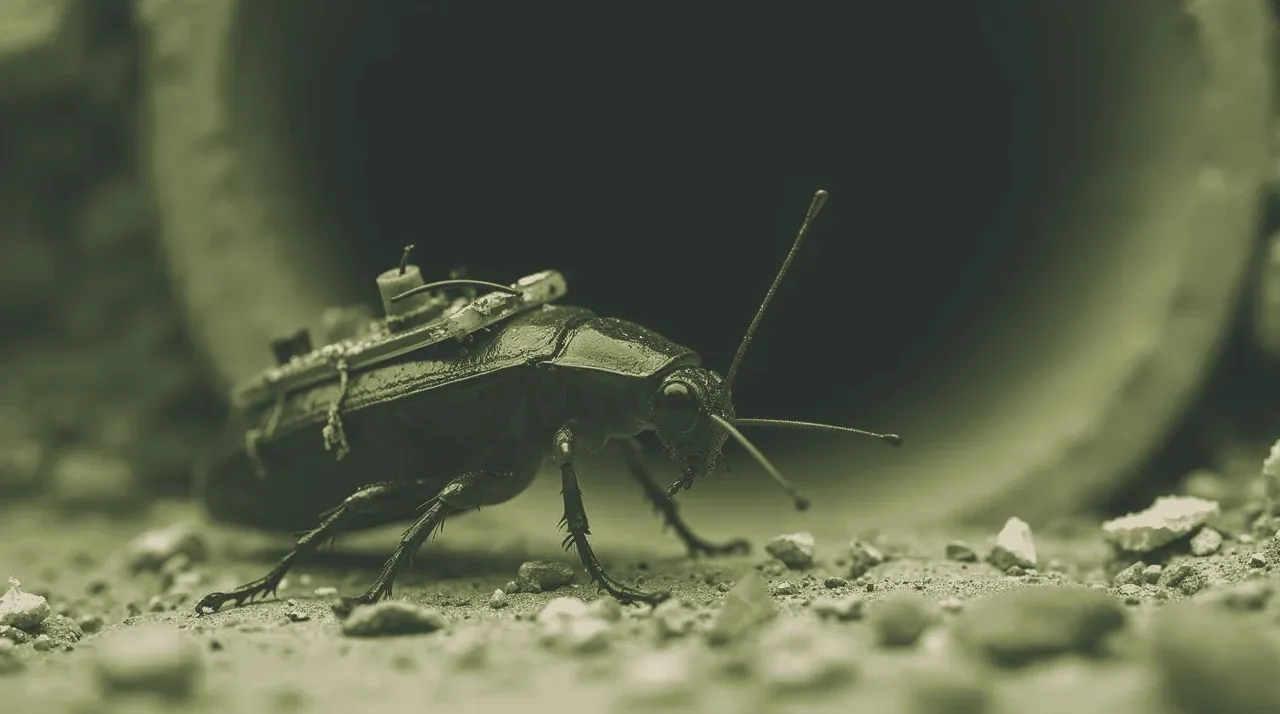
A Kassel-registered, California-run startup has raised 13 million euros to turn Madagascar hissing cockroaches into ISR sensors, and the German military's Cyber Innovation Hub is funding a troop trial called AutoBugs.
A Kassel startup, run from San Diego
Swarm Biotactics fits a few-gram electronic backpack onto a living Madagascar hissing cockroach, steers it with mild electrical stimulation, and sells the result to militaries as a reconnaissance sensor that can enter tunnels and rubble a drone cannot. The company was registered as a GmbH in Kassel in October 2024 and is run day to day from a lab near San Diego. It has raised 13 million euros, a 3-million-euro pre-seed followed by a 10-million-euro seed announced in June 2025, with Vertex Ventures US, Possible Ventures and Cologne-based Capnamic named as investors. CEO Stefan Wilhelm says most of that capital is European.
Wilhelm, 54, spent years at Deutsche Telekom and its Detecon consultancy before a decade on the US West Coast. He puts the company at about 60 people, roughly 70 percent in Germany and 30 percent in the United States. Its chairman is Jörg Lamprecht, a co-founder of the counter-drone firm Dedrone, which Axon agreed to buy in 2024 for an undisclosed sum. Local reporting counted around 20 backers in all, among them Susanne Wiegand, a former chief executive of the German defense and gearbox maker Renk, and the Munich Security Conference listed Lamprecht as Swarm's executive chairman in early 2025.
In April 2026, the Bundeswehr's Cyber Innovation Hub published a video confirming a project called AutoBugs, in which Swarm's insects were tested with troops at the German army's reconnaissance school in Munster. Wilhelm says AutoBugs is a paid project funded through the Bundeswehr's BWI IT company.
What the jamming war in Ukraine rewards
In Ukraine, both sides now jam and shoot down drones faster than they can field them, and electronic warfare has turned cheap quadcopters into a wasting asset. Wilhelm builds his pitch on that problem. A living insect, he argues, has no datalink to jam and no motor or thermal plume to track, so the countermeasures that ground a drone do not apply to it. He describes the system as "programmable like software, but persistent like nature."
The cost argument follows from how the insects are produced. Wilhelm says Swarm scales the way an organism does, by breeding, which compounds and in his telling makes the systems "dimensions cheaper" than conventional sensors. He also calls the swarm loss-tolerant, arguing that even if half of it is lost the mission can still be completed. Those are company figures, and no independent test has confirmed them.
Wilhelm says the backpack spends energy only on sensing and communication, never on movement, because the insect feeds and walks on its own. Components sit in a sleep mode and wake on an acoustic or optical trigger, which he says stretches a mission from the minutes a small drone lasts to days. None of that is independently measured.
Wilhelm describes close-range jobs for the insects. A swarm can form a digital tripwire around a camp, watch a trench, or work into tunnels, smuggling routes and hardened sites that a drone cannot reach, including Iran's buried Fordow enrichment plant. Swarm publishes no price list and sells per project to special forces and national armies, he says, which is part of why its performance and cost claims cannot be checked against a catalogue.
The science: 17.2 milliwatts and a 2.3-gram backpack
The component science behind cyborg insects is real, and most of it predates Swarm. A 2022 paper in npj Flexible Electronics mounted a flexible organic solar cell on a cyborg insect that produced 17.2 milliwatts while the insect kept walking, which showed the power problem could be solved on the animal itself.
Fitting and steering the hardware at scale has also been done in the lab. A 2025 Nature Communications study from Hirotaka Sato's group at Nanyang Technological University in Singapore, whom Wilhelm names as a contact, reported an automated line that attached a 2.3-gram backpack in about a minute and a four-insect team that covered roughly 80 percent of an obstacle course in ten minutes. Wilhelm says Swarm now works with a faster cockroach species that carries less, and has begun steering crabs through the same kind of neural interface.
Swarm's own product is far less documented. CBS's "60 Minutes," which filmed the insects in December 2025, reported current backpacks of up to 15 grams against a 10-gram target, and quoted the company expecting larger deployments only in 18 to 24 months. No independent figures exist for the system's range, endurance, control-failure rate or insect mortality in the field. The marketing also carries a contradiction Swarm has not resolved in public: Wilhelm has pitched "no thermal, no RF, no acoustic tell," while the same company advertises secure, mesh-networked communications, and a radio that never emits cannot also run a mesh network. Swarm has not published a datasheet that would reconcile the two.
Replicator, ReArm Europe, and the market for cheap mass
Swarm's language tracks US doctrine closely. Wilhelm talks about autonomous mass and about saturating an area with sensors so an adversary holds back because it assumes it is being watched. That is the vocabulary of Replicator, the Pentagon program launched in 2023 to field thousands of cheap, attritable autonomous systems, and of "Hellscape," the term Admiral Samuel Paparo has used for filling the Taiwan Strait with unmanned systems. Wilhelm casts his insects as the biological end of that same push for cheap, attritable mass.
Germany plans to raise defense spending toward 162 billion euros a year by 2029, Reuters reported, part of a rearmament wave that also produced the EU's ReArm Europe plan in March 2025, which aims to mobilize up to 800 billion euros. That money is funding a German startup cohort that includes Helsing in software, ARX Robotics in ground vehicles and Quantum Systems in drones, with Swarm at the experimental edge. Wilhelm illustrates the asymmetry with a roughly 100-dollar cyborg insect that crawls into the air intake of a fighter jet worth tens of millions, then reports what it finds or marks it for a later strike.
The distance from a trial to a contract
Defense-tech outlets reported in February 2026 that Wilhelm calls Swarm operational with paying NATO customers and the only Western company building this. Neither claim is confirmed by any public source, and no paying customer beyond the Bundeswehr work appears anywhere on the record. The field is not Swarm's alone either, because DARPA ran an insect-cyborg program, HI-MEMS, years ago and funds biohybrid robotics today, while Sato's NTU group holds a US patent on animal-borne hybrid robots. The strongest version a buyer can rely on is that Swarm may be the only venture-funded Western defense startup selling insect swarms as a product.
The animal-welfare question
The EU's animal-testing directive protects vertebrates and cephalopods, and it does not cover insects, so wiring a cockroach falls outside the rules that would govern a lab rat. Wilhelm says his own legal opinion, three more commissioned by the Bundeswehr, and a US review all found no obstacle, and that the mild stimulation hurts the insect no more than a pacemaker hurts a person. Researchers Lars Chittka and Matilda Gibbons told the Straits Times that insect pain cannot be ruled out, and that evidence for it exists in the relevant orders. Monika Stengl, a neurophysiologist in Kassel, raised similar welfare doubts in local coverage, and Matthias Monroy of the site Site36 has reported skeptically on the military use of the insects.
The application may not stay at reconnaissance. Wilhelm told "60 Minutes" that explosives are not the current focus but did not rule them out over time, and Site36 reported in April that the company plans an explosive capability. That step would move Swarm from an ISR tool toward a guided munition, and reopen the legal and ethical questions the insect's status currently sidesteps.
What to watch
Swarm has not disclosed a procurement contract with a stated volume or value, and such a deal would mark the shift from trial to program. Performance is still unmeasured from outside, because the company has released no range, endurance or failure data. Site36 has reported a planned explosive payload that Wilhelm has not ruled out, a step that would turn the product from a sensor into a weapon. Wilhelm also names amphibious and underwater systems as the next area Swarm wants to enter, where he says the reconnaissance gap is largest. So far the only paying relationship the company has confirmed is the German trial.
Frequently Asked Questions
What does Swarm Biotactics actually make?
It fits a few-gram electronic backpack, carrying stimulation electrodes, sensors, a battery and a radio, onto a living Madagascar hissing cockroach, steers the insect with mild electrical pulses, and sells the result to militaries as a close-range reconnaissance sensor. The Kassel-registered, San Diego-run company has raised 13 million euros, CEO Stefan Wilhelm says.
Is the German military really using the cockroaches?
The Bundeswehr's Cyber Innovation Hub published a video in April 2026 confirming a project called AutoBugs, in which the insects were tested with troops at the German army's reconnaissance school in Munster. Wilhelm says it is a paid project funded through the Bundeswehr's BWI IT company. No procurement contract, volume or value has been disclosed, and the company's wider claim of paying NATO customers is not confirmed by any public source.
Why use a live insect instead of a small drone?
Wilhelm argues a living insect has no datalink to jam and no motor or thermal signature to track, so the electronic warfare that is grounding drones in Ukraine does not apply to it. He also says the insects scale by breeding rather than manufacturing, which he claims makes them "dimensions cheaper" and loss-tolerant. Those are company figures, and no independent test has confirmed them.
Does the technology actually work?
The underlying science is real and mostly predates Swarm. A 2022 npj Flexible Electronics paper powered a cyborg insect with a 17.2-milliwatt body-mounted solar cell, and a 2025 Nature Communications study from Hirotaka Sato's NTU group in Singapore fitted a 2.3-gram backpack in about a minute. Swarm's own product is far less documented. CBS's "60 Minutes" reported the company expects larger deployments only in 18 to 24 months, and no independent range, endurance or failure figures exist.
Is it legal to wire up living insects, and could they be armed?
The EU's animal-testing directive covers vertebrates and cephalopods but not insects, so the work falls outside those rules. Wilhelm says his own legal opinion and three more commissioned by the Bundeswehr found no obstacle, while researchers Lars Chittka and Matilda Gibbons told the Straits Times that insect pain cannot be ruled out. Wilhelm told "60 Minutes" that explosives are not the current focus but did not rule them out over time, and Site36 reported in April that the company plans an explosive capability.
AI-generated summary, reviewed by an editor. More on our AI guidelines.

Marcus Schuler
Marcus Schuler edits BattlePolicy, a daily defense-technology brief connecting the companies and capabilities behind modern war to the contest among Europe, the US, Russia, and China.