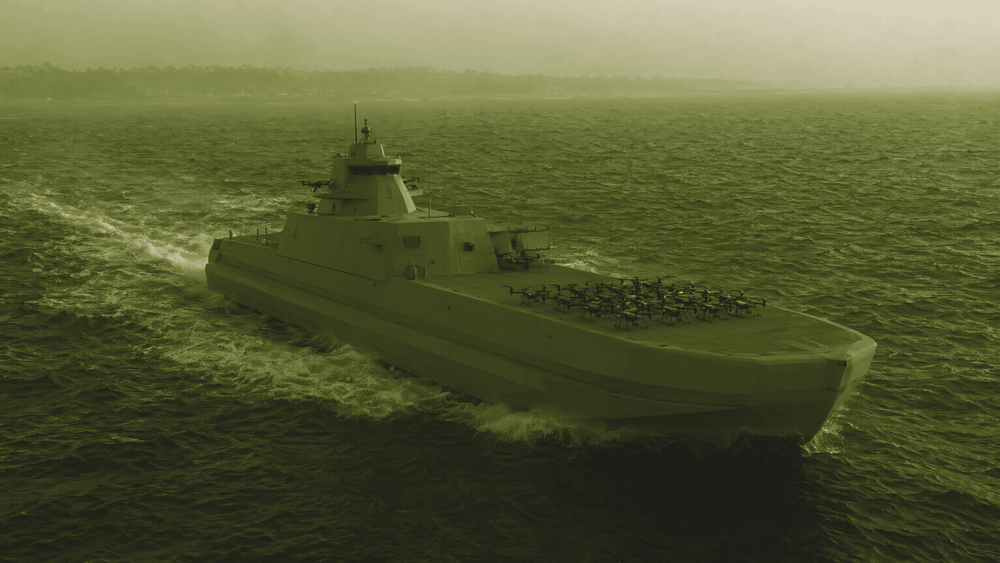
HUR's Black Sea detachment is ending five years of anonymity to offer NATO a sea-drone network that, by its account, keeps choosing targets when the link drops.
The production award pairs a fused bridge picture for watchstanders on five Arleigh Burke destroyers with the plumbing to collect shipboard data, retrain AI models ashore and update ships at sea.
After Ukraine lost Starshield service without warning, Palantir says neither it nor Washington can switch off the Maven AI system running at NATO's top military headquarters.
The Army's enterprise deal for Striveworks' Chariot AI, which sorts sensor and drone data into potential targets, now runs to $700 million over five years as NGC2 moves to I Corps.
The office meant to keep Pentagon AI trustworthy is 70 percent unstaffed and its coordinating council has no charter, while the department pushes AI into target recognition and agentic systems on a wartime footing.
The Army's cyber command wants offensive AI agents that 'must operate with minimal human oversight,' while its commander says the agents it runs today stay under human supervision.
The Fury's onboard autonomy carried out a Raptor pilot's orders, the first in-flight test of the command link the Air Force's drone-wingman plan depends on.
Model No. 13 forecasts where, when and with which drones Russia will strike near the front, Ukraine's defense ministry says, while a second NATO-Ukraine tool that ranks artillery plans is still in trials.
Dominion Dynamics and Ukraine's Tencore signed a memorandum on Oct. 13 to build the TerMIT ground robot in Canada for Ukraine's military. No value has been reported, and Dominion's chief executive is still seeking Canadian government funding.
Ukraine downs 57% of Russia's jet-powered drones, by President Zelensky's count. His former defense minister says a month-old interceptor has hit two and that AI will fly it next.
Project Griffin would let software respond to intrusions the Army can now only detect. Officials said the agents will not start work on Army networks right away.
Powerus says it is automating the final kill because the U.S. lacks Ukraine's drone-pilot brigades, while the Congressional Budget Office counts U.S. missile interceptor stocks down by up to two-thirds.
Shield AI is matching a $150 million Navy award that pays to make its AI-piloted, runway-free fighter exportable, lifting X-BAT commitments to $400 million before its first flight test.
Intelic's Nexus software links radars, cameras and interceptor drones from different makers on one screen in Ukraine, and the Netherlands is paying more than €30 million to build its own drone force on it.
Harmattan AI says IRIFI is designed to fly 2,000 kilometers without satellite navigation and finish a mission with no human control; Morocco signed on before payload, speed or price were disclosed.
The company-funded YFQ-48A cut parts and weight to get Northrop back into an Air Force drone-wingman plan that already has two airframes in production.
Rheinmetall and Breaker signed a teaming agreement on Oct. 6 to run Breaker's voice-command software on Australia's Boxer CRV. No contract value, quantity or Army funding was disclosed.
The Army awarded Anduril a five-year contract worth up to $1.8 billion to field NGC2's common data layer, starting with I Corps, the company said Oct. 5.
DEUTZ built the first GEREON ground robots for ARX Robotics at its Ulm plant, 12 weeks after the pair announced production. The batch is bound for Ukraine's Defense Forces. Neither firm disclosed volume or contract value.
Ukraine's ground robots can now cross the rivers and marshes that cut their supply runs, and the first one to do it on a mission was driven entirely by hand.
By owning the AI architecture itself, France aims to swap suppliers and push new mission software to its fighters and combat drones as fast as threats change.
Shield AI has fixed the factory and flight-test sites for its runway-independent AI-piloted fighter, which has yet to fly and whose production dates do not yet line up.
The Pentagon wants a 12th combatant command for drones and robotics by Oct. 1, 2027, and until Congress agrees, the work runs through the office already buying them.
Helsing is pitching software-flown combat jets to a Europe without a joint fighter program, but its evidence so far is a simulator result, two prototypes under construction and no announced order.
Occam's software keeps mass-produced FPVs tracking a target after jamming cuts the operator link, and the new money is meant to carry it from 12 Ukrainian units into European and NATO markets.
Israeli loitering-munition maker UVision will integrate Estonian startup Lendurai's Neocortex autonomy stack for a NATO customer, aimed at strikes that hold up when GPS and the datalink fail.
The Estonian-Ukrainian startup sells onboard autonomy as a layer for other makers' FPV, interceptor and fixed-wing drones, and it now has seed money and a drone-maker investor to scale it.
A roughly $4,000 conversion turns Soviet-era armor into driverless bombs with the speed and payload to breach fortified positions, and its maker expects demand to rise as winter mud stalls smaller ground robots.
The deleted clause would have required a person to check an AI-generated target before a strike, weeks before states decide whether to open treaty talks.
The first competition under the UK-Ukraine AI Partnership gives British developers a scarce training asset while the underlying data stays inside Ukraine's secure perimeter.
Fury and Vengeance have moved from company demonstrations to Air Force operator-led testing, while both manufacturers build production jets ahead of new federal funding.
At Scarlet Dragon 26-3 the XVIII Airborne Corps found no single sensor can stop a 100-drone swarm, while the Pentagon is already ordering attack swarms by the thousand.
OpenAI is giving Ukraine free access to Daybreak and GPT-5.6 Sol to defend the hospitals, power systems and telecom networks Russia attacks with both missiles and code.
A Gray Flag 2026 test sent a human-built mission plan to an autonomous MQ-20 Avenger, giving the Navy a platform-agnostic planning layer for combat drones it has not yet bought.
At least 20 counter-drone vendors at NORTHCOM's border-focused Falcon Peak 26.2 had to feed their tracks into Anduril's Lattice, including interceptors Ukraine already flies against Russian drones.
The Army Applications Laboratory gave Rune Technologies $4.1 million to take TyrOS across the 1st Cavalry Division and let it task drones and ground robots with resupply. The only disclosed live mission so far was one August drone run.
An AI-assisted report falsely tied a Chinese ship's cargo to a nuclear program during the Iran war. Senators now want inspectors general to examine how the Pentagon checks machine-made intelligence.
ARX Robotics gains a British Army platform and a Welsh production route through General Dynamics Land Systems-UK. The concept is uncosted and carries no Ministry of Defence funding.
Kawasaki Heavy Industries signed a 2026-2028 teaming agreement worth several million dollars with EdgeCortix, giving the Japanese chip startup an aerospace prime to carry its onboard AI. No aircraft or customer was named.
Ukraine's 500-company drone industry has its first large consolidation, and the buyer is an autonomy software firm that needs hardware for its code to run on.
The service says industry has solved basic swarm autonomy, narrowing its $2 million competition to vendors with systems already validated outside the laboratory.
A new portfolio turns fielded drones and robots into one command proposition as Israel's military centralizes responsibility for unmanned systems and AI.
The vehicle Iran recovered near the Strait of Hormuz cost about as much as one Tomahawk. Its intact, mass-produced hull may be worth more to an adversary than the secrets it was not carrying.
Chinese military procurement has moved from buying humanoid robots to buying the perception and training data that would make them work, and that shift is the real signal.
The software could make strike systems more autonomous under Russian jamming, but the developer needs drone and missile manufacturers to carry it into combat.
More than 400 pages released under a FOIA lawsuit show the Pentagon bought strategy advice and adversary briefings with the models, and OpenAI staff inside its commands.
Hermeus picked Anduril's Lattice to fly its Mach 3 Quarterhorse, the first time Anduril has put its mission autonomy on a large third-party airframe under a commercial deal.
Ukraine's 59th Brigade says roughly four in five HX-2 launches end in successful strikes. Its complaints concern propellers, catapults and warhead size, which is an industrial problem for a company built around software.
Tokyo's record 8.9 trillion yen request buys AI command-and-control, underwater attack drones and government-owned weapons factories, but the domestic drone industry it assumes does not exist yet.
The Department of War put OpenAI's ChatGPT Mil and Starshield AI's Grok on GenAI.mil the same day, and the limits each vendor accepts now differ more than the models do.
The Air Force bought an enterprise open-source alerting subscription for the whole US military — competitively, and from a vendor that says it deliberately avoided frontier models.
The Army's autonomous breaching package finished two weeks of live fire at Fort Bragg built almost entirely from small-vendor hardware, and goes to Fort Irwin in October.
Tencore and Insta signed a Joint Statement of Intent in Kyiv on Aug. 23 to build TerMIT 2.0 ground robots in Finland. The first target is 320 units for Ukraine's Defense Forces. No contract value, no sites and no schedule have been named.
Ukraine has logged more than 100,000 unmanned ground vehicle missions this year, and its procurement agency has just started buying whole classes of ground robots to ministry-written specifications.
Ukraine showed that drone warfare turns on the network connecting sensors and shooters. The US Army now has a working answer in NGC2, but the leaders and the unit that forced its adoption are being removed as the technology matures.
Mara closed a $7 million pre-seed for Spike, a counter-drone system built around a 250-gram autonomous interceptor priced to beat the FPV drones now driving most combat casualties.
The retrofit moves Hivemind beyond Shield AI aircraft, but five virtual satellites show how far the demonstration remains from autonomous fleet operations.
Three British startups have pilots under the new UK-Ukraine AI defense pact, but the first application will protect a UK military site rather than strike targets.
States reached 2026 without starting treaty negotiations on autonomous weapons. Autonomous targeting reached combat on an edge-computing module that U.S. export controls do not cover.
An Nvidia Jetson Orin gave Russia's mass-produced Molniya autonomous terminal targeting, with no radio control link for Ukrainian electronic warfare to jam.
A two-year-old autonomy startup announced a $100 million Pentagon contract. The federal notice matching that description is a prize challenge offering up to $100 million across multiple awards.
Six commercial trucks will carry mine-clearing, lane-marking and counter-drone payloads for combat engineers under a $14.3 million sole-source Overland AI contract due in October 2027.
Ukraine's Defence Ministry says more than 70 AI and computer-vision systems already strike targets and that every frontline drone should carry machine vision, with terminal guidance that holds a target after Russian jamming cuts the link.
The Army is paying $46 million for an autonomous hybrid-VTOL that can resupply several positions per sortie with no runway, no pilot and nobody at the drop point, and to make that work under jamming.
A $50 million award pushes Shield AI's 22,000-pound VTOL jet toward ships with no flight deck, on the strength of ground tests rather than flight time.
Japan's Ground Self-Defense Force is field-testing a German loitering munition already flying in Ukraine, and Helsing reached the procurement system through a retail conglomerate rather than a defense prime.
Archer Aviation is acquiring Boeing's Insitu, Wisk Aero and SkyGrid for equity rather than cash, picking up a Group 3 drone maker with $200 million in revenue and customers in 35 countries.
An expanded contract gives NCSIST the ability to build AI pilots locally for drones that can keep operating when electronic warfare breaks the operator link.
Deliveries of 50,000 AI-guided Shrike drones began in mid-July, putting $2,000 autonomous strike drones on the front and moving Ukraine's binding constraint from airframes to trained operators.
Ukrainian operators lose the radio link before impact and the strike lands anyway. Over Edwards Air Force Base, an AI agent flew 27 intercepts on a passive infrared feed. Both ends of the price curve are solving the same problem.
American autonomy software already drives Taiwanese sea drones. The NT$210 billion that would buy the fleet is stuck in cross-party talks, and the opposition's fallback caps spending at NT$40 billion a year.
Prime contractors have joined a record $4.1 billion of venture rounds in 2026, per Dealroom. PitchBook's segment data shows the capital concentrating in autonomy software and systems integration rather than in platforms.
AeroVironment is buying its swarm autonomy from a $15 billion software house instead of building it, a split that tells you where the margin in launched effects is heading.
Task Force Talon Synapse puts about 20 US and Emirati AI specialists in Abu Dhabi, giving CENTCOM a forward model-development cell in the theater where it is already running a strike campaign.
Swarmer will pipe its combat-tested swarm software into Brightline's SpatialCore, trading Ukrainian telemetry for a wider training set and access to Department of War contracting lanes.
DIU tapped the two-year-old startup to plan sustainment for US Army Europe and Africa, starting with medical resupply and casualty evacuation for the Eastern Flank Deterrence Initiative.
Five prototype teams will compete to pull US soldiers off high-risk resupply routes, with field testing alongside operational units set for early 2027.
A $10 million award buys the Pentagon an orchestration layer rather than another airframe, software meant to hold a commander's intent across drones, boats and ground robots from any maker after electronic warfare kills the link.
A bilateral statement of intent opens a formal export channel for Ukrainian land, air and maritime drones into Pentagon testing, though neither government has confirmed it and it commits nobody to buy anything.
A Tokyo-listed company is marketing autonomous Shahed interception into Japanese and Gulf procurement, running the Ukrainian drone trade in the opposite direction.
Anduril and Archer unveiled Thunder, an autonomous tiltrotor built to fly beside Apaches after lessons from Ukraine made attack helicopters some of the most exposed platforms on the battlefield.
NATO codification for the Kolibri 10 Advance opens Ukraine's state drone-buying platforms to an FPV strike drone that finishes its own attack after the operator's signal is jammed.