Ukraine's Sea Drones Stopped Hunting Ships. Now They Carry the Swarm.
The boat that pushed Russia's fleet out of the western Black Sea now carries a cluster of attack drones in its hull, and the Pentagon is copying the method for a possible war with China.
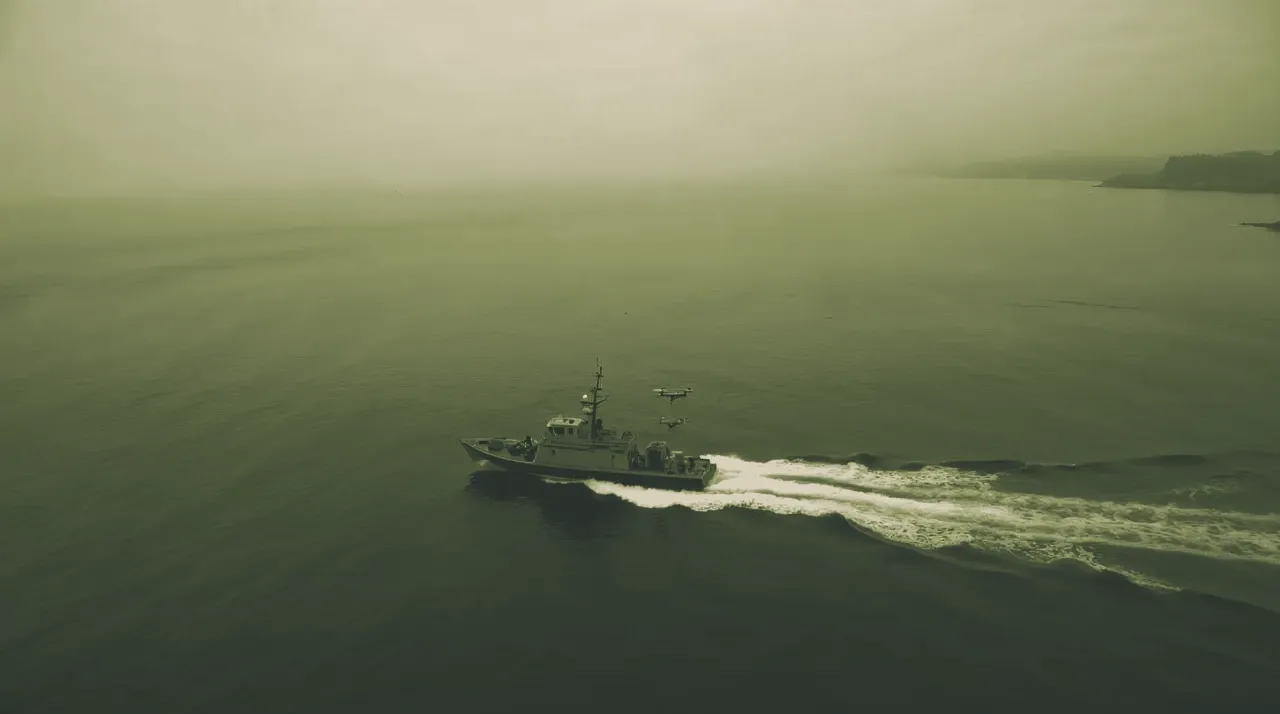
The boat that pushed Russia's fleet out of the western Black Sea now carries a cluster of attack drones in its hull. The weapon Ukraine is exporting is the method, and the Pentagon is copying it for the Pacific.
Ukraine's unmanned attack boats have become launch platforms for other drones, a change that carries well past the Black Sea where it was built. The Sea Baby, the naval drone operated by Ukraine's domestic security service, the SBU, now carries six to eight first-person-view attack drones in side compartments that open during a run, along with thermobaric Shmel rockets, Defense News reported on July 1, citing Russian accounts of the boats operating around the Kinburn Spit, about 40 miles east of Odesa. The same boat that helped drive Russia's fleet out of the western Black Sea can now deliver a cluster of short-range drones to a shoreline its operators could not otherwise reach.
The reason it belongs at the top of the day's file is the second half of that reporting. American forces have already used the boats, and the Pentagon is examining the method as it plans for a possible war with China.
A boat that moves the launch line
The advantage is range. An FPV drone launched from land is limited by how close its operator can get to the front, usually a few kilometers. Mounting the launcher on an autonomous boat moves that starting line out to sea. The SBU assumes a range of 930 miles, or 1,500 kilometers, on a 4,400-pound payload for the upgraded Sea Baby it unveiled in October 2025, according to Defense News. The vessel can approach from the water, then release short-range drones over positions no land-based crew could cover.
Some of the drones in the hold are guided by fiber-optic cable rather than radio, which makes them immune to the jamming that brings down ordinary FPVs, Forbes reported from Russian accounts of the Kinburn operations. The Sea Baby is piloted from a mobile ground station but carries AI-assisted targeting and navigation that let it keep operating when its link is jammed or severed, a feature Ukrainian designers built for the heavy electronic-warfare conditions over the Black Sea.
The price is what draws outside interest. Each boat runs a few hundred thousand dollars, less than a single modern torpedo, according to Defense News. That figure buys a platform Ukraine can send into contested water and lose without spending a crewed ship or its crew.
The Black Sea record
Ukrainian naval drones have sunk or damaged roughly a dozen Russian warships since 2022 and forced the Black Sea Fleet to move its main operations back to Novorossiysk, the U.S. Naval Institute reported in September. Ukraine fields no warships of its own, yet its drones have confined the fleet to its eastern ports, which is what gives the FPV-launcher tactic a two-year track record rather than a demonstration.
The operations have grown more ambitious. Sea drones carrying fiber-optic FPVs struck the Russian ports of Tuapse and Novorossiysk in September, hitting targets on the far side of the sea. In December the campaign went underwater, when Ukraine's Sub Sea Baby underwater drone struck an Improved Kilo-class submarine at its pier in Novorossiysk on December 15, which the SBU called the first time an unmanned underwater vehicle had hit a submarine in port. Russia denied damage, but satellite imagery the following day showed a nine-meter crater in the pier and the vessel, later identified as the B-271 Kolpino, sitting lower in the water and unmoved at its berth more than a month later, according to Defense News. Ukrainian and independent analysts assessed it as a mission kill.
Ukraine has also fitted FPV launchers onto ground robots and onto balloons that drift east on prevailing winds, though the naval drone carries the payload farthest. "The SBU became the first in the world to pioneer this new kind of naval warfare, and we continue to advance it," Brig. Gen. Ivan Lukashevych said at the October unveiling.
Two families, two export paths
Ukraine runs two separate naval-drone programs, and the difference between them decides who can buy the technology. The Sea Baby is developed and operated by the SBU. The Magura is built by Uforce for the GUR, Ukraine's military intelligence directorate, and it carries a commercial lineage the Sea Baby does not: Uforce is registered as a London-based startup, which gives a combat-tested weapon a corporate address Western governments can contract with directly.
The battlefield and the startup story — free in your inbox every week. No paywall.
Subscribe Free →Ukraine's export policy is what turned that corporate structure into a sales channel. Kyiv barred weapons exports in 2022 to keep production at the front, and began opening the market only in 2025. Uforce chief executive Oleg Roginsky told Bloomberg last week that the Magura's record against Russia confirms its value for the Indo-Pacific, and that the firm is in talks with regional buyers and weighing at least two production sites in the region.
Balikatan, and the Pacific problem
The first live use outside Ukraine came off the Philippines. U.S. special forces sank a target ship with a Ukrainian Magura at the Balikatan 2026 exercise on June 24, the first use of the technology in the Indo-Pacific, according to Defense News. It put a Ukrainian naval drone in American hands in the theater where Washington is planning for a possible conflict with China.
For U.S. planners the attraction is the match to the Pacific problem. A cheap, expendable boat that carries a cluster of attack drones to within striking range suits a theater where the distances reward mass and attrition over any single high-end hull. The Navy expects to field thousands of small uncrewed surface vessels across the Indo-Pacific by 2030, Capt. Garrett Miller, who leads its Surface Development Group One, said at an April 20 symposium. The Center for Strategic and International Studies urged the military last July to copy Kyiv's acquisition methods, arguing that Ukraine's approach is battlefield tested rather than modeled on paper. Ukraine's navy also ran the red team at the REPMUS naval-drone exercise in Portugal in September and beat the alliance's blue force in all five scenarios, the first time it had played the opposing side.
Between the Balikatan strike, the Navy's fielding target and the CSIS recommendation, Western demand is converging on a method Ukraine developed first.
The part that does not transfer
The export case has real limits. Naval analysts have cautioned that replacing crewed warships with drone boats is not a straightforward gain, because a small uncrewed vessel cannot hold sea space or escort shipping the way a crewed destroyer does. The Black Sea is also a favorable setting, since it is enclosed, and Russian ports lie within reach of the Ukrainian coast. The Pacific is open ocean measured in thousands of miles, where a boat with a few hundred kilometers of useful reach covers a smaller share of the theater, and the results against a fleet confined to its own coast may not repeat against a navy with room to maneuver.
Even with those limits, the part Western militaries are copying is the method rather than the specific boat: build cheap uncrewed platforms in volume and accept losses a crewed fleet cannot absorb. Ukraine has shown the approach works against a stronger navy and has attached a corporate export path to it. The Pentagon now has a working example to study while it plans for the Pacific.
What to watch
Whether the model travels will show up in a few places over the coming months. Uforce has yet to break ground on any Indo-Pacific production site, and doing so would turn Roginsky's talks into an actual supply line. The U.S. Navy's target of thousands of uncrewed surface vessels still has to survive the budget process, since a stated goal and a funded program are not the same. The question the skeptics keep pressing, whether the mothership concept works in open water as well as it has in the enclosed Black Sea, will be answered in the Pacific rather than the Black Sea.
Illustration. Generated key image, not a photo of the event.
Frequently Asked Questions
What changed about Ukraine's Sea Baby naval drone?
The Sea Baby, operated by Ukraine's security service, the SBU, now carries six to eight FPV attack drones in side compartments plus thermobaric Shmel rockets, turning a strike boat into a launch platform, Defense News reported on July 1. It lets Ukraine deliver short-range drones to shorelines that land-based launchers cannot reach.
How are the sea-launched FPVs resistant to jamming?
Some of the drones carried in the hull are guided by fiber-optic cable rather than radio, which makes them immune to the electronic jamming that downs ordinary FPVs, Forbes reported from Russian accounts of operations around the Kinburn Spit. The Sea Baby itself uses AI-assisted navigation to keep operating when its own link is jammed.
What is the difference between the Sea Baby and the Magura?
They are two separate programs: the Sea Baby is built and run by the SBU, while the Magura is made by Uforce for Ukraine's military intelligence directorate, the GUR, according to Defense News. Uforce is registered as a London-based startup, which gives it a corporate export path the Sea Baby does not have.
Why is the U.S. interested for a possible conflict with China?
U.S. special forces sank a target ship with a Ukrainian Magura at the Balikatan 2026 exercise off the Philippines on June 24, the first Indo-Pacific use, per Defense News. A cheap, expendable boat carrying attack drones fits the Pacific problem, where the Navy plans to field thousands of small uncrewed surface vessels by 2030, according to USNI News.
What are the limits of copying Ukraine's naval-drone model?
Naval analysts have cautioned that a small uncrewed boat cannot hold sea space or escort the way a destroyer can. The Black Sea is enclosed with Russian ports near the Ukrainian coast, while the Pacific is open ocean measured in thousands of miles, so a boat with a few hundred kilometers of useful reach covers less of the theater.
AI-generated summary, reviewed by an editor. More on our AI guidelines.

Marcus Schuler
Marcus Schuler edits BattlePolicy, a daily defense-technology brief connecting the companies and capabilities behind modern war to the contest among Europe, the US, Russia, and China.