General Cherry
General Cherry is Ukraine's scale-first interceptor maker — the for-profit rival to Wild Hornets, building a layered counter-drone catalog (AIR, Bullet, OPTIX) at a claimed 50,000+ drones a month, ranked #1 in kills, NATO-certified, and opening production lines in the US and Croatia.
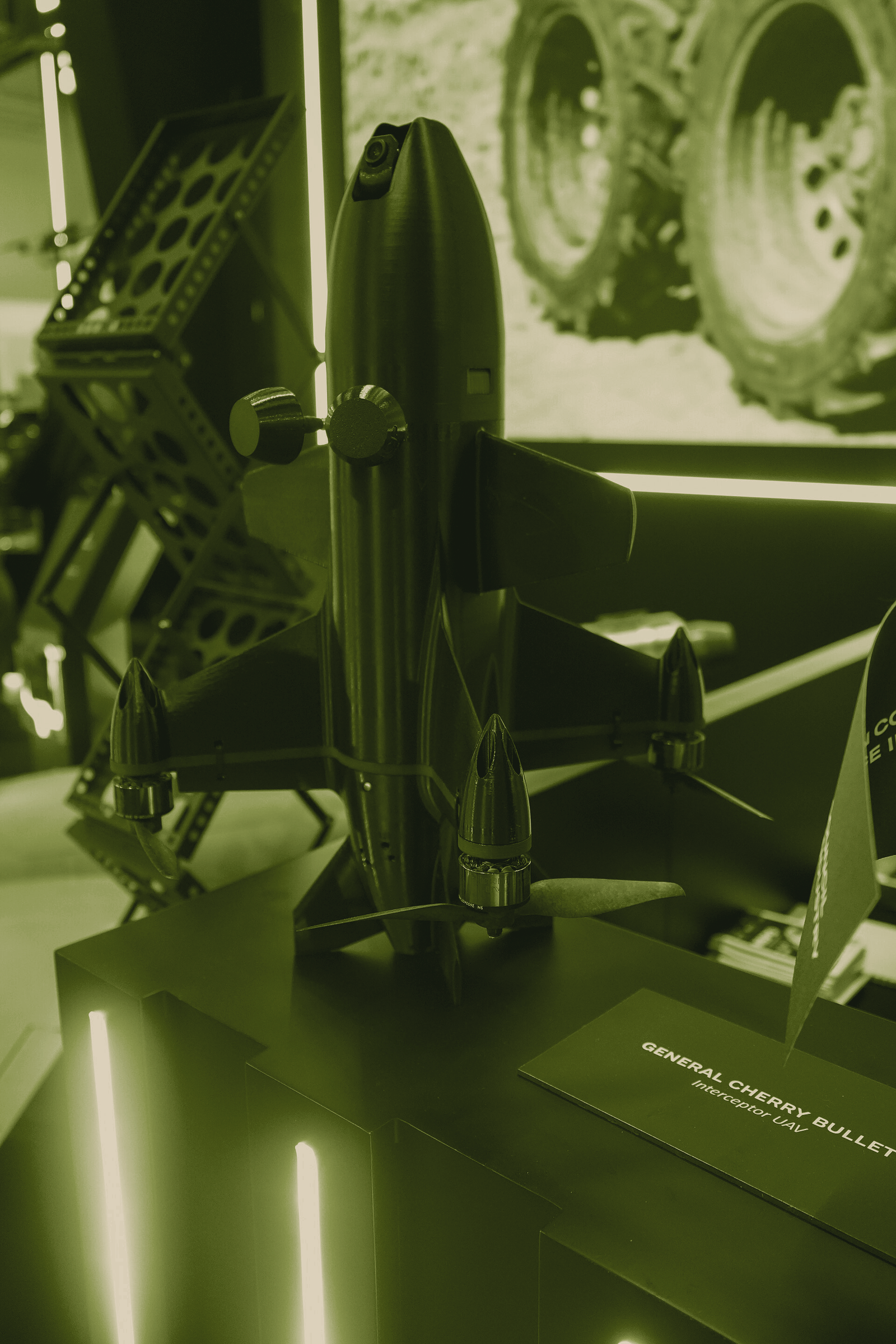

The industrialist of the interceptor war — General Cherry is the for-profit answer to Wild Hornets: where the Sting's makers are a donation-funded non-profit refining one product, General Cherry is a mass manufacturer with a whole catalog of counter-drone interceptors — a cheap one for recon quadcopters, a faster one for Lancets, a bullet-shaped one for Shaheds — built at a claimed fifty thousand-plus drones a month. It ranks first among Ukrainian makers in drone kills, holds the NATO quality certification for alliance sales, and is already opening production lines in New Hampshire and Croatia. If the Sting proved the interceptor works, General Cherry is proving it can be manufactured at scale and sold to the West.
Overview
General Cherry (Ukrainian: General Chereshnya; legal entity Center of Unmanned Technologies LLC) is the Zaporizhzhia-origin miltech firm that has become Ukraine's dominant interceptor-drone manufacturer by volume — a for-profit, scale-first counterpart to the non-profit Wild Hornets behind the Sting. Its distinguishing move is the layered catalog: rather than one interceptor, it fields a threat-matched family — the AIR (against reconnaissance quadcopters and small strike drones), the faster AIR Pro and AIR Speed (against Lancets and adapted commercial drones), and the flagship Bullet (a ~309 km/h VTOL against Shahed and Geran attack drones) — plus the OPTIX fiber-optic FPV line and electronic-warfare kits, all codified by Ukraine's Defense Ministry and sold through the Brave1 marketplace. The scale claims are large and rising (50,000–70,000 drones a month across ~33 products, though the figures are maker-reported and inconsistent), and the company reports ranking #1 among Ukrainian producers in enemy-drone kills per Army of Drones Bonus program data. Its combat record includes genre firsts — the first kill of Russia's AI "Klin" munition (February 2026), the first Ka-52 helicopter downed by an FPV drone (its OPTIX, March 2026), and the first Chernika kill (its AIR, June 2026). And its market posture is the most aggressive in the field: the first Ukrainian drone firm with NATO AQAP-2110 certification, a US joint venture with Wilcox Industries, a Croatian production agreement with Orqa, entry into the Pentagon's $1.1 billion drone program, and Bullet interceptors reaching Gulf states — all while a June 2026 Russian strike on its facility confirmed it is now a high-value target.
🔒 The full General Cherry file is for BattlePolicy Pro members. Below the line: development history, design and capabilities, variants, the combat record, advantages and limitations, comparable systems, outlook, the full specifications table, our sourcing, and the analyst assessment — procurement, suppliers and the BattlePolicy verdict. Unlock the full file with BattlePolicy Pro →
Below this point
- Development
- Design & capabilities
- Variants
- Combat record / operational use
- Advantages
- Drawbacks / limitations
- Counterparts
- Outlook
- Key specifications
- Sources
- Analyst Section
- Procurement & contracts
- Suppliers & related companies
- Comparable systems — analyst view
- Analyst note