Russia's 3,000-a-Month Jet Gerans Outrun Ukraine's $2,000 Interceptors
Russia flew 76 jet-powered Gerans at Ukraine in daylight on Aug. 18. Turbojet drones now reach two-thirds of some waves and roll off Alabuga at about 3,000 a month, faster than the $2,000 interceptors that beat the Shahed. Kyiv's jet-powered answer is still in combat testing.
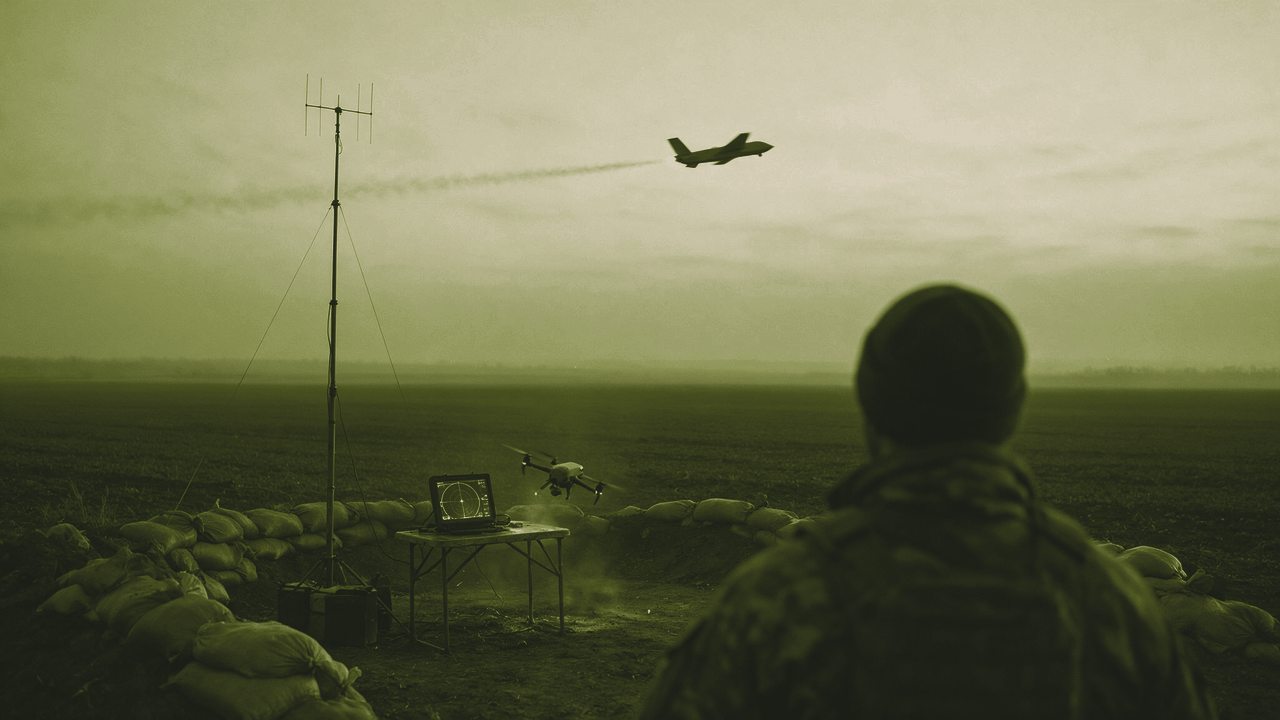
Russia has moved as much as two-thirds of some strike waves beyond the reach of Ukraine's cheap electric drone hunters. Kyiv's faster answer costs several times more and remains in combat testing.
76 jet drones over Kyiv in daylight
Russia's Aug. 18 daytime attack showed how the jet-powered Geran is dismantling the cost exchange that made Ukraine's interceptor drones work. The Ukrainian Air Force said Russia launched 76 jet-powered Shahed-type drones between 7 a.m. and 6 p.m., the Kyiv Independent reported. Air defenses intercepted 70; several got through and struck sites on the ground.
The attack kept the capital under pressure all day rather than concentrating the threat in one nighttime wave. Kyiv had recorded nine air-raid alerts by 6 p.m., and the Air Force said more than 20 jet drones were still in Ukrainian airspace at 6:30 p.m. Mayor Vitali Klitschko said debris fell at two locations in the Dniprovskyi district.
A raid in full daylight, built around jets, is what Russia does when the cheap nighttime defenses have started winning. The daytime jet wave pushes the strike package outside the speed and altitude envelope of the electric interceptors that defeated the propeller-driven Shahed.
Frequently Asked Questions
What happened on Aug. 18?
The Ukrainian Air Force said Russia launched 76 jet-powered Shahed-type drones between 7 a.m. and 6 p.m.; 70 were intercepted, several struck the ground, and Kyiv logged nine air-raid alerts by 6 p.m., per the Kyiv Independent.
How big is the jet-drone share of Russian attacks?
Air Force spokesman Col. Yurii Ihnat said Russia launched five times as many jet drones in July as in June and that they reach up to two-thirds of some packages, though not every wave. Col. Artem Skurativskyi puts the Geran-3 at up to 20% of Shaheds launched, per ArmyInform.
How many jet Gerans is Russia building?
Ukraine's HUR told Militarnyi that Russia has ended Geran-3 production and builds roughly 3,000 Geran-4 and Geran-5 drones a month at Alabuga, all on Chinese Telefly turbojets costing $35,000 to $40,000 each.
Why can't the cheap interceptors catch them?
Electric interceptors such as ZIRKA (340 km/h) and Octopus-100 (about 300 km/h) were built for a 185 km/h Shahed. A Geran-4 cruises at 350 to 500 km/h and up to 5,000 meters, so a tail-chase loses ground at up to 160 km/h, according to Defence Ukraine.
What is Ukraine's answer?
SkyFall's P1-SUN JetKiller reaches 370 km/h, F-Drones' LITAVR tops 400 km/h, and a jet-powered interceptor exceeding 600 km/h entered combat testing on Aug. 14, per Mykhailo Fedorov. Grenadyr's Tomasz Wozniak puts a jet interceptor under $10,000 versus about $2,000 for an electric one.
AI-generated summary, reviewed by an editor. More on our AI guidelines.
Below this point
- Ihnat's two-thirds figure
- Alabuga's Geran-4 and Geran-5
- Ten sites and 59 rails
- The 160 km/h pursuit deficit
- Patriots and the magazine problem
- SkyFall's 370 km/h JetKiller
- A sub-$10,000 defense against 3,000 a month
Ihnat's two-thirds figure
Col. Yurii Ihnat, head of the Air Force's communications department, said Russia launched five times as many jet-powered drones in July as in June. In some attacks, jets made up as much as two-thirds of all drones, though Ihnat stressed the ratio did not apply to every wave. He described their speed and altitude as "already becoming closer to those of cruise missiles."
That jump measures Russia's response to a defensive success. Yehor Cherniev, deputy chair of the Ukrainian parliament's national security, defense and intelligence committee, puts Ukrainian interception of cruise missiles and Geran-2 drones above 90%.
Col. Artem Skurativskyi of the 7th Rapid Response Corps' air-defense directorate gives a narrower figure, telling ArmyInform that Geran-3s account for up to 20% of Shaheds launched. He credits Ukraine's combined defenses with pushing interception of Geran-2 and Shahed-136 drones to between 80% and 93%, depending on the scale of the attack. A Geran-3 covers the distance from the Belarusian border to Kyiv in 35 minutes, four times faster than its piston-powered predecessor.
The two figures describe different slices of the campaign, but the direction is the same: Russia is shifting the difficult daytime portion of the wave to turbojet propulsion.
Alabuga's Geran-4 and Geran-5
Ukraine's military intelligence agency, HUR, identifies the Geran-3 as a localized Shahed-238 that kept the Geran-2 airframe and swapped its piston engine for a Chinese Telefly JT80 turbojet, good for 300 to 370 km/h. Russia has now ended Geran-3 production and set up serial assembly of the Geran-4 and Geran-5 at Alabuga in Tatarstan, at an estimated 3,000 a month, HUR told Militarnyi. Output of the two jet models has overtaken output of the Geran-2.
The Geran-4 reinforces the airframe and raises maximum takeoff weight from 350 to 450 kilograms. Militarnyi lists a Chinese turbojet of 160 kgf, twice the JT80's thrust, for a cruise speed of 350 to 500 km/h, a warhead of at least 50 kilograms, a range of about 850 kilometers and an operating band of 100 to 5,000 meters. Ukrainian intelligence's analysis of wreckage recovered in July found an electro-optical seeker in a redesigned nose, so the one-way attack drone can acquire and strike a target visually when satellite navigation is jammed. Speed narrows the kinetic window; terminal vision closes the electronic-warfare option.
The Geran-5 moves closer to a cruise-missile layout. It flies on a Telefly TF-TJ2000A engine rated at 2,000 newtons and carries a 90-kilogram warhead for roughly 1,000 kilometers; the Kyiv Independent puts its speed at up to 600 km/h and its ceiling at 6,000 meters. HUR says Russia may also fit it with R-73 air-to-air missiles to threaten the aircraft sent up to intercept it.
The turbojet remains Russia's clearest production vulnerability. HUR deputy chief Vadym Skibitskyi says Russia depends completely on Chinese engines costing $35,000 to $40,000 each. A Euromaidan Press review also identified an unsanctioned Chinese XK-F358 mesh radio in a Geran-5.
Ten sites and 59 rails
Russia is building the launch network needed to turn factory output into repeated waves. A Telegraph investigation using satellite imagery and DroneSec analysis identified at least 59 launch rails across 10 sites near Ukraine and Belarus, ISW and The War Zone noted; about 20 rails appeared long enough for Geran-4 or Geran-5 launches, seven of the sites had already supported attacks on Ukraine, and some can store more than 1,000 drones.
Strategic Aviation's Aug. 15 imagery showed how fast one node grows. At Tsymbulova in Oryol region, Russia finished 16 jet-drone launchers in about a month, 10 for the Geran-5 and six for the Geran-4, with at least 37 Geran-5 and eight Geran-4 airframes visible beside 56 Geran-2s.
The 160 km/h pursuit deficit
Ukraine's cheap interceptor fleet was designed around a 185 km/h Shahed-136. Wild Hornets said its Sting had destroyed more than 9,000 Shahed-class drones and Gerberas by June 2026. Defence Ukraine identifies the 1020th Anti-Aircraft Missile Regiment's May 3 engagement as the first confirmed Sting kill of a Geran-4, and says favorable geometry made it possible.
NOCTIS lists its ZIRKA interceptor at up to 340 km/h, a 30-kilometer range and a price near $2,000, developed with Vyriy Industries and the Darknode battalion of the 412th Nemesis Brigade. The Octopus-100 reaches about 300 to 305 km/h; Ukraine licensed it to the UK Ministry of Defence in November 2025 for British production of an initial 8,000 units.
Those speeds no longer guarantee a firing solution. A 340 km/h interceptor pursuing a Geran-4 at 500 km/h loses ground at 160 km/h. Electric interceptors therefore depend on head-on or high-angle flanking engagements; once the target passes the launch position, they cannot run it down. A Geran-4 near 5,000 meters also sits above the altitude where many FPV-derived airframes keep useful lift and battery life.
Skurativskyi says mobile fire groups are "of little effect against the jet modifications." The Geran's size and heat still create openings: its 3.5-meter body shows readily on radar and its hot exhaust draws man-portable missiles. The 81st Air Assault Brigade is already downing jet Shaheds with interceptors, he says, but those kills do not erase the geometry constraint.
Patriots and the magazine problem
Patriot, SAMP/T and IRIS-T can engage the faster Gerans, experts told RBC-Ukraine, with Gepard, Skynex and Mistral covering parts of the threat. The problem is price and inventory. TAF Industries argues the honest comparison for a jet interceptor is a surface-to-air missile that can cost up to $4.5 million, not the drone it kills.
Ukraine has no high-end magazine to spare. President Volodymyr Zelensky told CNN on Aug. 12 that Kyiv holds one-tenth of the interceptor missiles it needs and asked Washington to sell 5% to 10% of its stock; Al Jazeera puts Lockheed Martin's Arkansas PAC-3 line at roughly 50 missiles a month. Russia fired 376 missiles in July, up from 288 in March, and the UN monitoring mission counted 437 civilians killed that month, the most since May 2022. Every Patriot spent on a Geran is one fewer for the ballistic missiles that interceptor drones cannot touch.
SkyFall's 370 km/h JetKiller
Ukraine's industry is buying speed back at a higher price. SkyFall showed the P1-SUN JetKiller at Farnborough on July 20-24: 370 km/h, up from 310, a 30-kilometer range, a 9,000-meter ceiling, 15 minutes of endurance and a 500-gram payload. The company told Janes that radar tracks show jet Gerans averaging about 400 km/h at the top end but unable to hold it without burning through fuel, so the engagement concept waits for the target to slow. SkyFall aims for 400 and then 500 km/h and is still weighing an electric powertrain against a small turbojet.
Other programs are pushing past that compromise. Former defense minister Mykhailo Fedorov said on Aug. 14 that an unnamed Ukrainian team had begun combat testing a jet-powered interceptor exceeding 600 km/h, with its first confirmed kills still awaited. Firebolt Engineering's Griffen exceeds 350 km/h and has reportedly downed a Geran-2. F-Drones says its upgraded LITAVR tops 400 km/h and has passed factory testing.
The constraint is endurance, not the headline speed. Experts interviewed by RBC-Ukraine describe jet interceptors as separate and limited experiments because a high-speed powertrain drains the battery quickly.
A sub-$10,000 defense against 3,000 a month
Tomasz Wozniak of the defense investor Grenadyr estimates a jet-powered interceptor at under $10,000, against about $2,000 for an electric one. That still favors the defender against a Geran whose Chinese engine alone costs $35,000 to $40,000. But every seeker, turbojet and autonomy module strips margin from the exchange, and Alabuga's estimated 3,000 units a month forces Ukraine to match volume with faster, dearer effectors.
Russia has its own ceiling. Defense Express editor Oleh Katkov assesses that engine deliveries from Chinese private companies will cap expansion, and Anton Zemlyanyi of the Ukrainian Center for Security and Cooperation expects jet drones to stay an intermediate category between the Shahed and the cruise missile rather than replace either.
The Western requirement changes with that mix. Britain's Octopus-100 line exports Ukraine's interceptor layer, but a system built around a 300 km/h target does not cover a Geran-5 at 600 km/h and 6,000 meters. Counter-drone buyers now have to specify a target moving at 400 to 600 km/h at 5,000 to 6,000 meters, and the Telegraph's mapped launch sites put Warsaw inside a Geran-5's 1,000-kilometer radius, which makes that a NATO requirement and not only a Ukrainian one.
The next indicators are concrete: the first confirmed kills by the 600 km/h interceptor, whether Ihnat's two-thirds share becomes routine, continued construction at Alabuga and Tsymbulova, and any Russian turbojet that cuts the dependence on Telefly.

Marcus Schuler
Marcus Schuler edits BattlePolicy, a daily defense-technology brief connecting the companies and capabilities behind modern war to the contest among Europe, the US, Russia, and China.