Russia Builds Its Filin Cruise Missile From the Shahed Supply Chain
Russia's new Filin cruise missile pairs avionics from a Shahed-type drone supplier with a drone-class turbojet and US chips made as late as October 2025, and its claimed 800 km/h doubles the speed of Ukraine's multirotor interceptors.
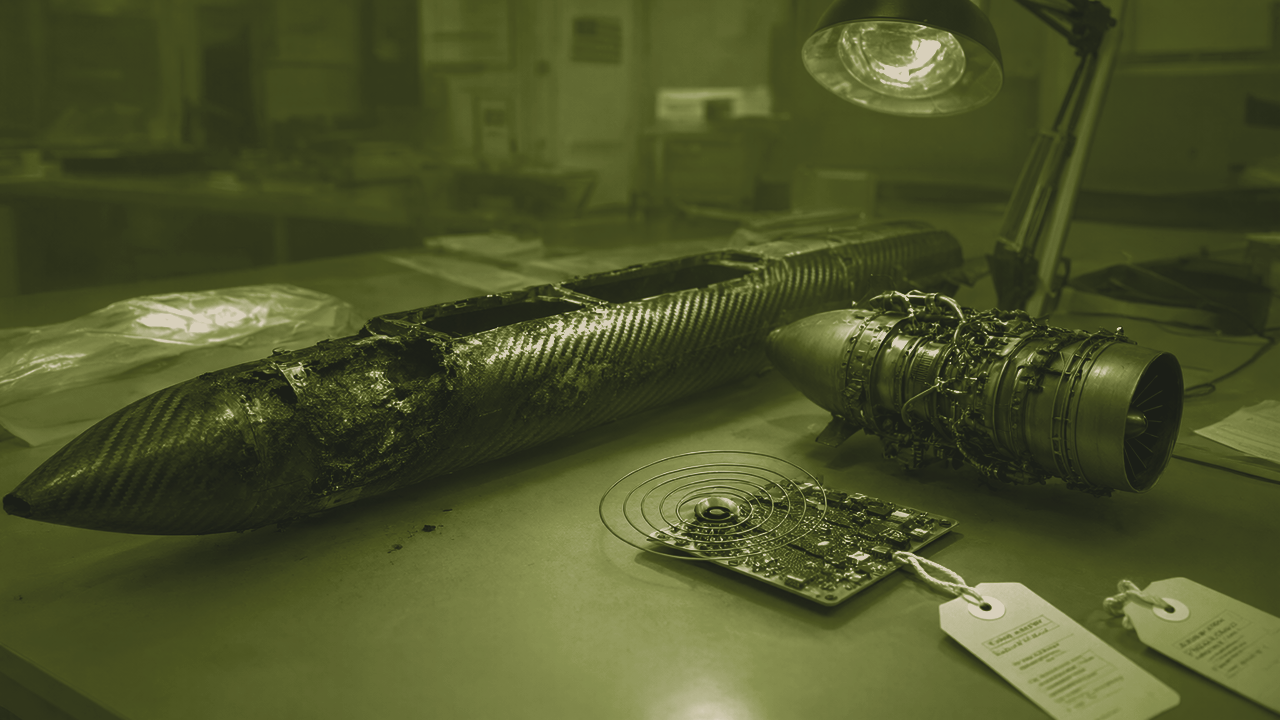
PLAZ avionics, a Russian drone engine and US chips made in late 2025 point to a cheap cruise missile built to fly above the speed of Ukraine's multirotor interceptors.
Filin and PLAZ
PLAZ avionics in Russia's Filin cruise missile show the Tactical Missiles Corporation drawing on the attack-drone supply chain to get past Ukraine's interceptors. Ukraine's military intelligence, HUR, published the weapon's breakdown on its War&Sanctions portal on 22 October 2026. The agency identified PLAZ LLC as the onboard-equipment manufacturer and found similar layouts and markings in Filin and Garpiya units.
HUR links PLAZ to production of the Garpiya, also rendered Harpiya, a Geran-2 modification built by JSC Izhevsk Electromechanical Plant Kupol. Filin's developer is JSC NPO Molniya, part of the Tactical Missiles Corporation, or KTRV. The agency dates Russian combat use to late summer 2026 and places Filin within a trend toward inexpensive, ground-launched jet weapons.
The 210 kg missile
HUR's specifications describe a 3.5 m fuselage, 3 m wingspan and maximum take-off weight of 210 kg. The airframe uses carbon fibre and fibreglass, with some parts 3D-printed. A powder booster launches it from the ground. Identified variants carry 50 kg or 100 kg warheads.
Russian performance claims relayed by HUR put maximum speed at 800 km/h, range at up to 1,200 km and flight altitude from extremely low to 6 km. These are advertised figures, not measured performance. Even so, the number matters: Ukraine's latest multirotor interceptor drones fly at 300 to 400 km/h, BBC News Ukrainian reported this month. Filin's claimed maximum is twice the top of that range.
HUR identified 35 US and 22 Chinese electronic components and standardized designs across units and circuit boards. Propulsion comes from Reynolds LLC's Russian R500 turbojet, previously identified in the S-71K Kover and S-71M Monokhrom air-launched missiles.
BattlePolicy's read: the parts list says more about how Russia now builds missiles than the speed claim does.
Frequently Asked Questions
What is the Filin missile?
A ground-launched Russian cruise missile developed by JSC NPO Molniya, part of the Tactical Missiles Corporation. Ukraine's military intelligence (HUR) says Russia began using it against Ukraine in late summer 2026.
How fast and how far does Filin fly?
Russian claims relayed by HUR put its maximum speed at 800 km/h and its range at up to 1,200 km, at altitudes from extremely low to 6 km. None of these figures has been independently measured.
How is Filin linked to Shahed-type drones?
HUR says its onboard equipment is made by PLAZ LLC, which also helps produce the Garpiya, a Geran-2 modification built by IEMZ Kupol. Filin and Garpiya units share similar layouts and markings, per HUR.
What engine powers Filin?
The Russian R500 turbojet from Reynolds LLC, per HUR. Reynolds' 2018 bench test gave it 48.6 kgf of thrust, and it was designed for drones weighing 100 to 300 kg.
Does Filin contain Western components?
Yes. HUR lists 81 component entries, including 35 from US manufacturers and 22 from Chinese ones. The newest dated part is an Analog Devices converter from October 2025.
AI-generated summary, reviewed by an editor. More on our AI guidelines.
Read next — from the Lexicon
Below this point
- Reynolds' R500
- The 81 component entries
- Ukraine's 400 km/h interceptors
- PLAZ after December 2023
- The next evidence

Marcus Schuler
Marcus Schuler edits BattlePolicy, a daily defense-technology brief connecting the companies and capabilities behind modern war to the contest among Europe, the US, Russia, and China.