GRID-REF 37°47′N 122°25′W
DISPATCH 02/26 · 9 Jun 2026
BATTLEPOLICY
Startup to front line. Strategy to consequence.
Lexicon · Iran

Shahed-136

Iran-origin, Russia-built long-range one-way attack drone — the saturation-strike icon of the Ukraine war, fired in mass nightly salvos to exhaust air defenses and strike infrastructure at a cost-exchange ratio that has rewritten the economics of strategic bombardment.
Shahed-136
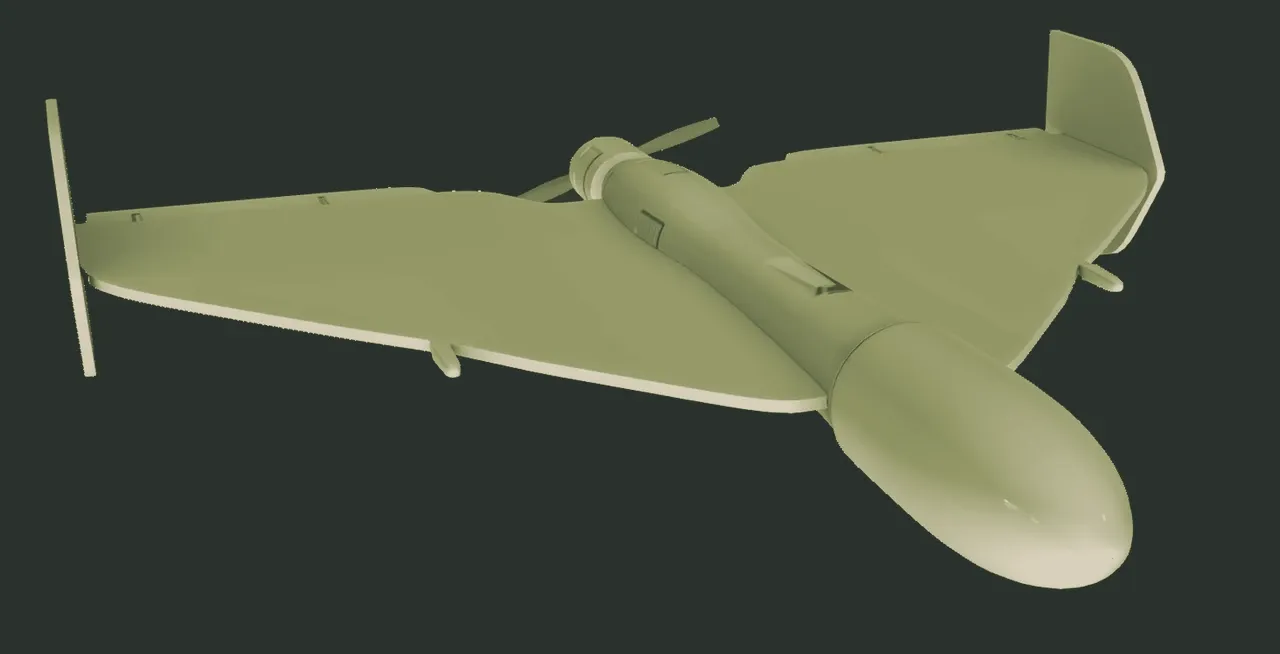
FIG.01 · Iran Image - A Shahed-136 (Geran-2) loitering munition. Photo by Idmental, CC BY 4.0, via Wikimedia Commons.
Iran-origin, Russia-built long-range one-way attack loitering munition — the saturation-strike icon of the Ukraine war, fired in mass nightly salvos to exhaust air defenses and strike critical infrastructure at a cost-exchange ratio that has rewritten the economics of strategic bombardment.

Overview

The Shahed-136 — designated Geran-2 ("Geranium-2") in Russian service — is a delta-wing, piston-engine one-way attack (OWA) loitering munition developed by Iran's Shahed Aviation Industries and mass-produced under license in Russia. Designed for long-range saturation strikes against fixed targets, it cruises at roughly 185 km/h over distances of up to 2,000 km carrying a 40–50 kg warhead, navigating by pre-programmed inertial and satellite guidance. First used in combat by Russia against Ukraine on 13 September 2022, the type rapidly became the defining saturation weapon of the war: fired in nightly salvos of dozens — often mixed with decoys — to exhaust ground-based air defenses and strike power-generation, fuel-storage, and logistics nodes deep inside Ukrainian territory. Its unit cost, estimated at roughly $20,000–50,000, makes it one of the cheapest long-range strike assets in operational use and the centrepiece of what analysts term the "cost-exchange crisis" — the economic asymmetry between cheap attacking munitions and the expensive interceptors required to stop them.

Development

The Shahed-136 emerged from Iran's Shahed family of loitering munitions and reconnaissance drones, developed by Shahed Aviation Industries and produced through Iran Aircraft Manufacturing Industrial Company (HESA). The type was publicly displayed in 2021 and had entered limited Iranian service before Russia's full-scale invasion of Ukraine created an urgent demand for a low-cost, long-range strike asset able to stress Ukrainian air defenses. According to Army Technology, Iran began supplying Shahed-136 airframes to Russia in mid-2022, with the first operational use recorded on 13 September 2022 against targets in Kharkiv. Russia subsequently established a licensed production line at the Alabuga Special Economic Zone in Tatarstan, where output has been scaled to roughly 3,000 units per month, or tens of thousands per year, as detailed by Iran International. The transfer and indigenization of Shahed production marked a decisive shift in Russia's strike strategy, adding a cheap mass-attrition layer beneath its more expensive Kalibr and Kh-101 cruise-missile salvos.

Design & capabilities

The Shahed-136 is built around a distinctive delta-wing planform with a pusher propeller driven by a small piston engine — likely a derivative of the German Limbach L550E or a Chinese MD550 clone, according to GlobalSecurity.org. The airframe measures roughly 3.5 m in length with a 2.5 m wingspan and a launch weight of approximately 200 kg. Its warhead, typically 40–50 kg of high-explosive fragmentation, is housed in the forward fuselage; some newer Russian-built Geran-2 variants carry warheads up to 90 kg, as noted by H.I. Sutton. Guidance relies on a pre-programmed inertial navigation system (INS) augmented by satellite navigation; Russian-produced units incorporate jam-resistant controlled reception pattern antenna (CRPA) arrays to counter Ukrainian GPS spoofing, a modification documented by drone-warfare.com. There is no datalink and no electro-optical seeker — the Shahed flies to fixed coordinates and cannot be retargeted in flight. Launch is by truck-mounted rail or rack, using a rocket-assisted takeoff (RATO) booster to accelerate the airframe to cruise speed. The airframe's largely composite and plywood construction, combined with its small size and low-altitude flight profile, yields a modest radar cross-section that complicates early detection by ground-based radars, though its loud piston engine — audible from the ground — provides an acoustic warning signature that Ukrainian air-defense networks have learned to exploit.

Variants

  • Shahed-136 (baseline): Iranian-produced original with a ~40 kg warhead, as used in early Russian strikes and retained in Iranian service. Range ~1,000–2,000 km depending on payload and routing.
  • Geran-2: Russian-licensed production variant built at the Alabuga SEZ. Features a ~50 kg warhead, jam-resistant CRPA satellite-navigation antennas, and incremental improvements to the airframe and propulsion. Represents the overwhelming majority of Shahed-class munitions fired in Ukraine since 2023. Some units carry warheads up to ~90 kg.
  • Shahed-131 / Geran-1: A smaller, shorter-range (~900 km) OWA drone with a ~15 kg warhead, often used alongside the Shahed-136 as a decoy or against softer targets, as described by GlobalMilitary.net.
  • Shahed-238 / Geran-3: A jet-powered derivative with a small turbojet engine replacing the piston powerplant, raising cruise speed to approximately 500–600 km/h. First downed by a Ukrainian interceptor drone in late 2025, it introduces a significantly reduced engagement window for ground-based air defenses, as reported by The War Zone and Army Recognition.

Combat record / operational use

The Shahed-136 achieved operational prominence as Russia's saturation-strike workhorse in the Ukraine war. From its debut on 13 September 2022, the type was fired in mass nightly salvos — often 30–60 or more drones per wave — against Ukraine's power grid, transformer stations, fuel depots, and logistics hubs. The operational concept is explicitly one of attrition: cheap Shaheds are launched alongside decoy drones (including the smaller Shahed-131/Geran-1 and unarmed variants) to force Ukrainian air-defense crews to expend scarce and expensive interceptors. According to a CSIS analysis, approximately 90% of Shahed-class drones are intercepted, yet precision bombardment with the type costs Russia roughly $350,000 per target actually struck — the cheapest per-effect cost in Russia's strike arsenal — against interceptors that range from over $1 million (NASAMS AMRAAM) to over $3 million (Patriot PAC-3 MSE). The cost-exchange arithmetic has been described by Phenomenal World as a fundamental challenge to defender economics. Ukrainian adaptations — including acoustic-detection networks, mobile machine-gun and autocannon teams, and increasingly low-cost interceptor drones — have progressively raised the interception rate, but the sheer volume of Shahed salvos continues to impose a heavy defensive burden that no single countermeasure has fully resolved.

Advantages

  • Exceptionally low unit cost (~$20,000–50,000) enables mass employment and saturation tactics that impose disproportionate defensive costs.
  • Long range (~2,000 km) permits deep strikes against strategic infrastructure far behind front lines.
  • Pre-programmed INS/satnav guidance is jam-resistant and requires no vulnerable datalink; Russian CRPA antennas further harden satellite-navigation reception.
  • Modest radar cross-section from composite/plywood construction complicates early radar detection.
  • Truck-mounted rail launch enables dispersed, mobile basing with minimal logistical footprint.
  • Saturation salvos — often mixed with decoys — force defenders to deplete expensive interceptor stocks against cheap drones.

Drawbacks / limitations

  • Very slow cruise speed (~185 km/h) makes the Shahed vulnerable to kinetic interception by guns, missiles, and even interceptor drones once detected.
  • Loud piston-engine acoustic signature provides an early-warning cue for defenders.
  • Fixed-target guidance only; cannot be retargeted in flight and is ineffective against mobile or pop-up targets.
  • Relatively small warhead (~40–50 kg) limits per-strike destructive effect compared to cruise missiles.
  • High interception rate (~90%) means the vast majority of drones fired are lost before reaching their targets.
  • Early production batches relied on imported Western-origin components (engine, avionics), creating a supply-chain vulnerability that Russia has worked to close through domestic substitution.

Counterparts

  • Kh-101 (Russia) — air-launched strategic cruise missile; far more expensive and survivable, used alongside Shahed salvos for high-value targets.
  • ATACMS (USA) — surface-launched tactical ballistic missile; represents the opposing end of the cost-spectrum in deep-strike capability.
  • Lancet (Russia) — shorter-range loitering munition (~35–45 km) optimized for tactical anti-materiel strike; fires from the same operational playbook at a different scale.
  • Switchblade 600 (USA) — man-portable loitering munition for anti-armor strike; far shorter range but shares the low-cost precision-attack logic.

Outlook

The Shahed-136 has cemented its place as the signature saturation-strike weapon of the 2020s and a template for cheap-mass long-range attack that other states are moving to replicate. Russia continues to scale Alabuga production, while the introduction of the jet-powered Shahed-238/Geran-3 signals an intent to compress engagement timelines and further stress air-defense architectures. Ukraine's shift toward low-cost interceptor drones and acoustic cueing networks has blunted but not negated the Shahed's effectiveness, and the fundamental cost-exchange asymmetry — a $35,000 drone forcing a million-dollar interceptor response — remains unresolved. The type's proliferation risk is high: Iran has supplied Shahed technology to Russia and exported the smaller Shahed-131 to regional proxies, and the design's relative simplicity makes it an attractive acquisition for states and non-state actors seeking a low-barrier long-range strike capability.

Key specifications

Spec Value
Type Delta-wing piston-pusher one-way attack loitering munition
Range ~2,000 km typical (1,000–2,500 km by variant)
Speed (Mach / km·s⁻) ~0.15 Mach / ~0.051 km·s⁻ (~185 km/h cruise)
Warhead (type & weight) High-explosive fragmentation; ~40 kg (Shahed-136) / ~50 kg (Geran-2); up to ~90 kg in some newer variants
Guidance Pre-programmed INS with satellite navigation (GPS/GLONASS); Russian variants incorporate jam-resistant CRPA antennas
Accuracy (CEP) Not publicly established
Launch platform(s) Truck-mounted rail or rack with rocket-assisted takeoff (RATO) booster
Propulsion Single piston engine (pusher), likely MD550 or Limbach L550E derivative
Length / diameter / launch weight ~3.5 m length / ~2.5 m wingspan / ~200 kg launch weight

Sources

  1. Army Technology — "Shahed-136 Kamikaze UAV, Iran." https://www.army-technology.com/projects/shahed-136-kamikaze-uav-iran/
  2. H.I. Sutton / Covert Shores — "Guide To Russian Shahed / Geran Strike Drones." https://www.hisutton.com/Russian-Geran-Shahed-Drones.html
  3. GlobalSecurity.org — "Shahed-136 / Geran-2 Loitering Munition." https://www.globalsecurity.org/military/world/iran/shahed-136.htm
  4. Iran International — "How Iran's drones supercharged Russia's fight in Ukraine." https://www.iranintl.com/en/202411197064
  5. Drone Warfare — "Shahed-136: Cost, Production Rate, RCS & Countermeasures." https://drone-warfare.com/research/shahed-136/
  6. CSIS — "Calculating the Cost-Effectiveness of Russia's Drone Strikes." https://www.csis.org/analysis/calculating-cost-effectiveness-russias-drone-strikes
  7. Phenomenal World — "Drones Like Bicycles" (cost of a Shahed). https://phenomenalworld.org/analysis/cost-of-a-shahed/
  8. The War Zone — "Russia's Jet-Powered Shahed Kamikaze Drone Is A Big Problem For Ukraine." https://www.twz.com/news-features/russias-jet-powered-shahed-kamikaze-drone-is-a-big-problem-for-ukraine
  9. Army Recognition — "Russia's Jet-Powered Shahed-238 Drones Introduce New Challenges to Ukraine's Air Defenses." https://www.armyrecognition.com/focus-analysis-conflicts/army/conflicts-in-the-world/russia-ukraine-war-2022/russias-jet-powered-shahed-238-drones-introduce-new-challenges-to-ukraines-air-defenses
  10. GlobalMilitary.net — "HESA Shahed 131." https://www.globalmilitary.net/aircraft/shahed-131/
FIELD DISPATCH · WEEKLY

BattlePolicy Weekly — free.

Defense tech, startups, and security — weekly. No paywall.

Related
Iran · Israel · Air Defense · ballistic missiles · Hezbollah · Nevatim

Iran fires its first ballistic salvo at Israel since the April truce

Iran's first ballistic strike since April aimed at two of Israel's main air bases; the IDF claims a clean intercept, and the exchange now sits on top of the US-Iran talks.

Iran · Israel · Air Defense · ballistic missiles · Hezbollah · Nevatim