UkrainePro
Bars
Bars is a Ukrainian jet-powered missile-drone built for long-range strikes, with a claimed reach of up to 1,000 km, speed above 700 km/h and terminal operator guidance.
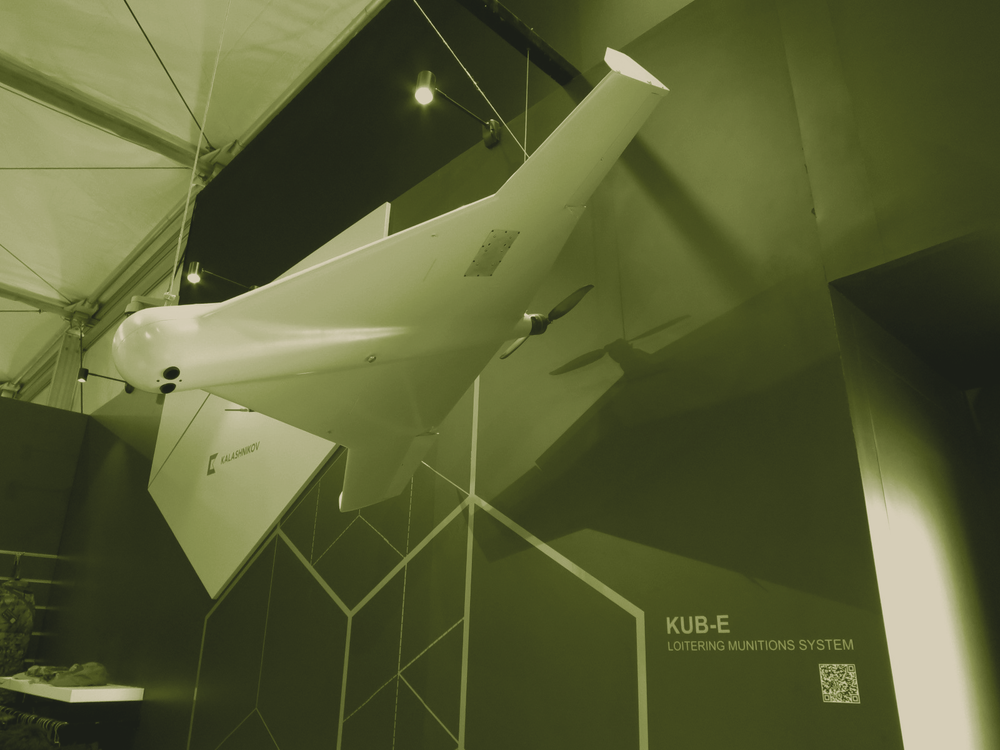
The ZALA KUB-BLA is a Russian catapult-launched loitering munition designed to attack fixed coordinates, with an expanding family of longer-range and electro-optically guided derivatives.
Bars is a Ukrainian jet-powered missile-drone built for long-range strikes, with a claimed reach of up to 1,000 km, speed above 700 km/h and terminal operator guidance.
Neros Archer is a US-made attritable FPV attack drone developed with Ukrainian and American military partners, selected by the US Army under its Purpose-Built Attritable Systems programme.
Helsing's first combat drone — a plywood-framed, AI-guided loitering munition co-produced in Ukraine. It launched badly enough that Kyiv stopped ordering, then improved enough to hit better than half its targets around Pokrovsk.
The small Shahed. About two-thirds the weight of a Shahed-136 with roughly a third of the warhead and a rotary engine, it entered Russian service as the Geran-1 in 2022 and is still a separately planned production line four years later.
Russia's second Shahed line — built not at Alabuga but by Almaz-Antey subsidiary Kupol in Izhevsk, with Chinese engineering help. Heavier warhead than a Geran-2, now sold abroad by Rosoboronexport and fielded in Mali.
The Perennial Hornet is a ~$5,000 AI-guided one-way strike drone from Eric Schmidt's Perennial Autonomy — an optically navigated fixed-wing aircraft Ukrainian units use to burn Russian supply trucks 50-150 km behind the front, the workhorse of Kyiv's "logistics lockdown" campaign.
The Shahed-101 is Iran's small one-way-attack drone — the quiet, catapult-launched progenitor of the Shahed-107, used by Hezbollah and Iraqi militias since 2021, confirmed in Ukraine from late 2025 (all-Iranian parts), and refielded in an electric, near-silent variant for Iran's 2026 Gulf strikes.
The Chernika-2 ("Blueberry") is Russia's foam flying-wing strike drone — 3.5 kg warhead, 100 km reach, ~$10k all-in, with Russian-claimed machine-vision navigation that flies under jamming. Over 11,000 claimed built; hitting Kharkiv since June 2025.
The Shahed-107 is Iran's mid-range strike drone reportedly built for Russia's war — announced as a 1,500 km HIMARS hunter, revealed by Ukrainian teardown as a ~300 km, 15 kg-warhead X-tail drone hitting the near rear. The gap between those two descriptions is the story.
The Molniya is Russia's plywood-and-tape strike drone — a $300–1,600 fixed-wing weapon launched by the thousands each month against Ukrainian cities and supply roads, now spawning fiber-optic, FPV-carrier, recon and 13 kg heavy variants. Cheap mass as doctrine.
Germany's combat-proven eVTOL loitering munition — a VTOL, AI-guided one-way attacker that pairs with reconnaissance drones for EW-resilient precision strikes.
Iran's jet-turbine loitering munition — a faster, costlier successor to the Shahed-136, fielded by Russia as the Geran-3 and by Iran itself in the Gulf.
Low-cost multi-purpose Russian drone, a Shahed-136 lookalike used as a saturation decoy, one-way attack, reconnaissance and signal relay, forcing costly air-defense engagements at extreme cost asymmetry.
Germany's software-defined AI one-way attack drone — an electrically propelled loitering munition with 100 km range and on-board AI for jamming-resistant precision strikes, fielded by Ukraine and under evaluation by NATO armies.
Russia's first jet-powered Shahed — a turbojet bolted onto a Geran-2 airframe to outrun cheap interceptors. It worked well enough to prove the concept and badly enough to be cancelled: Moscow halted production in August 2026 in favour of the purpose-built Geran-4 and Geran-5.
Russia's dominant loitering munition — an electric X-wing anti-materiel drone with shaped-charge, fragmentation, and thermobaric warheads, used at mass scale against artillery, armor, and air-defense assets in Ukraine.
Ukraine's game-changing naval attack drone — a low-profile, satellite-controlled USV that has sunk multiple Russian warships and scored the first-ever uncrewed vessel air-to-air kill.
Iran-origin, Russia-built long-range one-way attack drone — the saturation-strike icon of the Ukraine war, fired in mass nightly salvos to exhaust air defenses and strike infrastructure at a cost-exchange ratio that has rewritten the economics of strategic bombardment.