Shahed-131
The small Shahed. Half the weight of a Shahed-136 with a third of the warhead and a rotary engine, it entered Russian service as the Geran-1 in 2022 and is still a separately planned production line four years later.
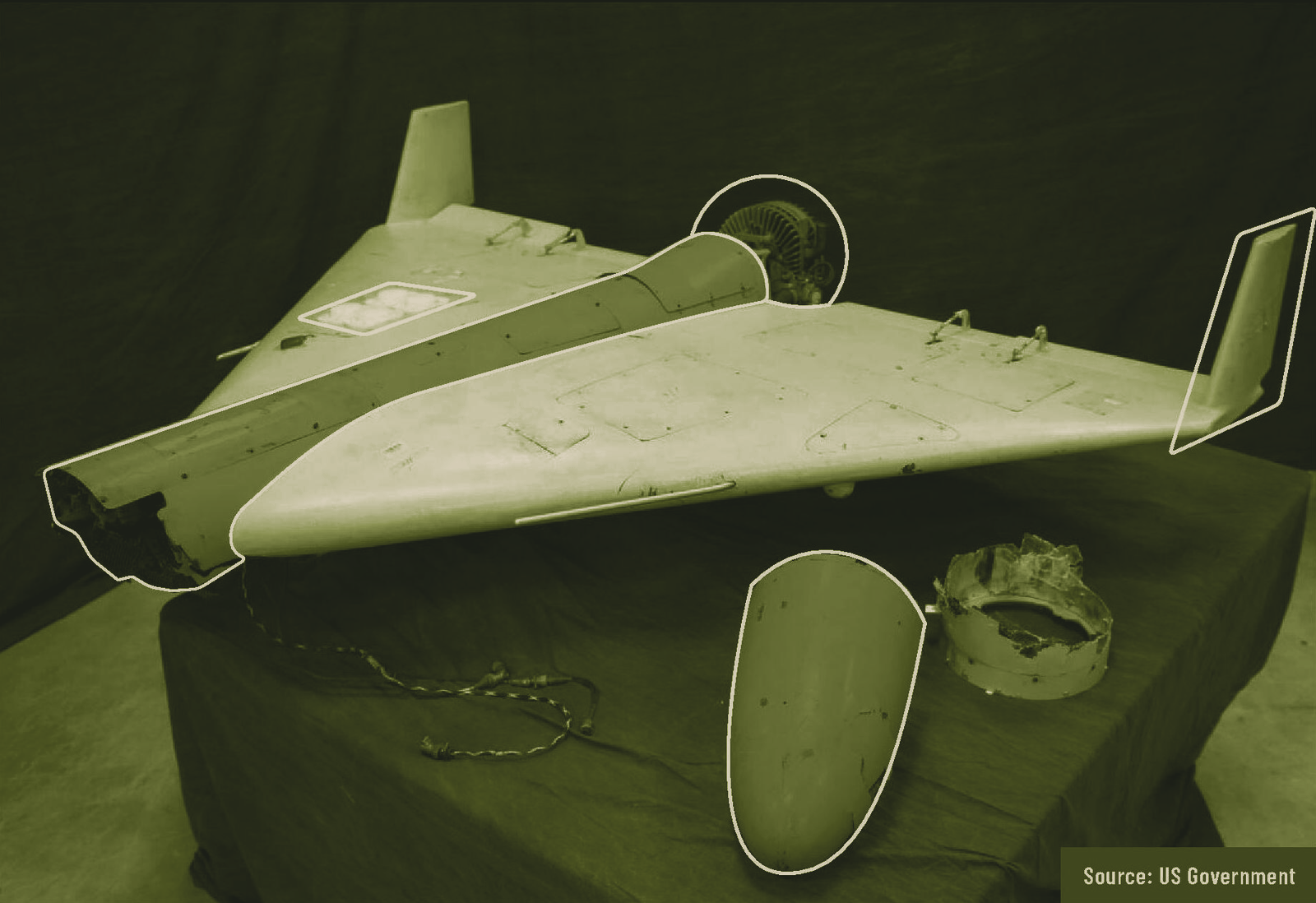
The small Shahed. Roughly two-thirds the weight of a Shahed-136 with about a third of the warhead and a rotary engine in place of the four-stroke, it entered Russian service as the Geran-1 in autumn 2022 — and four years later is still listed as a separately planned production line.
Overview
The Shahed-131 is the smaller member of the Iranian Shahed one-way attack drone family, developed by Shahed Aviation Industries and produced through Iran Aircraft Manufacturing Industrial Company (HESA). It shares the delta-wing, pusher-propeller planform of the better-known Shahed-136, but at roughly 135 kg take-off weight against about 200 kg, with a warhead of 10–20 kg against 40–50 kg, and a range commonly assessed at 900 km against the -136's 1,000–2,500 km.
Russia adopted it as the Geran-1 and began firing it at Ukraine in autumn 2022, alongside the Geran-2. Production was localised at the Alabuga special economic zone in Tatarstan along with the rest of the family. Its role has always been secondary — a cheaper, shorter-legged airframe used against softer targets and as part of the mass that saturates air defence — but it has never been retired. Ukraine's Defence Intelligence listed Geran-1 as one of nine separately planned drone lines in Russia's 11,000-unit August 2026 production plan, alongside Geran-2 through Geran-5, Garpiya and three Gerbera variants.
Development
The Shahed-131 preceded the -136 and entered serial production in Iran around 2019. It emerged from the same Iranian design lineage that produced the Shahed family of loitering munitions and reconnaissance drones, built around a design philosophy of extreme manufacturing simplicity: a delta wing with no separate tail surfaces, a small piston engine driving a pusher propeller, and guidance limited to flying a pre-programmed route to fixed coordinates.
Iran supplied the type to Russia along with the Shahed-136 in 2022, and Russia designated it Geran-1 in service. As with the -136, production was subsequently localised at Alabuga with Iranian assistance rather than remaining an import relationship — the transfer that turned a supply arrangement into a Russian industrial capability and ultimately produced the Geran-3, Geran-4 and Geran-5 jet derivatives.
The -131 has attracted less development attention than its larger sibling. Where the Geran-2 has accumulated gimballed electro-optics, alternative VOR/DME navigation, air-to-air missile carriage and onboard anti-interceptor jamming, the Geran-1 has remained comparatively static — a sign that Russia treats it as cheap volume rather than as a platform worth upgrading.
Design & capabilities
The Shahed-131 is a scaled-down Shahed-136 with one genuinely distinct feature: its engine.
- Airframe: delta wing, tailless, with a pusher propeller. Approximately 2.6 m long with a 2.2 m wingspan — noticeably smaller than the -136's roughly 3.5 m by 2.5 m.
- Take-off weight: about 135 kg, against roughly 200 kg for the Shahed-136.
- Propulsion: a Serat-1 Wankel rotary engine of about 38–39 hp, described in teardown analysis as a reduced variant of the MDR-208. The rotary engine is the -131's most distinctive technical feature and gives it a different acoustic signature from the four-stroke -136 — relevant because Ukrainian air defence relies heavily on acoustic detection networks.
- Warhead: 10–20 kg, most commonly cited at about 15 kg, high-explosive fragmentation, with shaped-charge variants reported. It is mounted near the front of the airframe.
- Range: 700–1,000 km, with the US Defense Intelligence Agency estimating 900 km.
- Speed: roughly 185 km/h cruise, the same slow subsonic profile as the rest of the piston Shahed family.
- Guidance: pre-programmed inertial navigation with satellite augmentation, flown to fixed coordinates. Russian-built examples have received the family's jam-resistant controlled-reception-pattern antennas.
- Launch: truck-mounted rail with rocket-assisted take-off, identical in principle to the -136.
The design trade is simple and deliberate: give up two-thirds of the warhead and more than half the range to get a materially cheaper airframe that still forces an air-defence engagement.
Variants
- Shahed-131 (Iran): The Iranian-produced original, in serial production from about 2019 and retained in Iranian service.
- Geran-1 (Russia): The Russian service designation and localised production variant, built at Alabuga. Fielded from autumn 2022 and still listed as a distinct line in Russian production planning as of August 2026.
- Shaped-charge variants: Reported in some teardown analyses as an alternative to the standard high-explosive fragmentation warhead.
Family context: the Shahed-136/Geran-2 is the larger sibling; the Shahed-101 and Shahed-107 are smaller Iranian one-way attack drones; the Shahed-238 is the jet-powered derivative that led to the Geran-3.
Combat record / operational use
Russia began launching Shahed-131s against Ukraine in autumn 2022, in the same opening wave of Iranian-supplied drone attacks that introduced the Shahed-136. The two types were used together from the outset, and Ukrainian reporting has consistently treated them as a combined threat: the -131 against softer or nearer targets and as part of the numerical mass, the -136 for deeper and harder ones.
Because Ukrainian Air Force tallies almost always report "Shahed-type" totals rather than breaking out sub-types, Geran-1-specific engagement counts are not publicly available. Its continued presence in the inventory is established instead through production planning: Maj. Gen. Vadym Skibitskyi of Ukraine's Defence Intelligence enumerated the August 2026 Russian drone production plan as covering "Geran-1, Geran-2, Geran-3, Geran-4, Geran-5, Garpiya, Gerbera, Gerbera-Kamikaze and Gerbera Seeker — 11,000 pieces" in total.
That listing is the most useful current fact about the type. It confirms the Geran-1 remains in planned production four years after introduction, even as Russia converts capacity toward the jet Geran-4 and Geran-5 and has cancelled the Geran-3 entirely. A small, cheap airframe with a 15 kg warhead evidently still earns its place in the mix.
The type has also been named in Ukrainian descriptions of the target set for new interceptors: the Alexa Spatium jet interceptor's declared targets include the Shahed-131 alongside the jet Gerans.
Advantages
- Cheaper than the Shahed-136 — a smaller airframe with a smaller engine and warhead costs less per round, and cost per round is the entire point of the category.
- Still forces an engagement — air defence cannot distinguish a 15 kg warhead from a 50 kg one on radar, so every -131 consumes an interceptor decision exactly as a -136 does.
- Adequate reach — 900 km covers the great majority of Ukrainian territory from Russian launch sites.
- Manufacturing simplicity — tailless delta, pusher propeller, no datalink in the baseline, minimal parts count.
- Different acoustic signature — the Wankel rotary engine sounds unlike the -136's four-stroke, complicating acoustic classification networks tuned to the larger type.
- Proven and unchanged — four years in service with no redesign required, and a production line Russia has not closed.
Drawbacks / limitations
- Small warhead — 10–20 kg limits it to soft targets, harassment and infrastructure damage at the margins; it cannot destroy hardened structures.
- Slow — about 185 km/h places it squarely in the band that cheap Ukrainian interceptor drones learned to defeat.
- Shorter range than the -136 — 900 km against up to 2,500 km constrains launch-point flexibility and routing.
- Coordinate-only guidance in the baseline — no seeker or operator link of the kind now fitted to the Geran-2 and Geran-4, so it cannot engage mobile or pop-up targets.
- Overshadowed by its own family — development attention and industrial capacity have moved to the jet variants, leaving the -131 technically static.
- Sub-type reporting is poor — Ukrainian tallies aggregate Shahed-type launches, so the -131's actual operational share is not publicly measurable.
Counterparts
- Shahed-136 (Iran/Russia) — the larger sibling and the reference point for everything in this entry.
- Geran-4 and Geran-5 (Russia) — the jet successors now absorbing production capacity.
- Garpiya-A1 (Russia) — the Kupol-built parallel line with a far heavier warhead.
- Gerbera and Parodiya (Russia) — the cheap decoys that fly alongside it and blur raid composition.
- Shahed-101 (Iran) — the next size down in the Iranian one-way attack family.
- Lancet (Russia) — a shorter-range tactical loitering munition in a comparable warhead class but a different role.
Outlook
The Shahed-131's continued production is the interesting fact about it. Russia has cancelled the Geran-3, converted Alabuga capacity toward jet airframes, and reoriented its long-range strike complex around speed — and it is still planning Geran-1 output in 2026. The explanation is almost certainly economic rather than tactical: at a time when a Geran-4's Chinese turbojet alone costs $35,000–40,000, a small piston airframe with a 15 kg warhead is the cheapest way to add a radar track to a strike package and force a defensive decision.
That points to the type's likely future as a mass and screening element rather than a strike weapon in its own right — closer in function to an armed Gerbera than to a Geran-2. If the enlarged Gerbera-2 with its 20–30 kg payload proves out, the two roles may converge and the Geran-1 may become redundant, which would be the clearest signal that Russia has rationalised its cheap-airframe portfolio.
For Iran, the -131 remains a proliferation item: smaller, simpler and more transferable than the -136, and exported to regional proxies. Its relevance outside Ukraine is as the entry-level long-range one-way attack capability that a non-state actor can plausibly operate.
Key specifications
| Spec | Value |
|---|---|
| Type | Delta-wing piston-pusher one-way attack loitering munition |
| Range | 700–1,000 km; DIA estimate ~900 km |
| Speed (Mach / km·s⁻¹) | ~185 km/h cruise (~0.15 Mach) |
| Warhead (type & weight) | High-explosive fragmentation, 10–20 kg (commonly cited ~15 kg); shaped-charge variants reported |
| Guidance | Pre-programmed inertial with satellite augmentation; Russian builds carry CRPA anti-jam antennas |
| Accuracy (CEP) | Not publicly established |
| Launch platform(s) | Truck-mounted rail with rocket-assisted take-off |
| Propulsion | Serat-1 Wankel rotary engine, ~38–39 hp (reduced MDR-208 variant), pusher propeller |
| Length / diameter / launch weight | ~2.6 m length / ~2.2 m wingspan / ~135 kg take-off weight |
| Russian designation | Geran-1 — a separately planned line in DIU's August 2026 production assessment |
Sources
- CSIS Missile Threat — "Shahed-131 and -136." https://missilethreat.csis.org/missile/shahed-131-and-136/
- Open Source Munitions Portal (ARES) — visual comparison of the Shahed-131 and Shahed-136. https://osmp.ngo/collection/ukr-%D1%88%D0%B0%D1%85%D0%B5%D0%B4%E2%80%91131-%D1%96-%D1%88%D0%B0%D1%85%D0%B5%D0%B4%E2%80%91136-%D0%B2%D1%96%D0%B7%D1%83%D0%B0%D0%BB%D1%8C%D0%BD%D0%B8%D0%B9-%D0%BE%D0%B3%D0%BB%D1%8F%D0%B4-%D0%B1/
- Ukrainska Pravda — "Ukrainian intelligence reveals Russia's plans to produce Geran and Gerbera drones." https://www.pravda.com.ua/eng/news/2026/08/10/8048080/
- The Defense Post — "How Iran's Shahed Drone Reshapes Modern Warfare." https://thedefensepost.com/2026/07/04/shahed-drone-guide/
- Quwa — "Shahed Drone: Iran's Attrition Weapon and the Cost-Exchange Crisis of 2026." https://quwa.org/iran/military-news-iran/shahed-drone-irans-attrition-weapon-and-the-cost-exchange-crisis-of-2026/
- Militarnyi — "Alexa Spatium Jet Interceptor Enters Ukrainian Defense Forces Service." https://militarnyi.com/en/news/alexa-spatium-jet-interceptor-enters-ukrainian-defense-forces-service/
- GlobalMilitary.net — "HESA Shahed 131." https://www.globalmilitary.net/aircraft/shahed-131/
🔒 The Analyst Section on Shahed-131 is for BattlePolicy Pro members. Below the line: procurement and contract history, the suppliers and companies behind the system, our head-to-head analyst view of the systems it actually competes with, and the BattlePolicy assessment note. Unlock the full file with BattlePolicy Pro →
Below this point
- Analyst Section
- Procurement & contracts
- Suppliers & related companies
- Comparable systems — analyst view
- Analyst note