Shahed-101
The Shahed-101 is Iran's small one-way-attack drone — the quiet, catapult-launched progenitor of the Shahed-107, used by Hezbollah and Iraqi militias since 2021, confirmed in Ukraine from late 2025 (all-Iranian parts), and refielded in an electric, near-silent variant for Iran's 2026 Gulf strikes.
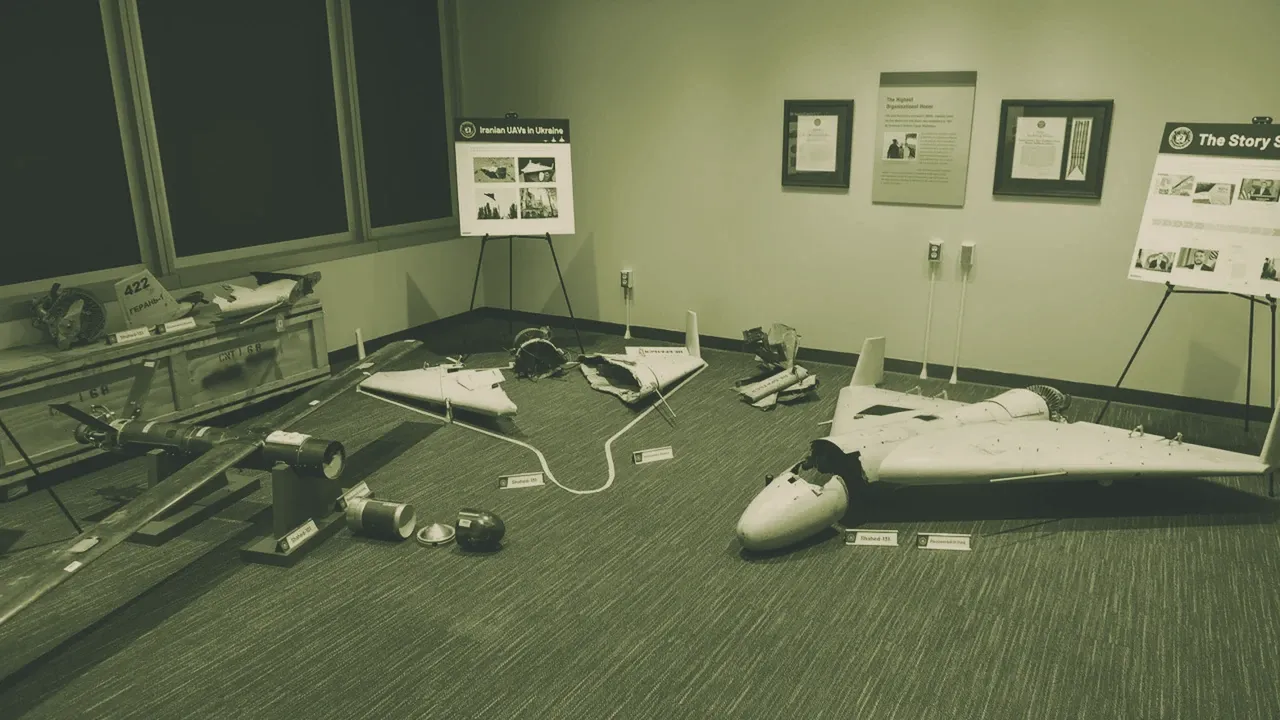
The small, quiet Shahed — the Shahed-101 is Iran's compact one-way-attack drone: a torpedo-bodied, cross-tailed machine launched off a catapult with an eight-kilogram warhead, the progenitor of the larger Shahed-107 and a weapon that has quietly appeared in every theatre Iran touches. It has flown for Iraqi militias since 2021, for Hezbollah against Israel from July 2024, turned up in Ukraine's wreckage fields in late 2025 built entirely from Iranian parts, and reappeared in a near-silent electric form for Iran's 2026 Gulf strikes. Smaller and cheaper than the mass-market Shahed-136, it is the family's precision-and-stealth member — and a case study in how one Iranian design proliferates across four wars at once.
Overview
The Shahed-101 is the small end of Iran's kamikaze-drone family — a narrow cylindrical fuselage with rear-mounted straight wings and four cross-shaped tail fins, catapult-launched, carrying roughly 8 kg of shaped-charge-and-fragmentation warhead to targets a few hundred kilometers away. Built by Shahed Aviation Industries, it predates and sired the enlarged, gasoline-engined Shahed-107; the two share a rear-propulsion layout and, confusingly, much of their spec sheet — the same November 2025 Ukrainian wreckage was labeled "101" by one outlet and "107" by another, a designation fuzziness this entry keeps flagged. What distinguishes the 101 is its role and its quiet: where the Shahed-136 saturates infrastructure with a 40 kg warhead in nightly mass, the 101 is a near-rear precision weapon (100–300 km) with a low, quiet profile — and its electric-motor variant, refielded for Iran's 2026 Gulf campaign, trades the usual piston engine for a nose propeller specifically to cut acoustic and thermal signature for low-altitude penetration. Declassified and displayed by the US DIA in 2023, used by Iraqi militias as the "Murad-5" and by Hezbollah against Israel from July 2024, and confirmed in Ukraine from late 2025 (with wreckage found to be entirely Iranian-made, not yet localized in Russia), the Shahed-101 is the family's quiet proliferator — the drone that shows up wherever Iran or its proxies are fighting, under a different name each time.
🔒 The full Shahed-101 file is for BattlePolicy Pro members. Below the line: development history, design and capabilities, variants, the combat record, advantages and limitations, comparable systems, outlook, the full specifications table, our sourcing, and the analyst assessment — procurement, suppliers and the BattlePolicy verdict. Unlock the full file with BattlePolicy Pro →
Below this point
- Development
- Design & capabilities
- Variants
- Combat record / operational use
- Advantages
- Drawbacks / limitations
- Counterparts
- Outlook
- Key specifications
- Sources
- Analyst Section
- Procurement & contracts
- Suppliers & related companies
- Comparable systems — analyst view
- Analyst note