GRID-REF 37°47′N 122°25′W
DISPATCH 02/26 · 9 Jun 2026
BATTLEPOLICY
Startup to front line. Strategy to consequence.
Lexicon · Russia

Lancet

Russia's dominant loitering munition — an electric X-wing anti-materiel drone with shaped-charge, fragmentation, and thermobaric warheads, used at mass scale against artillery, armor, and air-defense assets in Ukraine.
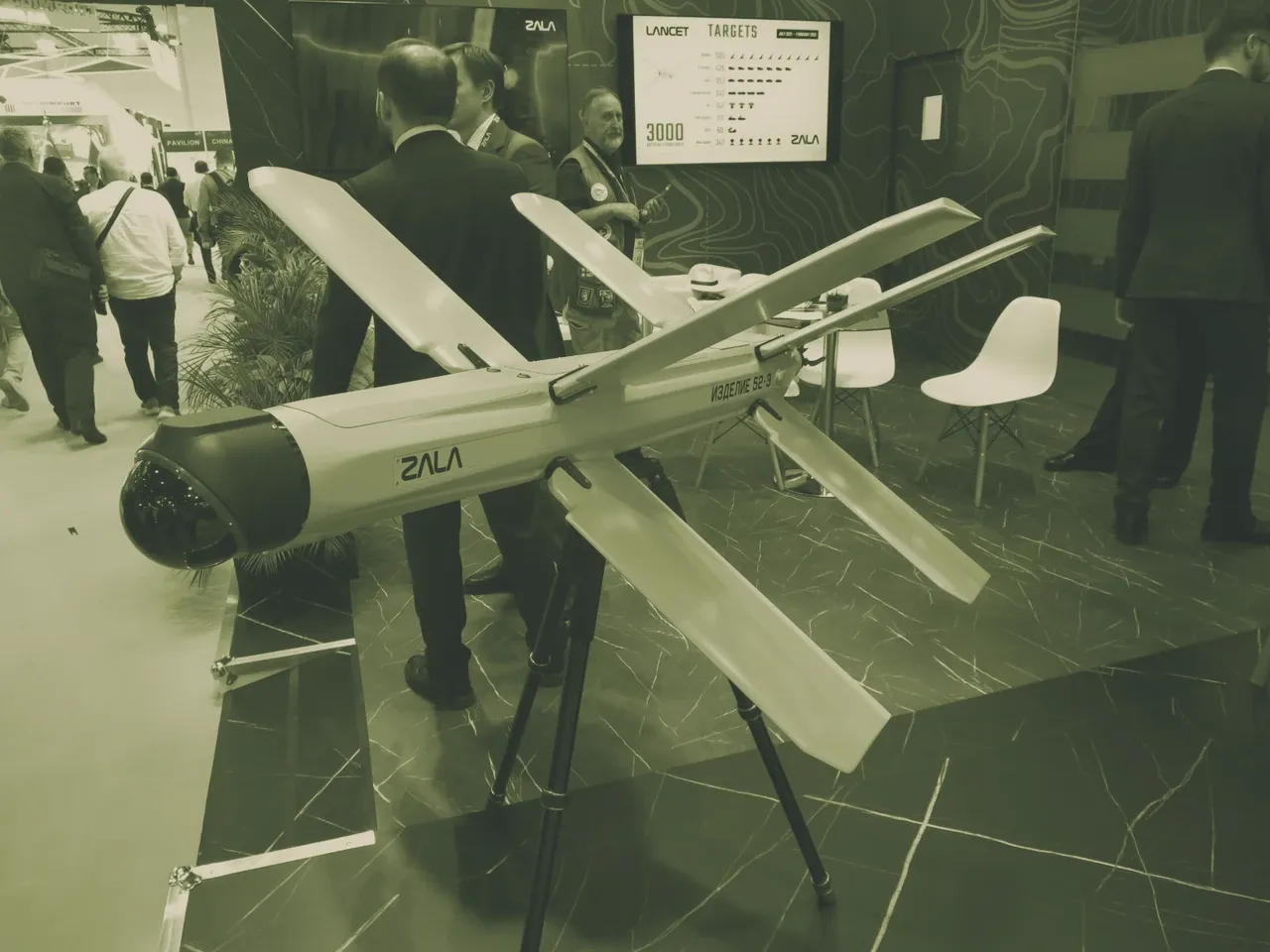
Lancet
FIG.01 · Russia Image - Lancet. Photo by Mztourist, CC BY 4.0, via Wikimedia Commons.
Russia’s dominant loitering munition — a cheap, electric X-wing one-way attack drone that turned the artillery duel in Ukraine into a cost-exchange crisis, striking howitzers, armor, and air-defense systems with shaped-charge, fragmentation, and thermobaric warheads.

Overview

The Lancet, produced by ZALA Aero (part of the Kalashnikov Concern), is a family of tube- or rail-launched loitering munitions that have become the most prolific and tactically significant one-way attack systems in Russian service. Two main airframes — the smaller Izdeliye-52 and the larger Izdeliye-51 — share a distinctive dual-cruciform (X-wing) layout and a quiet electric-pusher propulsion. Designed to loiter over a target area while a separate Z-16 reconnaissance UAV provides the operator with live video, the Lancet dives onto its target at speeds up to 300 km/h. Its combination of low cost (~$30,000–35,000 per round), four distinct warhead options, and immunity to most hard-kill active protection systems has made it a persistent threat to Western-supplied artillery, armour, and air-defence assets in Ukraine.

Development

ZALA Aero first displayed the Lancet at the ARMY-2019 military expo outside Moscow, and according to Wikipedia the type was combat-tested in Syria in 2020 before mass fielding during the Russian invasion of Ukraine in 2022. The design drew on the earlier, smaller KUB-BLA loitering munition but introduced a larger airframe, heavier warheads, and the twin-boom X-wing configuration that gives the Lancet its distinctive silhouette. By early 2023 the weapon was being used at scale, and production ramped through 2024–2025 to meet the voracious demand of front-line units, with the manufacturer claiming the ability to produce thousands of rounds per month.

Design & capabilities

The Lancet is built around a simple electric-pusher propulsion system and a dual-cruciform wing set that allows it to cruise at 80–110 km/h while retaining the agility to execute a near-vertical terminal dive at roughly 300 km/h. Two airframe sizes exist: the Izdeliye-52 (≈30-minute endurance, up to 35 km range) and the larger Izdeliye-51 (≈50-minute endurance, up to 45 km range). Warheads range from 3 kg (early models) to 5 kg (later production rounds) and are available in four variants — shaped-charge, shaped-charge/fragmentation, explosively formed penetrator (EFP)/fragmentation, and thermobaric — as detailed by Ukraine’s military intelligence in a 2026 technical release cited by ArmyInform. Guidance is provided by an operator-in-the-loop who steers via a nose-mounted electro-optical seeker and a line-of-sight datalink; there is no satellite communications link, which gives the Lancet a degree of immunity to wide-area GPS jamming but limits its effective radius to the horizon of the controlling ground station. The manufacturer has progressively introduced artificial-intelligence-assisted terminal homing, reducing the operator’s workload and making the weapon harder to spoof.

The weapon’s architecture makes it a cost-exchange nightmare for the defender. Analysis by CSIS puts the unit cost at a conservatively estimated $30,000–35,000 — a figure that, against a towed M777 howitzer or a self-propelled M109A6 Paladin, yields an exchange ratio of 1:100 or better when measured by replacement value alone.

Variants

The Lancet family breaks into two baseline airframes — the smaller Izdeliye-52 (shorter endurance, lighter warhead) and the larger Izdeliye-51 (longer loiter, heavier warheads) — and an evolving suite of warhead options. An export configuration, designated Lancet-E, was unveiled at the Dubai Airshow 2025 in versions fitted with an infrared seeker, EDR Magazine reported, signalling Moscow’s intention to market the weapon to foreign customers. A related but distinct system, the Scalpel, shares components and is sometimes described as a smaller-capacity Lancet derivative.

Combat record / operational use

The Lancet has been the most effective Russian loitering munition of the war in Ukraine, employed in a widely-documented campaign against Ukrainian towed and self-propelled artillery (M777, M109, AHS Krab), main battle tanks, air-defence radars, and command posts. Its operational pattern is the “recon-strike” pair: a Z-16 UAV locates a target and streams video to an operator, who then launches a Lancet to finish the engagement. By late 2025 the manufacturer claimed that more than 4,000 targets had been destroyed, including over 500 tanks and 260+ M777 howitzers — a claim that the Institute for the Study of War notes is a manufacturer declaration and has not been independently verified. Nevertheless, the volume of open-source video evidence and Ukrainian acknowledgements make it clear that the Lancet has forced a fundamental adaptation in how Ukrainian artillery and armour operate, driving an emphasis on concealment, rapid displacement, and passive countermeasures such as anti-drone netting and decoys.

Advantages

  • Highly favourable cost-exchange ratio (~$30k–35k per round against multi-million-dollar artillery pieces and armoured vehicles).
  • Multiple warhead options (shaped-charge, EFP-frag, thermobaric) allow it to engage armour, soft-skinned vehicles, and personnel in defilade.
  • Line-of-sight control without SATCOM complicates wide-area electronic attack; resistant to GPS jamming.
  • Quiet electric propulsion and small radar cross-section make detection difficult until the terminal dive.
  • Operator-in-the-loop with developing AI-assisted terminal homing permits retargeting and reduces the risk of wasting a round on a decoy.

Drawbacks / limitations

  • Range is limited to the horizon of the ground-based datalink (45 km max), keeping the operator within the reach of counter-battery fire and area-denial systems.
  • Subsonic cruise speed (80–110 km/h) leaves a long transit time during which the launcher must stay put.
  • The weapon is small but not invisible; dedicated anti-drone gunners and short-range air-defence systems can be effective if cued early.
  • The larger Izdeliye-51 airframe requires a catapult launcher and cannot be man-portable.
  • Production, while high, still competes with the demands of the Geran/Shahed and FPV-drone lines; output data is not independently verified.

Counterparts

Outlook

The Lancet is set to remain Russia’s principal short-range loitering munition, with development focused on AI-assisted autonomy, additional seeker types (IR, radar-homing), and variants optimised for swarming. The demonstrated combat record in Ukraine has validated the doctrine of cheap, precise one-way attack drones as a counter to numerically superior NATO-standard artillery, and the export push at Dubai suggests Russia sees a growing international market for the system. For NATO planners, the Lancet is the canonical case study of how a state adversary can produce and mass-field a low-cost, high-endurance loitering munition that saturates and forces costly adaptation across every ground-combat function.

Key specifications

Spec Value
Type X-wing electric loitering munition
Range up to 45 km (Izdeliye-51) / 35 km (Izdeliye-52)
Speed (Mach / km·s⁻) cruise ~80–110 km/h; terminal dive ~300 km/h (~0.08–0.25 Mach)
Warhead (type & weight) 3–5 kg (shaped-charge, SC-frag, EFP-frag, thermobaric)
Guidance operator-guided LOS video; developing AI-assisted terminal lock
Accuracy (CEP) not publicly established
Launch platform(s) catapult / rail launcher (ground vehicle-mounted)
Propulsion electric pusher propeller
Length / diameter / launch weight length ~1.65 m; wingspan ~2.6 m; launch weight ~12 kg

Sources

  1. Wikipedia — ZALA Lancet. https://en.wikipedia.org/wiki/ZALA_Lancet
  2. ArmyInform — Ukraine’s military intelligence releases detailed information on Russian loitering munitions Lancet and Scalpel. https://armyinform.com.ua/en/2026/03/23/ukraines-military-intelligence-releases-detailed-information-on-russian-loitering-munitions-lancet-and-scalpel/
  3. CSIS — Calculating the Cost-Effectiveness of Russia’s Drone Strikes. https://www.csis.org/analysis/calculating-cost-effectiveness-russias-drone-strikes
  4. Institute for the Study of War — Russian Force Generation and Technological Adaptations Update, July 25, 2025. https://understandingwar.org/research/russia-ukraine/russian-force-generation-and-technological-adaptations-update-july-25-2025/
  5. EDR Magazine — Dubai Airshow 2025: ZALA unveils new versions of the Lancet-E loitering munition. https://www.edrmagazine.eu/dubai-airshow-2025-zala-unveils-new-versions-of-the-lancet-e-loitering-munition
FIELD DISPATCH · WEEKLY

BattlePolicy Weekly — free.

Defense tech, startups, and security — weekly. No paywall.

Related
Ukraine · Russia · Policy · Chornobyl · Energoatom · shahed

Russia strikes Ukraine's central spent-fuel store at Chornobyl with a Shahed

A Russian drone hit the receiving building of the Holtec-built dry-cask site that freed Ukraine from shipping its nuclear waste to Russia, metres from where spent fuel sits.

Ukraine · Russia · Policy · Chornobyl · Energoatom · shahed