GRID-REF 37°47′N 122°25′W
DISPATCH 02/26 · 17 Jun 2026
BATTLEPOLICY
Startup to front line. Strategy to consequence.
Lexicon · Russia

Geran-3

Russia's jet-powered evolution of the Shahed one-way attack drone — a turbojet engine, higher speed, and jam-resistant navigation designed to overwhelm mobile air defenses, now in experimental combat over Ukraine.

Russia's jet-powered evolution of the Shahed one-way attack drone — a turbojet engine, higher speed, and jam-resistant navigation designed to overwhelm mobile air defenses, now in experimental combat over Ukraine.

Overview

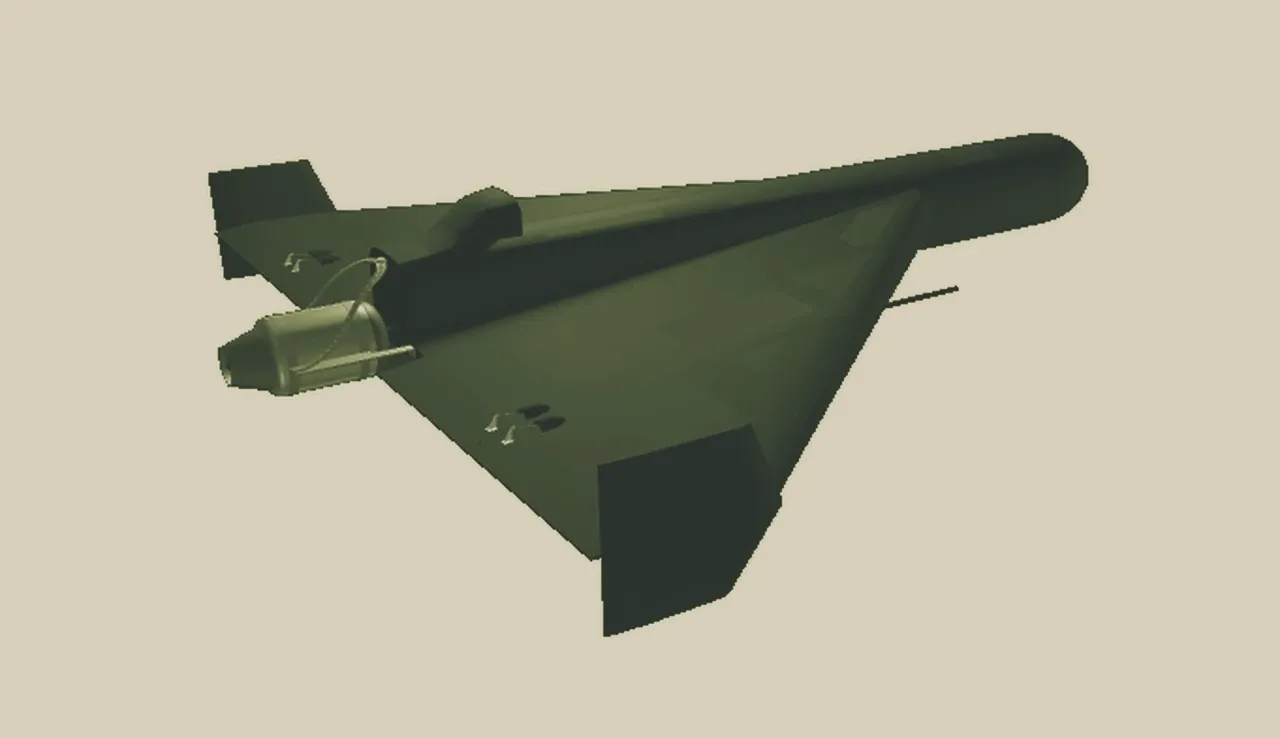
The Geran-3 (Герань-3) is a turbojet-driven one-way attack drone that brings a step-change in speed and survivability to Russia's family of Shahed-derived loitering munitions. Where the ubiquitous propeller-driven Geran-2 (Shahed-136) cruised at barely 180 km/h, the Geran-3 strikes at 300–370 km/h in its combat phase, compressing air-defense reaction times and forcing defenders to expend costly missiles rather than machine guns. The type is a cost-reduced Russian localization of the Iranian Shahed-238, built at the JSC Alabuga special economic zone and first encountered in Ukraine in mid-2025. By spring 2026 it was still employed at experimental scale — around 10–12 airframes a night — but Moscow’s declared goal is to make jet-powered Gerans half of a projected 110,000-drone annual output.

Development

Iran's Islamic Revolutionary Guard Corps unveiled the turbojet-powered Shahed-238 in November 2023, displaying three guidance variants — inertial/satnav, electro-optical, and anti-radiation — and claiming speeds around 500 km/h from a Toloue-10/13 micro-turbojet. Leaked documents from the Alabuga enterprise show Russian evaluators examined the jet prototype as early as April 2023, but Moscow initially balked at an asking price of up to $1.4 million per unit and stuck with the cheap piston-prop Geran-2.

The concept was revived domestically in 2024-2025. Ukraine’s Defense Intelligence (DIU) reported in February 2025 that Russia was setting up Geran-3 production at Alabuga, and the first wreckage appeared in Ukraine in early June 2025. A Defense Express analysis of the airframe that struck Kyiv on the night of 12 June identified it as a Russian-built Geran-3, distinguishable by its Shahed-family avionics panel and a compact jet engine. A detailed DIU teardown published on the War&Sanctions platform in September 2025 revealed a deliberately crude localization: an unshrouded Chinese Telefly JT80 turbojet bolted externally onto an airframe that otherwise mirrored the Geran-2, and a navigation suite carried over from the propeller version.

Design & capabilities

The Geran-3 marries the proven delta-wing Shahed airframe with a small turbojet, trading the low cost of the piston engine for drastically higher speed. Key design features identified by DIU and Ukrainian open-source research include:

  • Powerplant: Chinese-market Telefly JT80 turbojet (U-series), producing approximately 80 kgf of thrust. Iranian-origin examples use the Toloue-10/13.
  • Speed and range trade-off: The drone cruises at ~300 km/h to conserve fuel, delivering a range of approximately 1,000 km. In the attack phase it accelerates to ~370 km/h maximum, though at maximum speed fuel consumption robs it of the longer ranges possible with the original Shahed-238.
  • Guidance: A SADRA inertial navigation system backed by the Kometa-M12 jam-resistant satellite-navigation module, which uses a 12-element adaptive antenna array (CRPA) to resist electronic warfare. A camera and video-transmission payload — identical to that on the Geran-2 Y-series — provides terminal imagery.
  • Warhead: A baseline 50 kg high-explosive/fragmentation warhead; some sources indicate a load up to 90 kg when fuel is reduced, with thermobaric options reported.
  • Launch: Ground-launched from a ramp with rocket assistance, from “droneport” sites in Oryol Oblast and near occupied Donetsk.
  • Flight profile: Able to climb to 5–9 km altitude, above machine-gun and some MANPADS envelopes, then dive in the terminal phase. Radio-control modules and mesh-radio relays extend operator command up to 150 km beyond the border.

The airframe is around 3.5 m long with a 3 m wingspan, and take-off weight is estimated at 370–380 kg.

Variants

  • Shahed-238 (Iran): The parent design, with a streamlined nose and buried engine. Three guidance versions were displayed in 2023. A single Shahed-238 was documented over Ukraine in January 2024, after which the line went quiet.
  • Geran-3 “U” series (Russia): The localized, cost-reduced derivative. Externally mounted turbojet, Geran-2 Y-series avionics, and small-batch production confirmed by serial numbers such as U-36. Tested in combat from June 2025.
  • Geran-4: A more powerful variant (~160 kgf turbojet), 350–500 km/h, take-off weight around 450 kg, range 600–850 km. First combat use (and first interception) recorded on 3 May 2026; some examples carry an R-60 air-to-air missile.
  • Geran-5: Effectively a small cruise missile, ~600 km/h, ~1,000 km range, ~90 kg warhead. Shown publicly in Russia on 9 May 2026.
  • These are distinct from the Geran-2/Shahed-136 (piston-prop, ~180 km/h) and the Gerbera family of cheap decoy drones, which fly in mixed packages to saturate defenses.

Combat record / operational use

The Geran-3’s combat debut emerged gradually. After the lone Shahed-238 sortie in January 2024, DIU announced the Russian production effort in February 2025. The first confirmed Geran-3 struck Kyiv in early June 2025; residents reported a distinct whistling sound, and wreckage analysis by Defense Express identified the Russian-built airframe. Later that month an airframe bearing the serial U-36 was recovered, pointing to small-batch production.

Scale-up accelerated through the second half of 2025. On the night of 30 November 2025 Ukraine’s General Staff logged 138 Geran-3s in a single strike package — most were shot down, but the same night marked the first successful interceptions by Ukrainian Sting interceptor drones, which exploited the type’s slower cruise phase. Militarnyi documented those first kills.

By spring 2026 Russia was launching roughly 10–12 jet drones daily, largely against frontline and border cities where the high-speed dash is most effective. Ukrainian analysts noted that Russia was still experimenting with tactics, with about 30% of long-range drones now carrying radio-control links and mesh relays. The faster Geran-4 entered combat on 3 May 2026, but was promptly intercepted by a remote-controlled Sting, as reported by Militarnyi. By May 2026 serial production of the Geran-3 itself had not yet begun; the follow-on Geran-4 and Geran-5 were prioritized, with Geran-3 serial output planned for the second half of 2026.

Advantages

  • Speed defeats cheap defenses: ~300–370 km/h vs ~180 km/h for Geran-2 lets the drone break through machine-gun-equipped mobile fire groups and outrun electrically-powered interceptor drones, forcing the use of dedicated short- to medium-range SAMs.
  • Jamming-resistant guidance: The Kometa-M12 CRPA satnav plus inertial backup keeps the drone on course under heavy electronic warfare; Ukrainian officials described it as resistant to standard EW countermeasures, according to Business Insider.
  • Flexible flight profile: Can cruise at lower speed for range, then sprint in the terminal phase and dive from altitudes above 5 km, outside MANPADS and machine-gun envelopes.
  • Exploits existing production base: Leaked Alabuga assessments indicated jet drones could be assembled on existing Shahed-136 lines, easing scaling.
  • Inverts the cost exchange: Each interception requires an expensive missile or radar-guided gun round (e.g., 35 mm air-burst rounds at $1,000+), eroding the defender’s favorable cost ratio that existed against propeller Shaheds.

Drawbacks / limitations

  • Severe speed-range trade-off: At maximum speed fuel burn collapses effective range, so combat cruising is only ~300–350 km/h — a speed at which Ukrainian interceptor drones have already scored kills, notably on 30 November 2025.
  • Much higher per-unit cost: An Iranian-sourced Shahed-238 was priced at ~$900,000–$1.4 M, roughly 20-30 times the estimated cost of a Russian-built Geran-2. The Russian-produced Geran-3’s exact cost is unknown but the complex turbojet makes it far pricier than the piston-prop baseline.
  • Foreign-component dependency: DIU identified 45 foreign-made parts, including the Chinese Telefly JT80 engine and items of US, Swiss, German, British, and Japanese origin, creating sanctions-enforcement vulnerabilities.
  • Cruder than the Iranian original: Unshrouded engine, unmodified Geran-2 control surfaces, and small-batch hand-assembly characterized the early U-series; true serial production had not started as of mid-2026.
  • Experimental scale: As of May 2026 only about 10–12 jet drones were launched daily, and the launch sites themselves attracted Ukrainian strikes — SCALP/GBU-39 attacks hit “droneport” infrastructure in April 2026, Ukrainska Pravda reported.

Counterparts

  • Shahed-136 (Iran/Russia) — the propeller-driven backbone from which Geran-3 evolved.
  • Liutyi (Ukraine) — a Ukrainian long-range one-way attack drone of comparable class.

Outlook

Russia’s declared ambition is to make jet-powered platforms half of a planned 110,000-drone annual output (60,000 strike + 50,000 decoys), a leap from the estimated ~500 jet airframes per month in 2026. Whether Moscow can finance and industrialise such a scale is unproven — the unit cost remains an order of magnitude above the Geran-2, and the production lines face both sanctions constraints and pre-emptive strikes on component factories, such as the May 2026 attack on VNIIR-Progress.

Ukraine’s counter-adaptation is already visible: the Brave1 cluster is prioritizing 450–700 km/h interceptor drones and low-cost SAMs, and the fixed launch sites are being systematically targeted. The jet Geran has altered the drone war’s economic calculus, but the race between speed, cost, and production capacity is only just beginning.

Key specifications

Spec Value
Type Turbojet-powered one-way attack drone
Range ~1,000 km (DIU)
Speed (Mach / km·s⁻¹) ~300 km/h cruise, ~370 km/h maximum (DIU)
Warhead (type & weight) HE/fragmentation, ~50 kg baseline; up to ~90 kg with reduced fuel
Guidance SADRA inertial + Kometa-M12 CRPA satnav, camera/video transmission (Geran-2 Y-series electronics)
Accuracy (CEP) Not publicly established
Launch platform(s) Ground-launched (rocket-assisted/ramp)
Propulsion Chinese Telefly JT80 turbojet (U series)
Length / diameter / launch weight ~3.5 m length, ~3 m wingspan, ~0.5 m height; ~370–380 kg takeoff weight

Sources

  1. Militarnyi — “Ukrainian Intelligence Releases Detailed Analysis of Russian Geran-3 Jet-Powered UAV (Series U).” https://militarnyi.com/en/news/ukrainian-intelligence-releases-detailed-analysis-of-russian-geran-3-jet-powered-uav-series-u/
  2. Defense Express — “russia Wants to Significantly Scale Up Jet-Powered Geran Drone Production — How Many Are Produced Now.” https://en.defence-ua.com/news/russia_wants_to_significantly_scale_up_jet_powered_geran_drone_production_how_many_are_produced_now-18497.html
  3. Defense Express — “russian Jet-Powered Drone Hits Kyiv: Avionics and Engine Point to Geran-3 Based on Shahed-238.” https://en.defence-ua.com/news/russian_jet_powered_drone_hits_kyiv_avionics_and_engine_point_to_geran_3_based_on_shahed_238-14821.html
  4. Militarnyi — “Ukrainian Interceptor Drone Downs Jet-Powered Shahed for the First Time.” https://militarnyi.com/en/news/ukrainian-interceptor-drone-downs-jet-powered-shahed-for-the-first-time/
  5. Covert Shores (H I Sutton) — “Guide To Russian Shahed / Geran Strike Drones.” https://www.hisutton.com/Russian-Geran-Shahed-Drones.html
  6. Militarnyi — “Russian Forces Use Geran-4 Jet-Powered Strike Drone for First Time.” https://militarnyi.com/en/news/russian-forces-use-geran-4-jet-powered-strike-drone-for-first-time/
  7. Ukrainska Pravda — “The jet threat. Can Ukraine’s air defence withstand the new high-speed Shaheds?” https://www.pravda.com.ua/eng/articles/2026/05/19/8035370/
  8. Re:Russia — “Missile-Financial Balance: Russia is testing a model of air warfare in Ukraine that could be used in a conflict with NATO countries.” https://re-russia.net/en/analytics/0323/
  9. Business Insider — “Ukraine says Russia’s new jet-powered attack drone is full of foreign parts and immune to electronic warfare.” https://www.businessinsider.com/russia-jet-powered-drone-immune-electronic-warfare-ukraine-says-2025-9
  10. Wikipedia — “Shahed drones.” https://en.wikipedia.org/wiki/Shahed_drones
  11. United24 Media — “New Russian Jet Drone Mimics Cruise Missile — and It’s Already Hitting Ukrainian Cities.” https://united24media.com/latest-news/new-russian-jet-drone-mimics-cruise-missile-and-its-already-hitting-ukrainian-cities-10315
FIELD DISPATCH · WEEKLY

BattlePolicy Weekly — free.

Defense tech, startups, and security — weekly. No paywall.

Related