Jamming, Not Ambition, Is Pushing the Human Out of the Last Ten Seconds
Ukrainian operators lose the radio link before impact and the strike lands anyway. Over Edwards Air Force Base, an AI agent flew 27 intercepts on a passive infrared feed. Both ends of the price curve are solving the same problem.
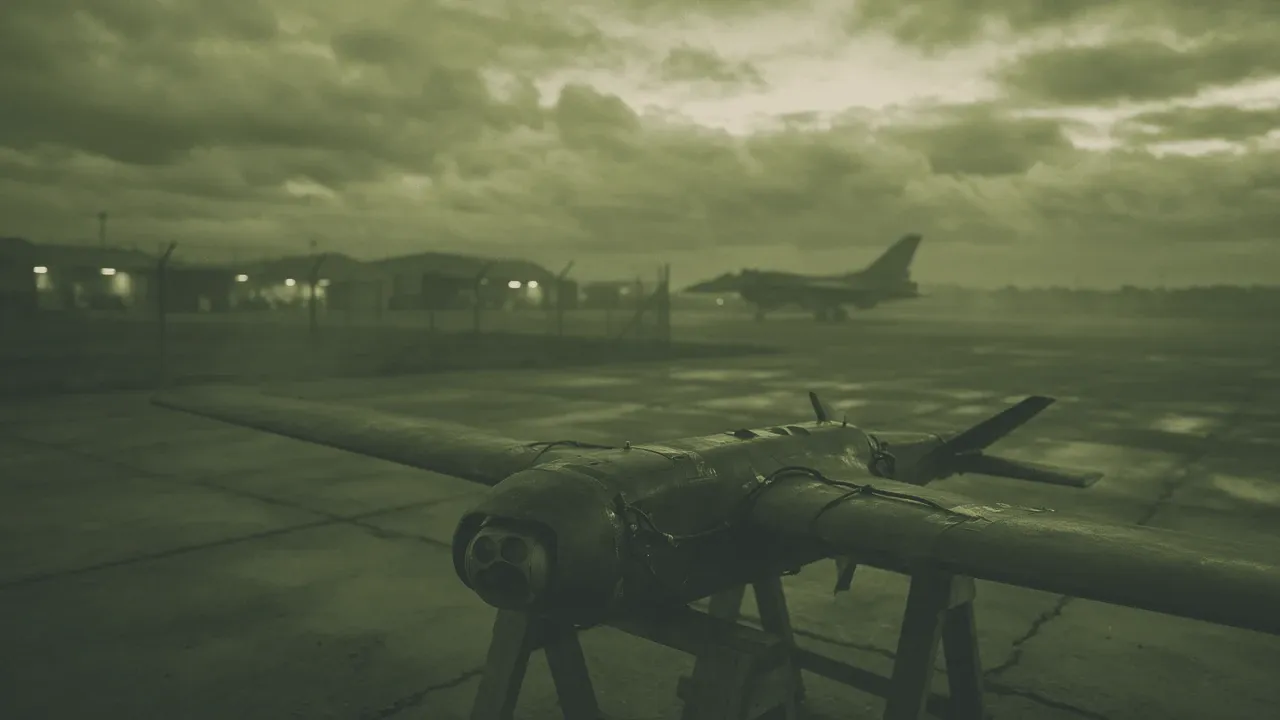
Ukrainian operators lose the radio link before impact and the strike lands anyway. Over Edwards Air Force Base, an AI agent flew 27 intercepts on a passive infrared feed. Both ends of the price curve are solving the same problem.
Ukraine's drone crews frequently lose control of their aircraft in the final seconds of an attack, and the attack completes regardless. That is the design, not a failure mode, and on 4 August the US Air Force disclosed a version of the same design flying on a modified F-16 over California. What is pushing the human out of the terminal engagement at both ends of the price curve is electronic warfare. It is not enthusiasm for artificial intelligence, and reading it that way misreads what is being bought.
Target lock, and the last kilometer without an operator
Ukrainian units call the capability target lock. Dmytro "Liber" Zhluktenko, a former drone operator now a lessons-learned analyst with the 413th Unmanned Systems Regiment "RAID", told Business Insider that many Ukrainian drones can find and hit a target after the operator loses control. Signal loss before impact is routine, he said, caused both by Russian jamming and by how the aircraft themselves are built. Perennial Autonomy's Hornet mid-range strike drone talks to its operator through an onboard Starlink terminal, and steep dives or hard maneuvering break the satellite lock without any help from the enemy.
The pattern across Ukrainian industry is consistent and deliberately narrow. A human identifies and designates the target, then machine vision holds it. F-Drones' LITAVR carries automatic terminal guidance that, per Ukraine's defense ministry, identifies the target and guides the drone to impact while the operator "controls only the speed." The Fourth Law sells its TFL-1 as a bolt-on module doing the same job across drone types. Buntar Aerospace builds optical navigation for jammed airspace, and cofounder Bohdan Sas described the achievable piece plainly: final target acquisition is relatively easy to automate, using OpenCV and a machine-learning model to recognize and track. Zhluktenko was explicit that deployed systems still keep a human in the loop to a very significant extent.
Manpower is the second driver. Agris Kipurs, who runs Latvian maker Origin Robotics, argued that autonomy is what lets small militaries scale, because "we don't have the numbers in terms of infantry." His Blaze interceptor makes the opposite design choice on purpose: it self-destructs when its link is severed rather than pressing on. The same technology supports both answers, which is why the engineering question and the policy question keep getting confused for one another.
The scale of what target lock buys was visible in June 2025. In Operation Spiderweb, Ukraine says drones smuggled close to Russian airbases in trucks hit 41 aircraft, and that when some lost signal they continued along their programmed route and armed on finding their targets. The Lowy Institute puts the damage at roughly $7 billion and about a third of Russia's strategic bomber fleet. The autonomy involved was crude. The leverage was not.
27 intercepts, eight flights, one passive sensor
Lockheed Martin's Skunk Works, the US Air Force Test Pilot School and industry partners flew 27 AI-controlled intercepts across eight flights on the X-62A VISTA, a heavily modified two-seat F-16 based at Edwards Air Force Base. The live target was a T-38 trainer. What separates the campaign, nicknamed Have Heat, from the mock dogfight that preceded it in 2024 is where the agent got its picture of the world: an underwing Legion Pod feeding live infrared search-and-track data instead of simulated target injects. In the 2024 event the X-62A and its opponent had been exchanging data throughout, as The War Zone noted, which left the hardest problem untouched.
Ron Fehlen, vice president and general manager of Skunk Works, said the agents "consumed classified infrared search and track feeds and executed combat-critical maneuvers in real time." Lockheed states that full integration and ground test of those agents took three months, using an in-house agent-generation system it calls Supermassive. A parallel effort, Have Holidays, put a third-party autonomous agent onto the same aircraft and tested guardrails to stop an autonomous vehicle from violating operator-set limits.
Why both ends picked the same architecture
Notice the sensor. IRST is passive. It emits nothing, so it does not warn the target that it is being tracked, and it is immune to radio-frequency jamming by construction. That is the identical property Ukrainian terminal guidance chases from the opposite direction and at four orders of magnitude less money: a camera and an onboard model that need no link at the moment of engagement.
The convergence is not stylistic. Both programs concluded that the radio link is the part of the kill chain an adversary can reliably take away, and both moved the final loop onto the aircraft behind a sensor that cannot be jammed or traced back. The Air Force wants collaborative combat aircraft pushed forward as IRST nodes for exactly this reason, since passive sensors ahead of crewed fighters produce tracks that stealth shaping does not defeat and that nothing can home in on. Ukraine wants the drone to finish the run after the operator has already gone deaf.
Russia's $10,000 answer
Russia reached the same conclusion at the bottom of the market. Its Seeker modification, forward-looking cameras feeding a Raspberry Pi that runs machine-vision software, has migrated from the Geran strike drone to the far cheaper Gerbera, David Axe wrote for Euromaidan Press. The operator locks onto a truck or a locomotive from about a kilometer out and the machine vision flies the remainder, holding through the Ukrainian jamming that would otherwise cut the link in the closing seconds. The Hudson Institute assessed on 29 July that Russia has standardized guidance, communications and navigation components across both variants.
The economics carry the story. A Geran runs $50,000 to $100,000. The 18-kg Gerbera, assembled at Alabuga from Chinese kits and first flown as a decoy to bleed Ukrainian air-defense stocks, costs about $10,000 and reaches up to 600 km, which covers every main supply line feeding Ukraine's front-line brigades. Ukraine's navy spokesperson says separately that Russia is now betting primarily on jet-powered Shahed variants while reducing its use of older models.
The Army wants it for under $150,000
Washington's answer to that arithmetic is still a missile, only a cheaper one. On 4 August the Army published a sources-sought notice for a Next Generation Counter-sUAS Missile, and the ceiling is the news: less than $150,000 per round in a quantity buy of at least 5,000, according to DefenseScoop. The threshold requirement is defeating Group 2 and Group 3 drones beyond 16 km at 6 km altitude, with an objective of 25-plus km at 8 km, launching under five seconds after the operator commits, on an all-weather RF seeker. It must fit the Coyote launcher, for which Raytheon won a $5 billion contract in 2025, and the Integrated Battle Command System Maneuver, for which the Army selected Anduril's Lattice software. Industry responses close on 20 August, and the service wants Technology Readiness Level 7 by the end of fiscal 2027.
Set that ceiling against the Gerbera and the exchange ratio still runs an order of magnitude in Russia's favor per engagement. The Army has cut the price of the shot substantially. It has not changed the shape of the answer.
Capital has already priced the direction of travel. Anduril raised $5 billion in May at a $61 billion valuation, double the $30.5 billion it carried after its Series G eleven months earlier, and Reuters reported on 24 July that it is in talks at roughly $100 billion. The company responded that no decisions had been made about any future financing. The wider pool moved with it: venture funding into the sector more than doubled to over $12 billion in the first half of 2026, per the Financial Times, eclipsing the roughly $10 billion raised across all of 2025. What those rounds are buying is consistent, and it is cheap expendable hardware rather than the replace-it-once-a-decade kind.
The industrial side is catching up to the money. Anduril's first YFQ-44A rolled off the Arsenal-1 line in Ohio in late July, and pre-production Furies flew operational tests at Creech Air Force Base alongside General Atomics' YFQ-42A. The Air Force aims to field its first operational CCAs by 2030, expects F-22 crews to serve as the initial airborne controllers, and says humans will stay on the loop to authorize lethal attacks.
What to watch
Three indicators separate the trend from the marketing.
- Whether Have Heat's agents move to a CCA airframe rather than staying on the VISTA test aircraft. The X-62A's Mission Systems Upgrade adds Raytheon's PhantomStrike radar, which will show whether the Air Force still wants an emitting sensor pushed forward or is committing to passive tracks.
- The NGCM responses on 20 August, which will establish whether anyone can actually build a 25-km interceptor for $150,000, or whether the ceiling gets quietly raised.
- Where Ukraine draws the human-in-the-loop line. Mykyta Rozhkov of Frontline Robotics expects "not fully autonomous, but pretty much autonomous operations done by robots in real battlefield conditions in 12 months." Ukraine's defense ministry said in June that one company had automated 95% of an interceptor drone's engagement cycle, leaving the operator to select the target and order the engagement.
That remaining 5% is where the policy argument actually lives. Jamming is what keeps shrinking it.
Frequently Asked Questions
What is "target lock" on a Ukrainian drone?
A human operator identifies and designates the target, then onboard machine vision holds it. If jamming cuts the video or command link, the drone keeps tracking the designated target and completes the attack. Dmytro Zhluktenko of Ukraine's 413th Unmanned Systems Regiment told Business Insider the capability is widely used because signal loss before impact is routine.
Are these fully autonomous weapons?
No. Zhluktenko said all currently deployed Ukrainian systems keep a human in the loop to a very significant extent, with the operator selecting the target. The automation covers recognition, tracking, navigation and terminal guidance. Ukraine's defense ministry said in June that one company had automated 95% of an interceptor drone's engagement cycle, with the operator still selecting and authorizing.
What happened in the Have Heat test?
Lockheed Martin Skunk Works, the US Air Force Test Pilot School and industry partners flew 27 AI-controlled intercepts across eight flights on the X-62A VISTA, a modified F-16 at Edwards Air Force Base, against a live T-38. The agent used live infrared search-and-track data from a Legion Pod rather than simulated targets, per Lockheed Martin's 4 August release.
Why does the infrared sensor matter?
Infrared search and track is passive. It emits nothing, so it does not alert a target that it is being tracked, and it cannot be jammed by radio-frequency electronic warfare, as The War Zone noted. That is the same property Ukrainian camera-based terminal guidance provides at a far lower cost.
What is the Army's Next Generation Counter-sUAS Missile?
A sources-sought notice published 4 August for an interceptor costing under $150,000 per round in a buy of at least 5,000, able to defeat Group 2 and Group 3 drones beyond 16 km at 6 km altitude, per DefenseScoop. It must work with the Coyote launcher and the Integrated Battle Command System Maneuver. Industry responses are due 20 August.
What is Russia's equivalent?
The Seeker modification, cameras feeding a Raspberry Pi running machine vision, which has moved from the Geran strike drone to the roughly $10,000 Gerbera, David Axe reported for Euromaidan Press. The Hudson Institute assessed on 29 July that Russia has standardized guidance, communications and navigation across both variants.

Marcus Schuler
Marcus Schuler edits BattlePolicy, a daily defense-technology brief connecting the companies and capabilities behind modern war to the contest among Europe, the US, Russia, and China.