One Operator, Five Drones, No GPS: Ukraine Moves to Scale Group Drone Resupply
Ukraine's Defence Ministry says group control doubled one assault battalion's cargo deliveries in a month, and the company behind the jam-resistant links is taking them to US and Finnish platforms.
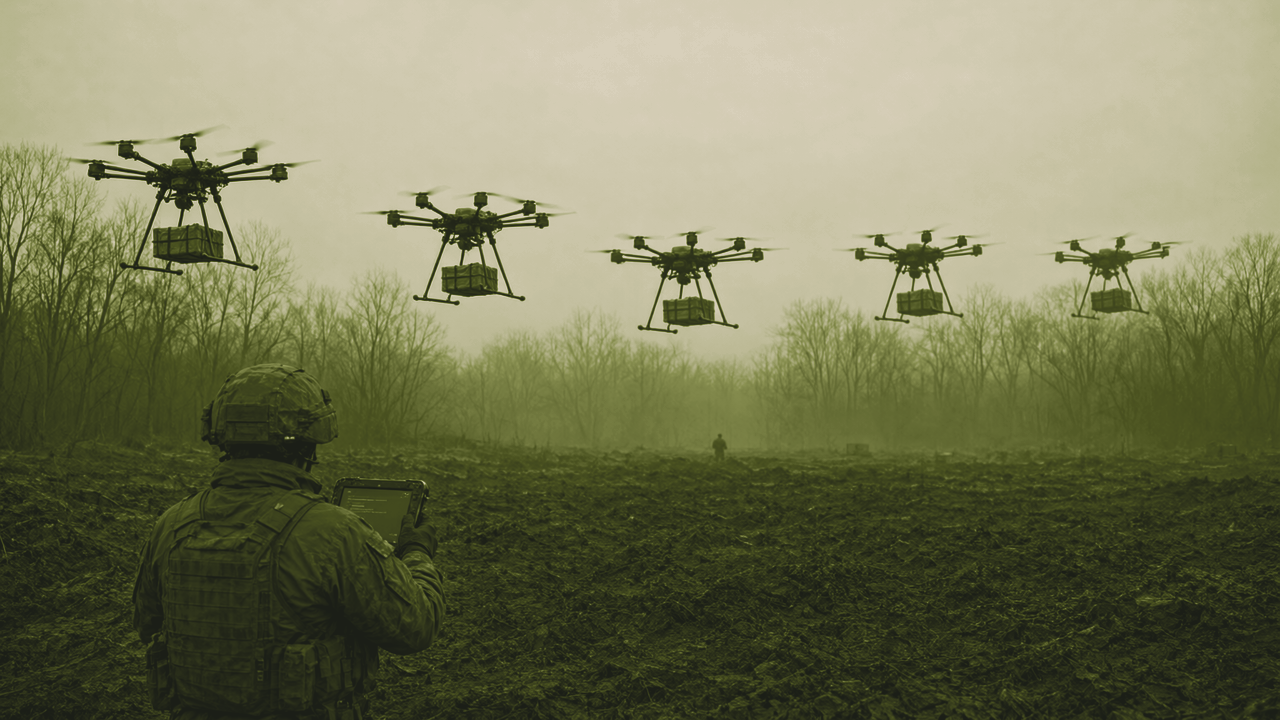
Ukraine's Defence Ministry says group control doubled one assault battalion's cargo deliveries in a month, and the company behind the jam-resistant links is taking them to US and Finnish platforms.
Ukraine's Defence Ministry and the Brave1 defense innovation cluster are working to scale up multi-drone control for front-line resupply, the ministry said this week. The drones take off one after another and fly autonomously to a designated point without GPS.
Frequently Asked Questions
What is group drone control?
Drones take off one after another and fly autonomously to a designated point without GPS. The operator marks an area on a map, the system plans collision-free routes for the group, and the operator takes manual control only in the final minutes, according to Ukraine's Defence Ministry.
What is Pasika?
Pasika ("Apiary") is a group-control system from Ukrainian company Sine Engineering, a Brave1 member. Brave1 says it lets one operator control five drones at once.
What results has the ministry reported?
The 108th Separate Assault Battalion "Da Vinci Wolves" doubled its cargo deliveries within a month of using group control, the ministry said. It gave no absolute figures, drone type or payload.
Why does GPS-free flight matter?
Russian electronic warfare jams satellite navigation along the front. The ministry says the drones fly without GPS and keep their orientation under jamming through secure communications.
Where else is Sine's technology going?
Red Cat signed a memorandum of understanding on Nov. 2 to integrate Sine's links and GPS-independent positioning into its drones and Blue Ops uncrewed surface vessels, starting with maritime platforms. Sine also announced a research initiative with Finland on Oct. 22, the Kyiv Independent reported.
AI-generated summary, reviewed by an editor. More on our AI guidelines.
Read next — from the Lexicon
Below this point
6 more sections.
An operator marks an area on a map, and the system calculates routes for the whole group while preventing collisions. Secure communications keep the drones oriented under Russian electronic warfare. All aircraft sit on one interface; the operator switches between them with one click and takes manual control only in the mission's final minutes.
One system in use is Pasika, or "Apiary," built by Brave1 member Sine Engineering. It lets a single operator fly five drones at once, according to Brave1.
The 108th Separate Assault Battalion "Da Vinci Wolves" of the 59th Separate Assault Brigade of Unmanned Systems was among the first units to use group control systematically for logistics. Its cargo deliveries doubled within a month, the ministry noted. The statement gave no absolute delivery figures, drone type or payload.
Sine says it supports more than 200 Ukrainian drone manufacturers and that its solutions are behind most active interception operations. The company was the first project selected under the US-Ukraine Reconstruction Investment Fund, and on Oct. 22 it announced a joint research initiative with Finland covering resilient communications, navigation and onboard autonomy, the Kyiv Independent wrote.
On Nov. 2, Red Cat signed a memorandum of understanding with Sine's US business to fit its jam-resistant links and GPS-independent positioning into Red Cat aerial drones and Blue Ops uncrewed surface vessels. Integration and field work are already underway.
The navigation and link layer that lets one soldier run five cargo drones through Russian jamming is now headed for American and Finnish hardware. Red Cat says the companies intend to start with maritime platforms, and Sine is seeking a place for its Finnish project in the Ukraine-Finland Drone Deal signed in September.

Marcus Schuler
Marcus Schuler edits BattlePolicy, a daily defense-technology brief connecting the companies and capabilities behind modern war to the contest among Europe, the US, Russia, and China.