Kyiv's Jamming Dome Meets Russia's 32-Element Shahed Antennas
Ukraine stopped 89% of propeller Shaheds in October against 66% of jet variants. The radio contest, a citywide jamming dome over Kyiv against Russia's growing anti-jam antennas, now decides how many drones reach its costlier defenses.
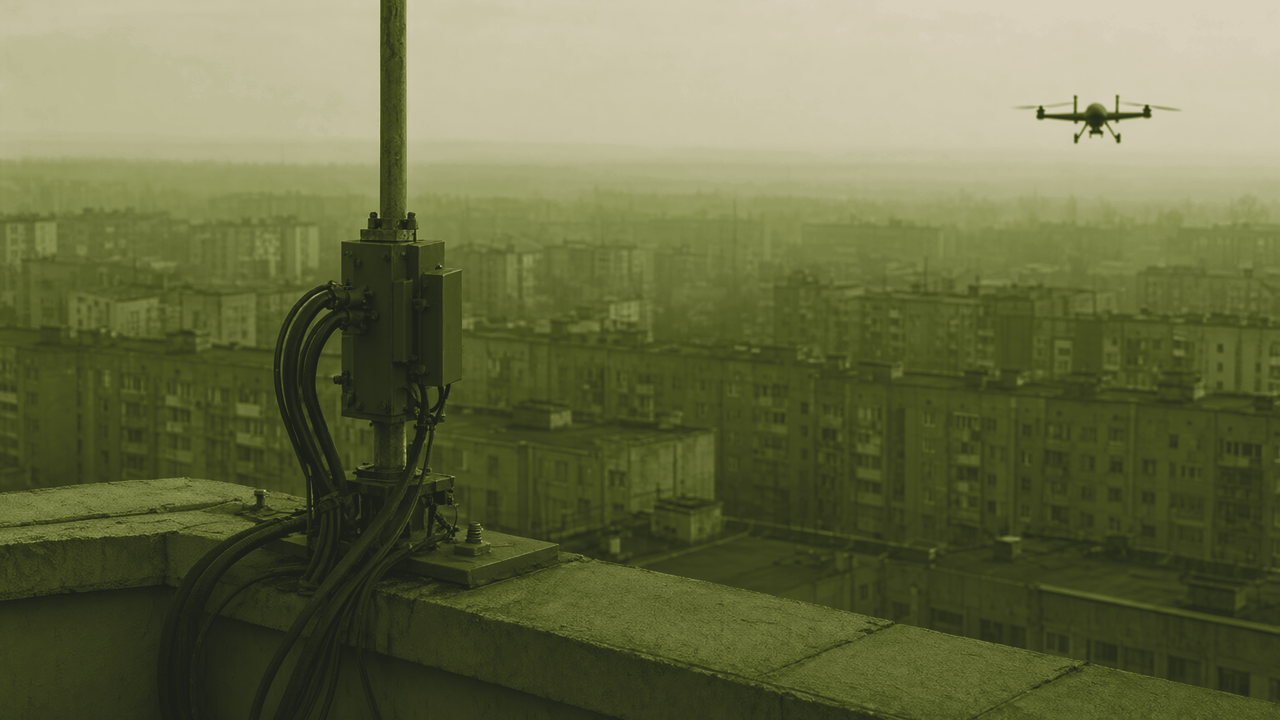
Ukraine stopped 89% of propeller Shaheds in October against 66% of jet variants. The radio contest now determines how many drones reach its costlier defenses.
Kyiv's electronic-warfare dome has forced Russia to rework its remotely piloted Shaheds, presidential defense-technology adviser Serhii "Flash" Beskrestnov said Nov. 2. Ukraine's major EW manufacturers worked around the clock for several weeks, equipping "many hundreds of locations" across the city to break the mesh radio links through which operators inside Russia steer the drones and hunt targets in flight.
Jamming is the cheapest and most widely deployed layer of Ukraine's air defense, and it is the layer under pressure. Beskrestnov has already identified 32-element anti-jam antennas on Shaheds attacking Kyiv, double the 16-element arrays Russia uses at scale; each added element lets the antenna suppress one more jamming source. "This race is difficult for us because it is easier for the enemy to increase the number of elements on an antenna than it is for us to add electronic warfare sites," he said. Of the dome, he wrote: "This operation has forced the enemy to pause, upgrade their Shaheds and look for other solutions."
October's 66% and 89%
Ukraine's General Staff counted 6,473 Shahed-type launches in October and 4,859 destroyed. Defenses stopped 66% of jet variants against 89% of propeller models. Earlier in the autumn the jet rate had been about 55%.
The Air Force's October ledger, published Nov. 3 and relayed by the Defense Ministry a day later, counted more than 8,000 aerial targets destroyed and over 43,000 tactical drones neutralized. It listed 4,455 Shahed-131/136s, Gerberas and Parodiya decoys; 2,688 Shahed-238s, up from 1,935 in September; 1,104 reconnaissance drones; and 809 Lancets. Missile interceptions comprised 14 Kh-101s, 12 Kalibrs, 11 Iskander-M/KN-23s, eight Iskander-Ks, seven Kh-59/69s, one Zircon and 143 Banderols. The tallies do not reconcile: the Air Force count includes decoys, the General Staff counts Shahed launches, Air Force spokesman Yurii Ihnat's October figures add up to roughly 8,740 drones, and the Air Force daily data collated by ISW show 6,158 launched and 5,169 intercepted.
The Air Force's preliminary tally for the night of Nov. 3-4, as of 08:00 with more than 20 drones still airborne, showed 272 destroyed or jammed of 310 launched, including 64 of 81 jets. One night does not move a monthly rate, but it shows what the radio layer is fighting for: every jet Shahed the dome and the jammers turn away is one the interceptor drones, fighters and missiles never have to meet. What the dome actually blocks, what the new antennas defeat, and why those are two different radio fights, follows below.
Frequently Asked Questions
What is the electronic-warfare "dome" over Kyiv?
Jamming antennas and equipment installed at many hundreds of locations across the city over several weeks to break the mesh radio links Russian operators use to steer Shahed drones and pick targets in flight, according to presidential adviser Serhii "Flash" Beskrestnov on Nov. 2.
How well did Ukraine stop Shaheds in October 2026?
Ukraine's General Staff counted 6,473 Shahed-type launches and 4,859 destroyed, stopping 66% of jet-powered variants and 89% of propeller models. The Air Force's broader ledger, which includes decoys, lists more than 8,000 aerial targets downed.
What are the 32-element antennas on Russian Shaheds?
Kometa satellite-navigation modules by VNIIR-Progress with arrays of patch antennas that null out jamming. HUR says 16-element arrays are used at scale and 20-element serial production is being set up; Beskrestnov has found 32-element units on drones attacking Kyiv, per Defense News.
Who makes the radio modems that let Russia pilot Shaheds remotely?
An investigation by The Insider found Shenzhen Xingkai Technology supplies XK F-359 mesh modems to Russia through intermediaries, holding about half of the high-performance mesh-modem market, with an invoice for 500 units at 19.5 million yuan.
When will Ukraine get the 500 Patriot PAC-3 missiles?
The State Department approved the $2.1 billion sale on Oct. 30, funded by Canada, Germany and Norway. A department official put deliveries between the fourth quarter of 2030 and the fourth quarter of 2033, after a 30-day congressional review.
AI-generated summary, reviewed by an editor. More on our AI guidelines.
Read next — from the Lexicon
Below this point
- Kyiv's mesh-radio screen
- Kometa's 16, 20 and 32 elements
- Russia's winter launch capacity
- Interceptors and the engine constraint
- PAC-3 deliveries and Russian stocks
- What to watch
Kyiv's mesh-radio screen
Kyiv's dome attacks the connection that lets a Shahed change targets after launch. Beskrestnov described an operator inside Russia controlling the aircraft through an onboard modem. The General Staff, the Defense and Interior ministries, the National Security and Defense Council and the President's Office worked on the operation, he said, under the president's constant supervision. Equipping hundreds of locations in weeks was an industrial and organizational task as much as a radio-engineering problem.
Militaer Aktuell's technical explainer describes each modem-equipped Geran acting as a relay for others, passing video and commands beyond an operator's direct radio range, and shows a control-signal route running through Belarus. A GPS jammer alone cannot reliably stop an aircraft continuing along a preset course; Kyiv therefore targeted the control link. Countering the mesh network's frequency hopping requires responses measured in microseconds.
The Insider's investigation identifies the commercial supplier behind that capability: Shenzhen Xingkai Technology. It found XK F-359 mesh modems moving through the intermediaries Atlant-Inzhiniring and LT Global Forwarding, declared in customs documents as antennas and remote controls. Journalists posing as suppliers to the Alabuga drone plant obtained an invoice for 500 modems worth 19.5 million yuan, approximately EUR 2.6 million. The investigation estimates Xingkai supplies about half of Russia's high-performance mesh-modem market. The devices contain AMD FPGA chips; AMD denies a direct business relationship.
The modems hold connections over 100 to 300 kilometers, enabling in-flight retargeting and onboard video. That capability changes the defensive requirement: disrupting navigation and interrupting an operator's commands address separate functions.
The industry portal ITC.ua cautions that the dome blocks one control path, leaving Russia options to change configurations, use alternative transmission routes or improve autonomous flight. Beskrestnov separately warned in October of possible hidden ground relays inside Kyiv. That warning remains unconfirmed. The dome is a disruption Russia must answer, not a permanent denial of remote control.
Kometa's 16, 20 and 32 elements
Russia's Kometa upgrades defend satellite navigation, a separate part of the radio contest from mesh control. Defense News reported Nov. 2 that Ukraine's military intelligence agency, HUR, has documented the VNIIR-Progress modules on Geran drones, glide-bomb kits, Iskander-M and Kinzhal missiles, and the Filin cruise missile. HUR's Oct. 19 disclosure described 16-element arrays already used at scale and preparations for serial production of 20-element versions. Russian defense firms ordered more than 100,000 Kometa modules in various configurations this year, HUR said.
The number of elements matters alongside their arrangement and the processing algorithm that separates satellite signals from interference, according to HUR. For Ukraine, this means the defensive requirement can change through a component upgrade across several weapon families, rather than through an entirely new aircraft.
Night Watch commander "Alkhimik" found a practical response after buying a 32-element antenna recovered from a crashed Shahed on the secondary market. He told Militarnyi in July that it combined two 16-element arrays covering different satellite-navigation bands. His proposed counter uses two jamming systems: one for L1 and another for L2/L5. The finding specifies an additional coverage requirement, not a measured cost comparison.
Fly Group Ukraine development director Anatoliy Khrapchynskyi told Reuters in September of another approach: networked devices feed the drone false coordinates, and its own autopilot steers it away from cities. Bigger arrays therefore increase the defensive burden without making navigation invulnerable.
Russia's winter launch capacity
Russia can combine component changes with changes in attack composition. Beskrestnov observed waves of older gasoline-engine Shaheds overnight Nov. 1 and said Moscow apparently expected heavy cloud to hinder interceptor crews.
The Drone Warfare Intelligence Monitor's October review identifies a launch complex near Millerovo, in Rostov Oblast, built in about six weeks with eight launch positions and 32 preparation areas. Analysts assessed its capacity at 100 drones daily. The monitor also collates estimates of Russian jet-drone production at 2,000 to 4,000 a month.
ISW's Nov. 2 assessment puts jet-drone speeds at up to 600 km/h and concludes that Russia used fewer drones during summer while accumulating piston and jet aircraft for winter. The October interception improvement therefore meets a campaign with accumulated stocks as well as continuing output. A better percentage alone cannot establish that the number reaching targets is falling.
Interceptors and the engine constraint
Ukraine's industrial response depends on producing interceptors fast enough to catch jet Shaheds in quantity. Volunteer and former defense-minister adviser Serhii Sternenko expects "more or less mass production" of a counter by the end of 2026. Electric interceptors are furthest along. He estimates they can reach 550 to 600 km/h and hold it for at least a few minutes, while judging turbojet designs more promising over time.
Sternenko identifies engines as the constraint. Ukraine produces some electric motors; turbojet manufacture is harder, more complex and more expensive. He describes the jet-powered Bars drone-missile's adaptation as an interceptor as successful. His preferred future system is a turbojet aircraft comparable in size to a Geran, carrying weapons including smaller interceptors. That remains a proposed direction, rather than the production capacity available this winter.
The Drone Warfare Intelligence Monitor counts at least 20 companies developing interceptors and a government order exceeding 1,000 units. Alexa Spatium reached 600 km/h, while most existing interceptors top out at 250 to 320 km/h. Company count and order volume do not substitute for aircraft fast enough to engage.
Ukraine's Defense Ministry said Nov. 4 that support from Norway and other partners is expanding F-16 capabilities and that Norwegian assistance is scaling counter-drone systems, including turrets and interceptor drones.
PAC-3 deliveries and Russian stocks
The missile shortage makes every additional demand on air defense harder to absorb. Ihnat described Ukraine as "clearly short" of PAC-3 interceptors. His October attack tally included nearly 150 ballistic missiles and 80 cruise missiles, alongside more than 4,000 jet drones, approximately 4,740 conventional drones and nearly 360 Banderol/Dan-T weapons.
The US State Department approved a potential $2.1 billion sale of 500 PAC-3 MSE missiles Oct. 30, funded by Canada, Germany and Norway. The sale can be concluded only after a 30-day congressional review, and a State Department official put delivery between the fourth quarter of 2030 and the fourth quarter of 2033. Existing-stock transfers and other buyers yielding production slots are the only routes to earlier missiles. HUR's Nov. 4 estimate, a repeat of its October figures, places Russia's holdings at up to 700 ballistic missiles and several thousand cruise missiles, with production exceeding 200 a month, including up to 110 ballistic weapons.
The EW layer helps determine how much Ukraine must spend intercepting the rest. Beskrestnov's account shows that a network installed within weeks can force Russian adaptation, while Kometa's component upgrades impose further requirements on Ukrainian sites. Drones passing that layer leave more work for interceptors and fighters, increasing pressure on a defense already short of missiles. ISW assesses that Russia is likely conserving ballistic and cruise missiles to exploit the Patriot shortage after jet drones lose their current advantage.
What to watch
- Jet interceptions: whether the final Nov. 3-4 count and subsequent nights sustain 64 stopped of 81 launched, above October's 66%.
- Kometa output: HUR confirmation of 20-element serial production and further 32-element recoveries beyond Kyiv.
- Jamming coverage: deployment of paired L1 and L2/L5 systems, alongside any replication of Kyiv's mesh screen elsewhere.
- Interceptor production: Sternenko's end-2026 milestone, particularly turbojet-engine availability.
- Norwegian assistance: quantities and delivery dates for F-16 support, turrets and interceptor drones.
- PAC-3 transfers: agreements releasing existing stocks before new-production deliveries begin in late 2030.

Marcus Schuler
Marcus Schuler edits BattlePolicy, a daily defense-technology brief connecting the companies and capabilities behind modern war to the contest among Europe, the US, Russia, and China.