Strela-10
A 1976 Soviet missile system built to shoot down low-flying jets, now hunting Lancets and Hornets. Its infrared seeker was never designed to find something the size of a quadcopter — which is why Ukraine bolted an electro-optical sight to nine of them.
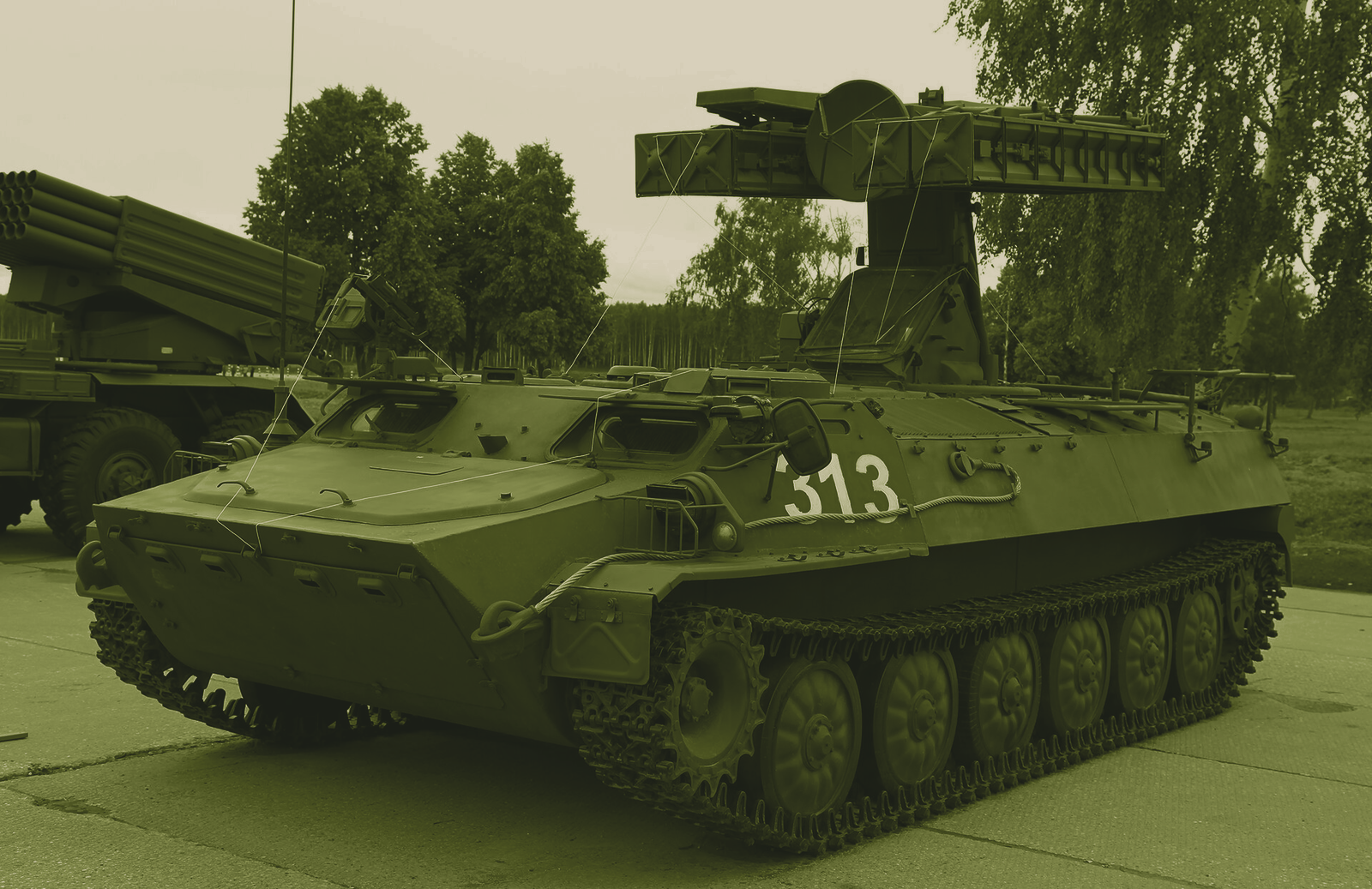
A Soviet missile system designed in 1976 to shoot down low-flying jets and helicopters, now used by both sides to hunt loitering munitions. Its infrared seeker was never meant to find something the size of a quadcopter, which is why Ukraine fitted nine of them with an electro-optical sight.
Overview
The 9K35 Strela-10, designated SA-13 Gopher by NATO, is a Soviet short-range surface-to-air missile system on a tracked MT-LB-derived chassis, carrying four ready 9M37 missiles on a trainable launcher. It entered service in 1976 as regimental air defence against low-flying strike aircraft and helicopters — the layer beneath the medium-range SAMs, and a contemporary of the ZSU-23-4 Shilka gun system it was designed to complement.
Its distinguishing technical feature is the 9M37 missile's dual-channel seeker, which runs passive infrared and photo-contrast guidance in parallel. Photo-contrast homing tracks a target against the visual contrast of the sky behind it rather than by heat, which gives the missile a way to engage targets with a weak thermal signature — an unusual capability for a system of its generation and one that turns out to matter against drones.
Both Russia and Ukraine field it, and both now use it primarily against unmanned aircraft rather than the manned targets it was built for. Ukraine upgraded nine systems with an electro-optical package in 2024; Russian crews have used it against Ukrainian Hornet attack drones. Neither side can make it work against small FPV quadcopters.
Development
The Strela-10 was developed by KB Tochmash as the successor to the Strela-1, entering service in 1976. The design brief was regimental-level air defence: mobile, tracked, able to keep pace with mechanised formations, and effective against aircraft attacking at low level where longer-range SAMs struggled. The 9M37 missile's dual infrared and photo-contrast seeker was intended to give it engagement options against targets deploying flares or presenting a poor thermal aspect.
Successive Soviet variants — Strela-10M, M2 and M3 — improved seeker discrimination and countermeasure resistance without changing the basic architecture. The system was widely exported and remained in service across the former Warsaw Pact.
The significant modern development is Ukrainian and dates to May 2024, when nine Ukrainian Strela-10M systems received a "Valley" electro-optical upgrade. Those modernised units were tested against Russian drones including ZALA, Lancet and Supercam types, and modernised systems were subsequently credited with downing Lancets. The upgrade addresses the system's core deficiency against modern targets: acquiring something small and cool enough that the original seeker cannot reliably find it.
Design & capabilities
- Missile: 9M37 and later variants, four rounds ready on the launcher
- Guidance: dual-channel passive infrared plus photo-contrast, running in parallel
- Chassis: tracked MT-LB-derived hull, shared with the 2S1 Gvozdika family
- Role (original): low-flying aircraft and helicopters at regimental level
- Role (current): unmanned aircraft and loitering munitions
- Ukrainian upgrade: "Valley" electro-optical sighting system on nine Strela-10M vehicles (May 2024)
The photo-contrast channel is the technically interesting element and the reason the system has any counter-drone utility at all. A Lancet or a ZALA reconnaissance drone has a small heat signature — a small piston or electric motor, no jet exhaust — and a pure infrared seeker of 1970s design struggles to acquire it. Tracking the airframe as a dark shape against a bright sky is a different and sometimes more tractable problem.
The limits are severe and well documented. The 9M37's seeker cannot acquire FPV drones — small quadcopters present neither adequate thermal signature nor a large enough visual contrast at useful ranges. Against the Shahed-class one-way attack drones that dominate strategic strikes, the Strela-10 is a point-defence asset with a short envelope rather than a primary answer, and open-source reporting does not show it as a leading Shahed killer. Its practical niche is the middle band: reconnaissance drones and loitering munitions, larger than an FPV and slower than a jet.
Being a missile system rather than a gun, it also has the magazine problem: four ready rounds against strike packages of a hundred or more.
Variants
- 9K35 Strela-10 (baseline): The 1976 system with the 9M37 missile.
- Strela-10M / M2 / M3: Soviet-era improvements to seeker discrimination and countermeasure resistance.
- Strela-10M with "Valley" electro-optical upgrade: Nine Ukrainian systems modernised in May 2024 with an electro-optical sighting package, tested against ZALA, Lancet and Supercam drones.
Combat record / operational use
Both sides operate the Strela-10 and both have repurposed it against unmanned aircraft.
Ukrainian use: the nine "Valley"-upgraded Strela-10M systems were tested against ZALA, Lancet and Supercam drones, and modernised systems were credited with shooting down Lancets — a meaningful result, since the Lancet has been among the more damaging Russian systems against Ukrainian artillery and air defence.
Russian use: Russian crews have engaged Ukrainian Hornet attack drones with the Strela-10, with Russian reporting in July 2026 noting explicitly that a system developed against low-flying aircraft and helicopters is now employed against drones.
Both sides lose them. Ukraine's 423rd Separate Battalion of Unmanned Systems ("Scythian Griffins") destroyed a Russian Strela-10 in January 2026, and Ukrainian drone forces have destroyed multiple Russian air-defence systems in the same period using drones with warheads above 10 kg to ensure the equipment was beyond repair. That is the recurring irony of short-range air defence in this war: the systems meant to kill drones are themselves prime drone targets, and they are found by the same persistent reconnaissance that finds artillery.
The Strela-10's position in the counter-drone architecture is therefore narrow. It is not the answer to Shahed-type mass attack — that is guns, interceptor drones and electronic warfare — and it cannot touch FPVs. It occupies the reconnaissance-drone and loitering-munition band, where its dual-mode seeker gives it a genuine if limited capability.
Advantages
- Dual-channel seeker — parallel infrared and photo-contrast guidance offers two acquisition paths, useful against low-thermal-signature drones.
- Effective against loitering munitions — upgraded Ukrainian systems have downed Lancets, a genuinely valuable result.
- Mobile and tracked — MT-LB-derived chassis keeps pace with manoeuvre formations and repositions across soft ground.
- Passive engagement — infrared and photo-contrast homing means the system can engage without radiating, avoiding anti-radiation missile targeting.
- Available on both sides — Soviet-era stock with established maintenance and crew expertise.
- Cheaply upgradeable — the Ukrainian "Valley" electro-optical package demonstrates meaningful capability gain on nine vehicles without new platforms.
- Longer reach than gun systems — covers a band beyond the Shilka's 2.5 km.
Drawbacks / limitations
- Cannot engage FPV drones — the 9M37 seeker cannot acquire small quadcopters, which are the most numerous threat on the battlefield.
- Four ready rounds — magazine depth is inadequate against saturation attacks.
- Not a Shahed solution — open-source reporting does not show it as a significant one-way-attack-drone killer.
- 1970s seeker technology — even modernised, acquisition against small, cool targets is marginal.
- Only nine upgraded — the Ukrainian "Valley" programme is a pilot-scale effort, not a fleet modernisation.
- A priority target itself — Ukrainian and Russian drone units hunt these systems specifically, and both sides have destroyed them.
- Weather and visibility limits — both the infrared and photo-contrast channels degrade in cloud, fog and poor light.
Counterparts
- ZSU-23-4 Shilka (Russia/Ukraine) — the gun system it was designed to complement, cheaper per engagement with a far deeper magazine.
- Tor-M2 (Russia) — the modern Russian short-range SAM that supersedes it.
- Pantsir-S1 (Russia) — the gun-missile system occupying the same tactical band with modern fire control.
- Gepard and Skynex (Germany) — the Western gun answer to the same problem.
- Lancet (Russia) — the loitering munition it has been credited with defeating.
- Igla-S (Russia) — the man-portable infrared system in the layer beneath it.
Outlook
The Strela-10 will remain in use on both sides for as long as the stock lasts, filling a narrow band that nothing cheaper covers: reconnaissance drones and loitering munitions above FPV size and below Shahed speed. The Ukrainian "Valley" upgrade shows that band can be widened somewhat with modern optics, and at nine vehicles the programme is small enough that expansion would be a straightforward decision if the results justified it.
What the system cannot do is scale to the threat that matters most. Four missiles per launcher against 120–300 drones a night is arithmetic that does not work, and the seeker cannot see the FPVs that dominate tactical losses. The counter-drone answer has moved decisively toward guns for cheap close-in kills, interceptor drones for the strategic strike layer, and electronic warfare across both — with legacy SAMs as a supplement.
The more durable observation concerns survivability. Both sides now hunt each other's short-range air defence with drones, and a Strela-10 in a firing position is exactly the sort of high-value, thermally distinct, slow-moving target that reconnaissance drones are good at finding. The system's own passivity helps, but it does not solve the problem, and the loss of these vehicles on both sides is a quiet but significant erosion of the layer that protects everything else.
Key specifications
| Spec | Value |
|---|---|
| Type | Tracked short-range surface-to-air missile system |
| Missile | 9M37 and later variants; 4 ready rounds on the launcher |
| Guidance | Dual-channel passive infrared plus photo-contrast, operating in parallel |
| Chassis | MT-LB-derived tracked hull |
| Original role | Low-flying aircraft and helicopters at regimental level |
| Current role | Reconnaissance drones and loitering munitions |
| Ukrainian upgrade | Nine Strela-10M systems fitted with "Valley" electro-optical sighting, May 2024 |
| Demonstrated results | Upgraded Ukrainian systems credited with downing Lancet loitering munitions; Russian crews engaging Hornet attack drones |
| Key limitation | 9M37 seeker cannot acquire FPV drones |
| In service | Since 1976; fielded by both Russia and Ukraine |
Sources
- www1.ru — "Strela-10 SAM missile pierced Hornet drone" (Russian counter-drone use). https://www1.ru/en/news/2026/07/13/raketa-zrk-strela-10-pronzila-dron-hornet.html
- Ukrinform — "Military shows destruction of Russian Strela-10 air defense system." https://www.ukrinform.net/rubric-ato/4082944-military-shows-destruction-of-russian-strela10-air-defense-system.html
- "Russia's FORGOTTEN SAM — Why the 9K35 Strela-10 Killed NATO's Low Flying Doctrine" (9M37 dual-channel guidance; 2024 Valley upgrade; Lancet kills). https://www.youtube.com/watch?v=QypxDD3ScWs
- "Soviet's IR-Guided OUTMATCHED — Why the Strela 10 Missed Every Target That Mattered" (nine Strela-10M systems, Valley electro-optical upgrade, FPV acquisition limits). https://www.youtube.com/watch?v=7hOBMJOK33Y
- UNN — "Ukraine's Air Defense Systems: Types, Purpose, and Engagement Capabilities." https://unn.ua/en/news/ukraines-air-defense-systems-types-purpose-and-engagement-capabilities
- ua.news — "Ukrainian drone forces destroy six Russian air defence systems." https://ua.news/en/war-vs-rf/sbs-za-dvi-dobi-znishchili-shist-rosiiskikh-sistem-ppo-video
🔒 The Analyst Section on Strela-10 is for BattlePolicy Pro members. Below the line: procurement and contract history, the suppliers and companies behind the system, our head-to-head analyst view of the systems it actually competes with, and the BattlePolicy assessment note. Unlock the full file with BattlePolicy Pro →
Below this point
- Analyst Section
- Procurement & contracts
- Suppliers & related companies
- Comparable systems — analyst view
- Analyst note