The Wire · live GRID-REF 37°47′N 122°25′W
DISPATCH 03/26 · 4 Sep 2026
BattlePolicy
Startup to front line. Strategy to consequence.
Lexicon · Ukraine

ZSU-23-4 Shilka

A 1965 Soviet anti-aircraft gun built to shoot down jets, now one of the cheapest ways Ukraine kills Shahed drones. Sixteen modernised Shilkas funded by a charity recorded their first Shahed shootdowns in December 2025.
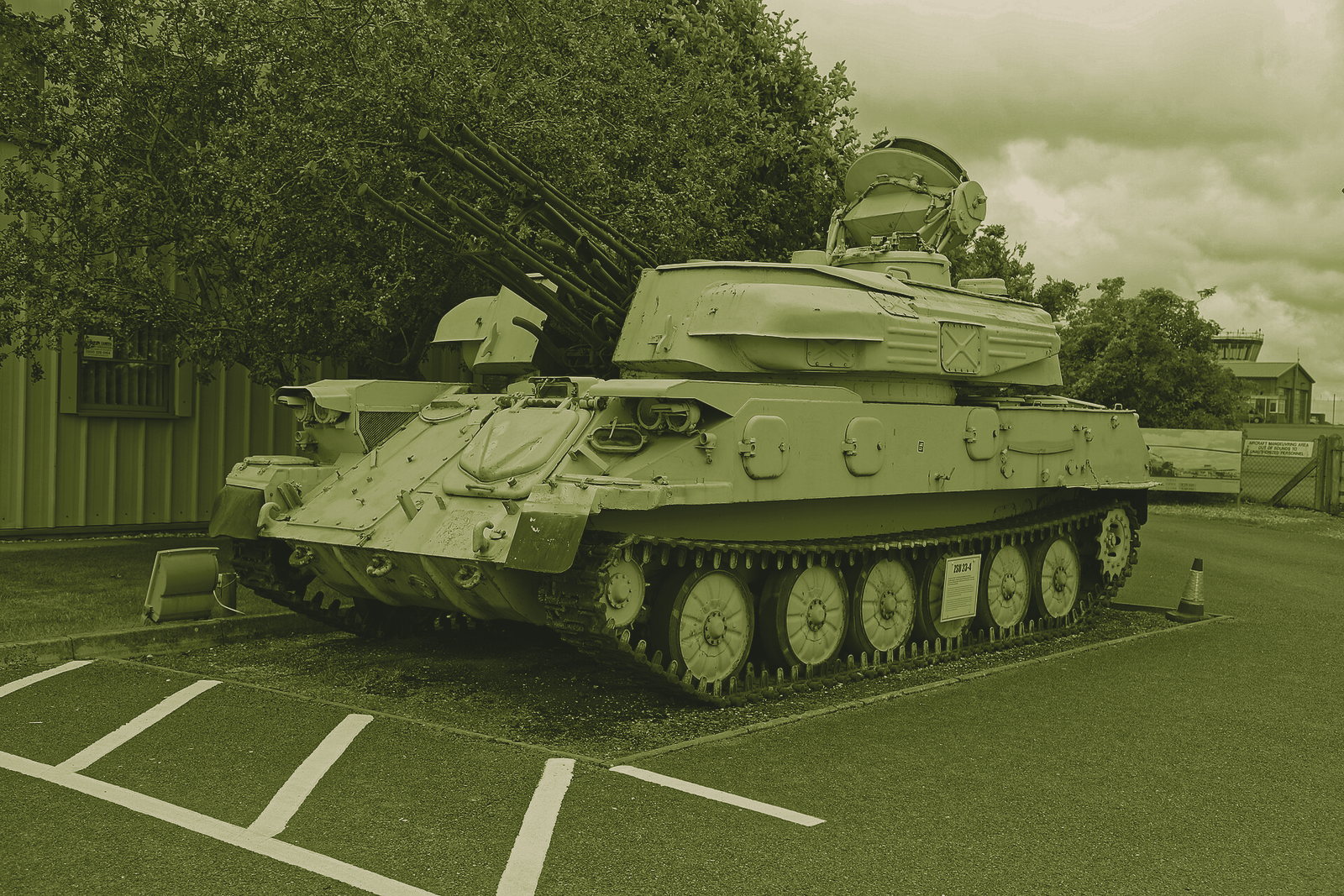
ZSU-23-4 Shilka
FIG.01 · Ukraine Image - A ZSU-23-4 Shilka self-propelled anti-aircraft gun. Photo by Acabashi, CC BY-SA 4.0, via Wikimedia Commons.
A Soviet anti-aircraft gun designed in 1965 to shoot down low-flying jets, now one of the cheapest ways Ukraine destroys Shahed drones. Sixteen modernised Shilkas paid for by a charitable foundation recorded their first Shahed kills in December 2025.

Overview

The ZSU-23-4 Shilka is a Soviet tracked self-propelled anti-aircraft gun mounting four 23 mm autocannon in a powered turret with an integral fire-control radar. Introduced in 1965, it fires a combined 3,400–4,000 rounds per minute, carries around 2,000 rounds, and engages out to roughly 2.5 km in range and 1.5 km in altitude.

Those numbers are unremarkable against modern aircraft, which is why the type had largely passed out of front-line relevance. Against a Shahed-type drone flying a predictable course at low altitude and under 200 km/h, they are more than adequate — and the ammunition costs a tiny fraction of any interceptor missile. That economic fact is the whole reason the Shilka is in this lexicon.

Ukraine's Come Back Alive Foundation funded the modernisation of 16 ZSU-23-4M-A1 systems and delivered them to the armed forces; foundation CEO Taras Chmut confirmed the first Shahed shootdowns in December 2025. Unmodernised Ukrainian Shilkas, by contrast, were assessed as having minimal effectiveness against modern targets.

Development

The Shilka entered Soviet service in 1965 as divisional air defence against low-flying strike aircraft and helicopters, pairing four 23 mm AZP-23 cannon with the RPK-2 Tobol gun-laying radar on a tracked chassis. Around 6,500 were built and it was exported extremely widely. Its combat history spans the Middle East, Afghanistan and beyond, where it also acquired a secondary reputation as a devastating direct-fire weapon against ground targets.

By the 2000s it was obsolete in its designed role — modern combat aircraft do not fly within 2.5 km of a Shilka — and Ukraine's remaining vehicles were in original configuration with correspondingly minimal utility.

The Ukrainian revival is a counter-drone story and a crowdfunding one. The Come Back Alive Foundation, Ukraine's largest defence-focused charity, completed modernisation of 16 ZSU-23-4M-A1 systems and announced their delivery in December 2025. The upgrade addresses the specific problem of engaging small, low-signature targets: reporting describes new digital radar systems designed to track small, low-signature drones, along with optical and digital sighting aids. Ukrainian analysis notes that a Shilka can operate with its radar off, using passive cameras and its lead-angle computer, and still kill a drone — which matters in a battlefield where radiating attracts an anti-radiation missile.

Design & capabilities

The Shilka is a tracked, fully enclosed, radar-equipped gun system.

  • Armament: four 23 mm AZP-23 autocannon
  • Rate of fire: 850–1,000 rounds per minute per barrel, for a combined 3,400–4,000 rpm
  • Effective range: approximately 2.5 km in range, 1.5 km in altitude
  • Ammunition carried: approximately 2,000 rounds
  • Fire control: RPK-2 gun-laying radar in the original; modernised Ukrainian vehicles add digital radar and optical/electro-optical sighting
  • Crew: 4
  • Chassis: tracked, giving cross-country mobility and rapid repositioning

The counter-drone case rests on a volume-of-fire argument. A Shahed presents a small target, but it is slow, non-manoeuvring and flying a predictable path. Four barrels putting nearly 4,000 rounds a minute into its flight path do not need to be precise; they need to be pointed correctly and to keep firing. Cost per engagement is measured in tens of dollars of 23 mm ammunition against $500,000-plus for a NASAMS or Patriot interceptor.

The limitations are equally clear and are the reason Gepard is preferred where available:

ZSU-23-4 Shilka Gepard
Calibre 23 mm ×4 35 mm ×2
Effective range ~2,500 m ~3,500 m
Shell energy Lower Substantially higher
Fire control 1960s radar, or modernised digital Modern radar with airburst fuzing

Ukrainian analysis is direct about it: the Shilka has a shorter effective range than the Gepard, lower shell energy, and an older fire-control system whose effectiveness against small drones is limited unless modernised.

Variants

  • ZSU-23-4 (baseline): The 1965 original with RPK-2 radar.
  • ZSU-23-4M / M2 / M3: Soviet-era incremental improvements to reliability and fire control.
  • ZSU-23-4M-A1: The configuration of the 16 systems modernised by the Come Back Alive Foundation and delivered to Ukrainian forces in December 2025, with updated radar and sighting for small-target engagement.
  • Field improvisations: Both sides have mounted 23 mm armament on trucks and improvised platforms; the towed ZU-23-2 twin cannon is the far more numerous relative, with a similar ~2.5 km envelope and very cheap ammunition.

Combat record / operational use

The Shilka's current record is a counter-drone one. Come Back Alive's modernised systems recorded their first confirmed Shahed shootdowns in December 2025, and analysis of Ukraine's counter-drone architecture places the ZSU-23-4 among the layers that together achieve 60–80% interception rates against mass Shahed attacks, describing it as highly effective but limited in number.

That last qualifier is the constraint. Sixteen modernised vehicles is a meaningful contribution and a rounding error simultaneously, against nights of 120–150 drones.

The broader gun-air-defence picture in which the Shilka sits is genuinely striking. One analysis credits gun teams with up to 80% of confirmed Shahed intercepts at their 2023 peak, and Ukrainian summary data puts overall air-defence effectiveness around 80% in 2026. Ukrainian cost-per-kill tables place gun and mobile-group solutions at $1–500 per engagement against missile interceptors costing hundreds of thousands.

The picture has shifted since. Interceptor drones now do the heavy lifting: Ukraine's deputy air force commander Yurii Cherevashchenko put interceptor-drone kills at 40% of Russian one-way attack drones by April 2026, up from around 25% in winter, and Commander-in-Chief Syrskyi said over 70% of Shaheds downed in the Kyiv region in February 2026 fell to interceptor drones. Guns remain the cheap close-in layer rather than the primary killer.

The Shilka's harder problem is the one facing every gun system: jet-powered Geran-4 and Geran-5 drones at 350–600 km/h are outside what a 2.5 km, 1.5 km-altitude envelope can realistically engage. The gun layer solved the piston Shahed and does not solve its successor.

Advantages

  • Extremely cheap per engagement — 23 mm ammunition costs a trivial fraction of any interceptor missile, inverting the cost exchange that Shahed attacks are designed to exploit.
  • Enormous volume of fire — 3,400–4,000 rounds per minute compensates for the small target and imprecise tracking.
  • Deep magazine — around 2,000 rounds carried, against two to four ready rounds on missile systems like Raven or Gravehawk.
  • Can engage passively — with the radar off, using cameras and the lead-angle computer, avoiding an emissions signature.
  • Mobile and tracked — repositions quickly across terrain to cover shifting drone corridors.
  • Available and familiar — Soviet stock held in quantity, with maintenance expertise on hand.
  • Modernisable cheaply — the Come Back Alive programme demonstrates that digital radar and sighting can be retrofitted by a charity-funded effort.

Drawbacks / limitations

  • Very short range — ~2.5 km and 1.5 km altitude is a point-defence envelope only.
  • Low shell energy — 23 mm carries far less destructive energy than the Gepard's 35 mm, requiring more hits.
  • Obsolete baseline fire control — unmodernised vehicles are of minimal use against small drones.
  • Few modernised systems — 16 upgraded ZSU-23-4M-A1s against nightly attacks of 120–300 drones.
  • Cannot engage jet GeransGeran-4 and Geran-5 at 350–600 km/h and higher altitudes are outside its envelope.
  • Requires the drone to come to it — a point-defence gun protects what it is parked next to and nothing else.
  • No capability against modern aircraft — its designed role is long obsolete.

Counterparts

  • Gepard (Germany) — the superior gun system: 35 mm, ~3,500 m, modern fire control, credited around 95% effectiveness at low altitude.
  • Skynex (Germany) — 35 mm airburst C-UAS, the modern expression of the same ammunition-economics argument.
  • Strela-10 (Russia/Ukraine) — the Soviet short-range missile system in the adjacent band.
  • Sting and Alexa Spatium (Ukraine) — the interceptor drones that have displaced guns as the primary Shahed killer.
  • Raven and Gravehawk (UK) — missile systems reaching 12–15 km where the Shilka reaches 2.5.
  • Shahed-136 and Gerbera — the targets it is effective against.

Outlook

The Shilka's counter-drone renaissance is real, cheap and probably brief. It works because the piston Shahed-136 is slow, low and predictable — and Russia has responded by producing roughly 3,000 jet Geran-4 and Geran-5 airframes a month, flying at 350–600 km/h and at altitudes a 23 mm gun cannot reach. Against the drone that defined 2023, the Shilka is an excellent answer. Against the one defining 2026, it is largely irrelevant.

That does not make the investment wrong. Slow drones and decoys — Gerbera and Parodiya — still constitute a large share of every strike package, and killing them with 23 mm ammunition rather than missiles is exactly the right allocation. The gun layer's job is to make cheap threats cheap to defeat, and it does that.

The transferable finding is the modernisation model. A charitable foundation retrofitted digital radar and sighting onto sixteen 1965-vintage vehicles and produced confirmed kills against a threat that costs $20,000–50,000 a unit. Every NATO member holds obsolete gun air-defence systems in storage; the Come Back Alive programme is a demonstration that these can be made relevant against drones for very little money. That lesson is worth considerably more than the sixteen vehicles.

Key specifications

Spec Value
Type Tracked self-propelled anti-aircraft gun with integral fire-control radar
Armament 4 × 23 mm AZP-23 autocannon
Rate of fire 850–1,000 rpm per barrel; 3,400–4,000 rpm combined
Effective range ~2.5 km range, ~1.5 km altitude
Ammunition carried ~2,000 rounds
Fire control RPK-2 radar (baseline); digital radar and optical sighting on modernised ZSU-23-4M-A1
Crew 4
Produced ~6,500 in the USSR
Ukrainian modernisation 16 × ZSU-23-4M-A1 upgraded by the Come Back Alive Foundation, delivered December 2025
First Shahed kills December 2025 (confirmed by Taras Chmut, Come Back Alive CEO)
Cost per engagement Tens of dollars of ammunition, against $500,000+ for a SAM interceptor

Sources

  1. Militarnyi — "Modernized Shilkas from Come Back Alive Foundation Destroy Their First Shaheds." https://militarnyi.com/en/news/modernized-shilkas-from-come-back-alive-foundation-destroy-their-first-shaheds/
  2. ArmyInform — "How the 'Shilka' has changed: its history and current role in the War." https://armyinform.com.ua/en/2025/11/20/how-the-shilka-has-changed-its-history-and-current-role-in-the-war/
  3. Ukraine War Analytics — "Gun-Based Air Defense" (Shilka vs Gepard comparison). https://ukraine-war-analytics.com/air-defense/gun-based-air-defense.html
  4. Ukraine War Analytics — "How Ukraine Shoots Down Shaheds: 2026 Methods." https://ukraine-war-analytics.com/weapons/shahed-interception-methods-2026.html
  5. Zona Militar — "Las Fuerzas Armadas de Ucrania recibieron sistemas antiaéreos Shilka modernizados." https://www.zona-militar.com/2025/12/22/las-fuerzas-armadas-de-ucrania-recibieron-sistemas-antiaereos-shilka-modernizados-para-hacer-frente-a-drones-rusos/
  6. Reuters — "Inside Ukraine's drive to defeat the dreaded Shahed drone" (interceptor drone share). https://www.reuters.com/business/aerospace-defense/inside-ukraines-drive-defeat-dreaded-shahed-drone-2026-04-29/
  7. Defense News — "Ukraine claims near-90% air-defense success in March as attacks increase." https://www.defensenews.com/global/europe/2026/04/01/ukraine-claims-near-90-air-defense-success-in-march-as-attacks-increase/
  8. NGU Info — "Зенитка ВСУ: как артиллерийская ПВО удерживает украинское небо в 2026 году." https://ngu.com.ua/ru/zenytka-zsu-iak-harmatne-ppo-trymaie-ukrainske-nebo-u-2026-rotsi/
🔒 The Analyst Section on ZSU-23-4 Shilka is for BattlePolicy Pro members. Below the line: procurement and contract history, the suppliers and companies behind the system, our head-to-head analyst view of the systems it actually competes with, and the BattlePolicy assessment note. Unlock the full file with BattlePolicy Pro →

Below this point

  • Analyst Section
  • Procurement & contracts
  • Suppliers & related companies
  • Comparable systems — analyst view
  • Analyst note
Related
Russia · Ukraine · air defensePro

Igla-S

A shoulder-fired infrared missile that Russia now launches from helicopters to hunt Ukrainian drones — and bolts to Shahed airframes so the drone can shoot back at the aircraft sent to intercept it.

Russia · Ukraine · air defensePro

Strela-10

A 1976 Soviet missile system built to shoot down low-flying jets, now hunting Lancets and Hornets. Its infrared seeker was never designed to find something the size of a quadcopter — which is why Ukraine bolted an electro-optical sight to nine of them.