USAPro
ADM-160 MALD
The ADM-160 MALD is an expendable air-launched decoy that imitates aircraft radar signatures. The MALD-J variant adds radar jamming; Ukraine uses the baseline decoy alongside strike weapons.
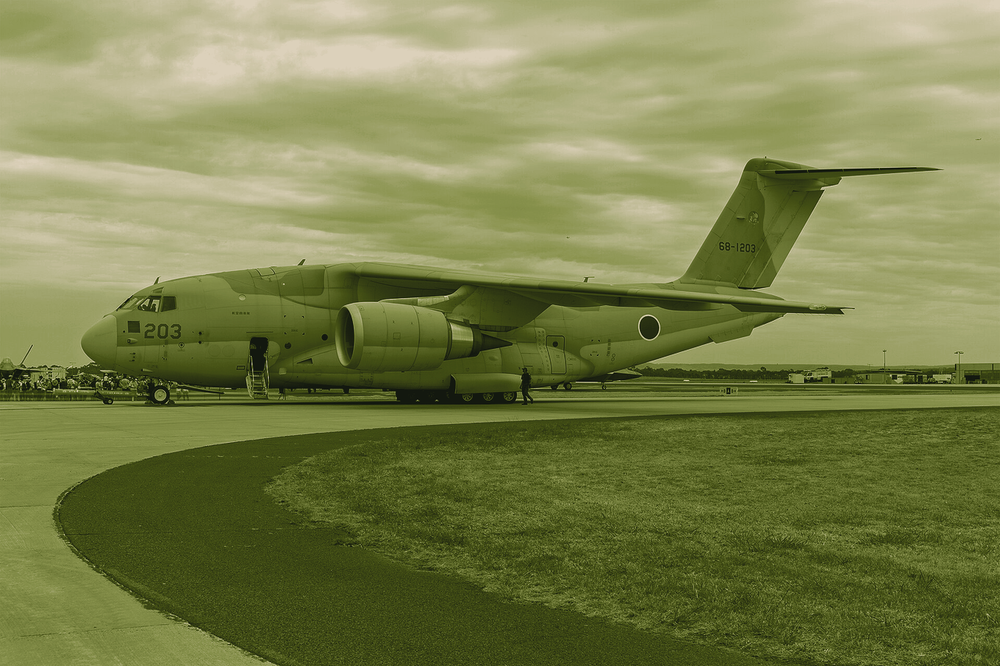
The Kawasaki EC-2 is Japan's C-2-derived stand-off electronic warfare aircraft, developed to disrupt hostile radar and communications and replace the EC-1.
The ADM-160 MALD is an expendable air-launched decoy that imitates aircraft radar signatures. The MALD-J variant adds radar jamming; Ukraine uses the baseline decoy alongside strike weapons.
Lima is a Ukrainian ground-based electronic-warfare system designed to disrupt the satellite navigation of Russian drones, guided bombs and missiles.
Stone Cloak is a British drone-mounted electronic-warfare device, described by the UK government as a jammer, supplied to Ukraine to hinder Russian air-defence tracking and targeting, with intellectual property shared for Ukrainian production.
Russia's tracked electronic-warfare station designed to trigger radio-proximity-fuzed shells before they reach protected troops.
The EA-37B Compass Call is a US Air Force airborne electronic-attack aircraft that transfers the Compass Call mission from the EC-130H to a modified Gulfstream G550.
Palantin is a Russian truck-mounted electronic-warfare complex that detects and suppresses radio communications while coordinating multiple reconnaissance and jamming systems across an operational-tactical network.
The MQ-1C Gray Eagle is the US Army's armed medium-altitude, long-endurance uncrewed aircraft, combining persistent surveillance, targeting, electronic warfare and Hellfire strike capabilities.
The EA-18G Growler is a carrier-based airborne electronic-attack aircraft that detects, locates and jams hostile emitters while supporting strike aircraft with anti-radiation missiles and air-to-air weapons.
Anduril Pulsar is a family of software-defined electromagnetic warfare systems intended to detect, classify and counter changing radio-frequency threats across fixed-site, vehicle, airborne and portable configurations.
The MAC OWL Sova is a Ukrainian mine-resistant armored vehicle combining STANAG Level 4 mine protection with an integrated ten-module electronic-warfare dome intended to defeat FPV drones.
Russia's answer to Starlink is not a jammer. Kalinka listens for the uplink a terminal sends to the satellite and works out where the operator is sitting — turning a communications link into a targeting cue.
A plywood aircraft with no warhead and a metal-coated sphere in the fuselage. The Luneburg lens makes it read on radar as a Shahed, so Ukrainian air defence must treat every one as lethal — which is the entire weapon.
CACI's SkyValor is a long-range, autonomous counter-drone system that defeats UAS without gunfire, jamming their links and firing nets to capture them intact. The Pentagon validated it for use across the entire US Joint Force in June 2026 after a southern-border test.
Airbus's U760 Ravenstorm is an uncrewed collaborative combat aircraft concept — a stealthy loyal wingman for air-to-air combat, strike and jamming unveiled at ILA Berlin 2026 and aimed at Germany's post-FCAS combat-drone race. So far it is a model, not an aircraft.
D-Fend's EnforceAir is an Israeli counter-drone system that detects a rogue drone's radio protocol, takes over its control link and lands it at a predefined safe spot - no jamming, no shooting. Motorola Solutions agreed in June 2026 to buy D-Fend for $1.5 billion.
DART is a Ukrainian balloon-launched strike missile: dropped from a stratospheric aerostat at 12-18 km, it shuts off its own navigation at ~6 km and finishes on a fixed solid-fuel course, leaving Russian jamming nothing to attack. Its graphite warhead is built to short out power grids.
Volna Kupol Garant ("Wave Dome Guarantor") is Russia's trailer-mounted electronic-warfare complex built to jam Starlink's Ku-band uplink, denying Ukraine's Starlink-guided strike drones their control link across a roughly 20-square-kilometer bubble.
The U.S. Navy's shipboard electronic-warfare backbone — a long-running AN/SLQ-32 modernization program that detects, classifies and, in newer blocks, jams radar-guided anti-ship threats.
Russia's R-330Zh Zhitel is a truck-mounted electronic-warfare station built to detect, direction-find and jam GNSS, satellite-phone, cellular and selected radio communications.
Pole-21 is Russia's distributed R-340RP GNSS-jamming network, built to mount on cell towers and deny GPS, GLONASS, Galileo and BeiDou navigation over protected areas.
Shipovnik-Aero is a Russian truck-mounted electronic-warfare complex built to detect, jam, spoof and reportedly hijack small UAVs, with wider communications-suppression functions.
Scorpius is IAI/Elta's AESA-based electronic-warfare family, using software-defined multi-beam jamming for ground, naval, airborne self-protection, standoff-jamming and training roles.
KORAL is Aselsan's truck-mobile radar electronic-warfare system, pairing electronic support and electronic attack vehicles to detect, classify, jam and deceive hostile radars at stand-off range.
Divnomorye is a highly secretive Russian ground-based electronic-warfare complex, reported as a strategic successor to Moskva-1 and Krasukha systems with radar- and satellite-jamming roles.
Tobol is Russia's secretive 14Ts227 ground-based space-electronic-warfare system, publicly documented as a satellite-protection complex and reportedly tested against Starlink links in Ukraine.
Helsing AI is a European defense-software stack built around Altra, Cirra and Centaur, applying machine learning to land targeting, electronic warfare and combat-aircraft autonomy.
A clever bolt-together weapon — a small glide bomb strapped to a surplus rocket motor to give HIMARS a 150 km punch that can curve around defenses and even strike behind the launcher. On paper a bargain deep-strike round; in Ukraine, blunted badly by Russian jamming.
Ukraine's home-grown drone-killer EW — a Proximus-built system that passively detects UAVs out to ~100 km, then jams their control links and satellite navigation (GPS/GLONASS/Galileo/BeiDou) inside ~20 km. Built specifically to counter Russia's Orlan-10, and now a Ukrainian export.
Russia's flying cell-tower attacker — a command truck plus Orlan-10 drones carrying a payload that mimics a GSM base station to locate phones, jam cellular networks and blast fake SMS at enemy troops and civilians. Electronic warfare and psychological warfare in one airborne package.
Russia's mobile laser — unveiled in Putin's 2018 "super-weapons" speech, named for a warrior-monk — built to dazzle reconnaissance-satellite sensors and hide mobile ICBMs from orbit. Fielded since 2019, but almost everything about it is a Russian claim experts treat with caution.
Russia's tracked tactical jamming complex — nine MT-LB vehicles that fuse four jamming-station types under one console to detect, locate and suppress enemy radio, GSM, satellite comms and GPS. A constant Ukraine-front presence, and a prized target: captured in 2022, hunted by FPV drones since.
Russia's strategic shortwave jammer — a truck-borne complex with 32-metre antenna masts built to detect and suppress NATO's long-haul HF radio at ranges Russian sources claim reach 5,000–8,000 km. Fielded in Kaliningrad, Crimea and the Arctic; reportedly sold to Iran.
A Russian counter-battery system that finds enemy guns without a radar — it just listens and watches. Fusing sound, ground vibration and thermal flash, it fixes a firing position in seconds while emitting nothing, so it can't be detected or jammed like the radars it replaces.
Helsing's AI-piloted combat drone — Europe's bid for sovereign autonomous airpower. One low-observable jet, flown by the Centaur AI pilot, in a strike version (CA-1KA) and an escort-jammer version (CA-1EA) pitched as the European answer to the Growler. Nothing has flown yet.
A secretive Russian ground system built to switch off communications satellites — jamming the relay birds that armies (and Ukraine) depend on. It is the counter to the transparent battlefield: if sensing is the new deterrent, this is the attempt to blind it. Ukraine drone-killed one in January 2026.
A Chinese firm sells radar-stealth "by the kilogram" — Star-Navi's XRAM-C spray-on radar-absorbing coating, off-the-shelf in 1/5/10 kg tubs. The claimed ~3 dB cut is modest, but commoditizing even a small signature reduction for cheap mass drones is the story.
Russia's jet-powered Shahed, built to outfly the cheap interceptor drones that were knocking propeller Shaheds down. Early figures said the speed cost it range. A year of upgrades says otherwise: 850 km declared, 960 km flown, 96% of Ukraine in reach.
The jam-proof attack drone reshaping the front: a standard FPV flown down a hair-thin glass fiber instead of a radio link — immune to every electronic-warfare countermeasure, and the weapon that pushed the "kill zone" from 10–20 km out to 50.
Portugal's combat-hardened tactical ISR drone — a gasoline-powered fixed-wing UAS with VTOL kit, proven over 10,000 flight hours in Ukraine, now doubling as the RAF's StormShroud EW platform and expanding rapidly across NATO markets.
A Russian mobile broadband radar-jamming system built to blind airborne surveillance radars and disrupt satellite signals — deployed to Syria and Ukraine, and captured intact near Kyiv.