Fiber-Optic FPV Drone
The jam-proof attack drone reshaping the front: a standard FPV flown down a hair-thin glass fiber instead of a radio link — immune to every electronic-warfare countermeasure, and the weapon that pushed the "kill zone" from 10–20 km out to 50.
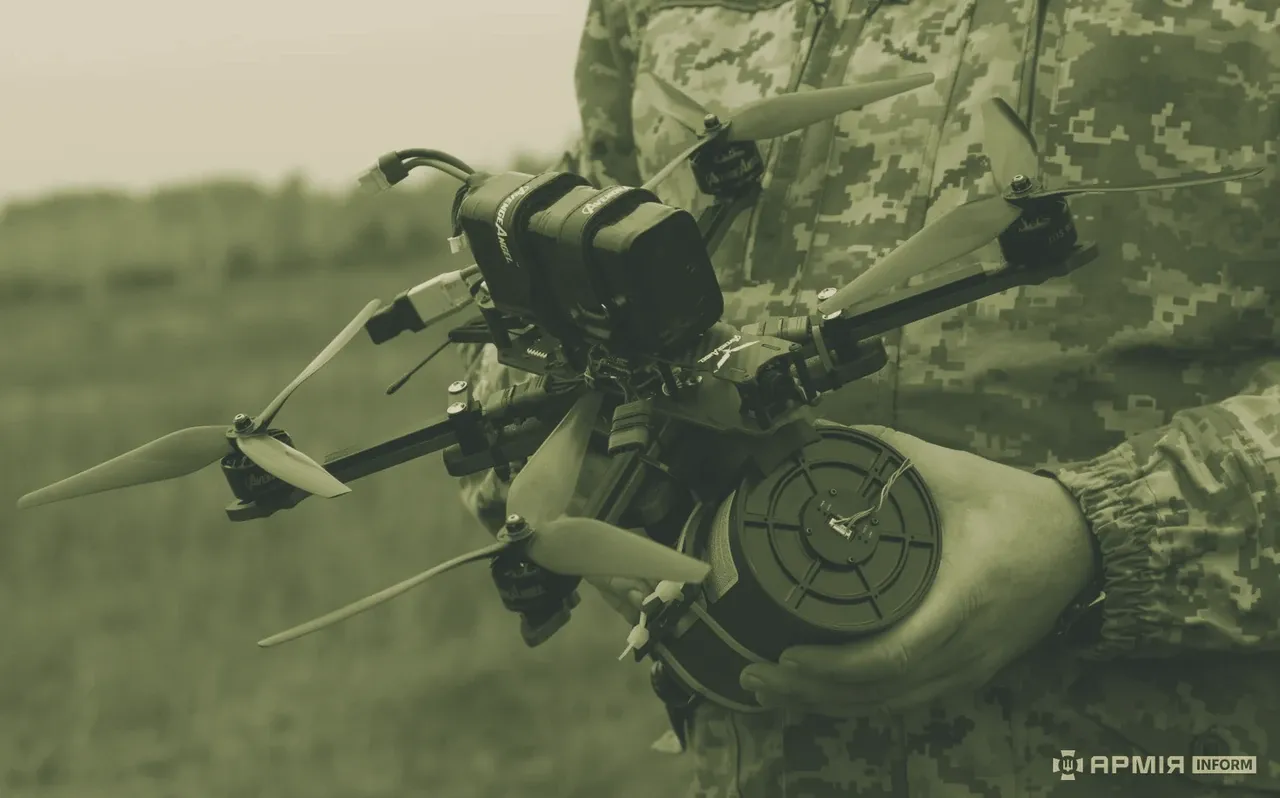

A first-person-view attack drone whose radio link is replaced by a hair-thin glass fiber that unspools in flight — making it immune to jamming, spoofing and direction-finding, the single adaptation that has done most to widen the deadly "kill zone" along the Russia–Ukraine front.
Overview
A fiber-optic FPV drone is an otherwise conventional first-person-view quadcopter in which the pilot's control link and video feed travel down a physical single-mode optical fiber (typically 0.2–0.5 mm thick) that pays out from an onboard spool as the drone flies, rather than over radio. Because it emits no radio signal, it cannot be jammed, spoofed or located by electronic-warfare (EW) systems, and it holds a clear feed through forests, buildings and terrain that would break a radio link. That single change — trading the radio's freedom of movement for an unbreakable tether — has made the type one of the defining weapons of the Russia–Ukraine war, fielded in the hundreds of thousands by both armies and now spreading well beyond it.
🔒 The full Fiber-Optic FPV Drone file is for BattlePolicy Pro members. Below the line: development history, design and capabilities, variants, the combat record, advantages and limitations, comparable systems, outlook, the full specifications table, our sourcing, and the analyst assessment — procurement, suppliers and the BattlePolicy verdict. Unlock the full file with BattlePolicy Pro →
Below this point
- Development
- Design & capabilities
- Variants
- Combat record / operational use
- Advantages
- Drawbacks / limitations
- Counterparts
- Outlook
- Key specifications
- Sources
- Analyst Section
- Procurement & contracts
- Suppliers & related companies
- Comparable systems — analyst view
- Analyst note
Development
The concept is old — wire-guided weapons such as the TOW and Stuhna-P anti-tank missiles have steered down a filament for decades. It returned to the battlefield only when EW saturation on both sides made ordinary radio FPVs unreliable: by 2024 jamming was defeating a large share of radio drones, and fiber was the cheap, low-tech workaround after on-board AI and autonomy proved less dependable.
Russia fielded it first at scale. The archetype, the Knyaz Vandal Novgorodsky ("Prince Vandal of Novgorod," KVN) built by the Ushkuynik center under Aleksey Chadaev, was first deployed in Kursk Oblast in August 2024, according to The Kyiv Independent. Russia then institutionalised the capability through its Rubikon Center for Advanced Unmanned Technologies, set up in 2024 on the orders of Defence Minister Andrey Belousov according to Forces News, which built the fiber-drone playbook in Kursk and exported it to the Pokrovsk and Toretsk axes. Ukraine had fielded early fiber models as early as 2023 but set the concept aside in favour of AI-equipped systems, according to OSW, then raced to catch up through 2025: more than 80 Ukrainian-designed fiber systems were approved within months, per the Atlantic Council; the Unmanned Systems Forces unveiled a domestic "Silkworm" spool in February 2025, as reported by The Kyiv Independent; and 25–30 km spools entered serial production, according to Taifun.
Design & capabilities
The drone carries a lightweight bobbin of optical fiber, around 0.2–0.5 mm thick according to Taifun, that unwinds from the rear (the spool stays with the airframe; the fiber lies on the ground behind it). The fiber's only job is to carry control and high-definition video, which it does with no latency, no signal degradation and no emissions to detect. The result is a weapon that is simultaneously unjammable and hard to find: there is no control signal to direction-find back to the operator, and the airframe itself has a near-negligible radio and thermal signature. Pilots fly the drone manually as a normal FPV — the fiber replaces the radio, not the human in the loop, so there is no autonomy gain — and strike armoured vehicles, dugouts, logistics trucks, artillery and, increasingly, other drones. Effective reach is governed by spool length: 5–20 km is common, 25–30 km is serially produced, and 30–50 km is experimental and less reliable, with a Ukrainian flight reaching roughly 41 km in January 2025, as reported by Defense Express. Usable mission radius is shorter than the reel length, since a safety margin of fiber must remain.
Variants
The "type" is a class rather than a single airframe. On the Russian side it spans the Ushkuynik KVN family and numerous Rubikon-procured builds. On the Ukrainian side it is a fragmented ecosystem — "dozens of different solutions from various manufacturers," in Defence Minister Mykhailo Fedorov's words, as reported by Euromaidan Press — fiber kits fitted to popular FPV frames flown by units such as Azov, Achilles, K-2 and Birds of Magyar — spanning short-range strike drones and longer-range 25–40 km interdiction builds. Recon variants swap the warhead for an inert ISR payload.
Combat record / operational use
Fiber-optic FPVs were decisive in Kursk, where Russian crews used them to choke the single Sumy–Sudzha supply route; Ukraine lost about 25% more vehicles than Russia there, according to the Atlantic Council. Through 2025–2026 the type drove what the Institute for the Study of War called Russian "partial battlefield air interdiction" around Pokrovsk, severing road logistics deep behind the line. Russian crews targeted vehicles near Kostiantynivka and along the Kramatorsk–Dobropillia highway from May 2025, per ISW. The practical effect has been to help widen the front's lethal "kill zone" from the 10–20 km President Zelensky described in August 2025 to as much as 50 km in some areas, according to Ukrainian security official Davyd Aloian, as reported by Business Insider. Ukraine matched the volume: 374,000 fiber drones were delivered under Defense Procurement Agency contracts in 2025, and more than 92% of that total again by April 2026, according to Ukraine's Ministry of Defence.
Advantages
- Immune to all EW — no radio link to jam, spoof or direction-find; the single capability no electronic countermeasure defeats.
- Reliable feed everywhere — clear control and video through forests, urban terrain and dense jamming that break radio FPVs.
- Low signature, hard to trace — near-zero RF/thermal emissions, and no signal leading back to the operator.
- Cheap and producible — a fiber kit on a commodity FPV frame; tens of thousands fielded per month.
Drawbacks / limitations
- Physical tether — the fiber can snag, abrade or break on terrain, vegetation or structures, ending the mission.
- Heavier and slower — spool weight and drag cut speed and agility, making the drone an easier target to shoot down.
- Range capped by reel — reach is bounded by spool length and one-way; long-range (>30 km) builds are bulky and less reliable.
- Telltale trail — the laid fiber can be visible (including in IR) and can betray launch and operator positions.
- Supply-chain exposure — fiber is largely Chinese-sourced, per The Kyiv Independent; spool prices have spiked with AI-data-center demand, as reported by DroneXL.
Counterparts
The fiber-optic FPV is the EW-proof branch of the broader FPV/loitering-munition family that includes radio-controlled FPVs and systems such as Russia's Lancet and Western loitering munitions like the Switchblade. Where those depend on a radio or satellite link (and are therefore vulnerable to jamming) or on costly autonomy, the fiber drone substitutes a $-cheap glass thread for all of it. Its closest conceptual ancestors are wire-guided missiles (TOW, Stuhna-P).
Outlook
Fiber optics did not beat electronic warfare so much as route around it, and that is why it has no EW counter and is unlikely to acquire one: defenders are pushed back onto physical and kinetic measures — anti-drone nets, rotating barbed-wire fiber-cutters, shotguns, acoustic and infrared detection, interceptor drones, and hunting the operators and stockpiles. NATO made counter-fiber-optic-drones the central theme of its 2025 Innovation Challenge, according to the Atlantic Council. The capability has already proliferated to Hezbollah — now its primary weapon against Israeli forces, according to BBC News — and, per the Atlantic Council, reportedly to Sudanese militias, Mexican cartels and the Chinese PLA, signalling that the "tethered, unjammable, cheap" model is becoming a global baseline rather than a Ukrainian-front curiosity.
Key specifications
| Spec | Value |
|---|---|
| Type | Wire-guided (fiber-optic) FPV strike drone — quadcopter class |
| Endurance | Single sortie; one-way strike (recon variants recoverable) |
| Range | 5–20 km common · 25–30 km serial · 30–50 km experimental · ~41 km record (UA, Jan 2025) |
| Cruise / max speed | Lower than radio FPV (spool drag/weight); not reliably specified |
| Payload | ~1.5–3 kg (vendor-claimed) |
| Datalink / control | Unspooling single-mode optical fiber (0.2–0.5 mm) — no RF; jam/spoof/DF-proof |
| Autonomy level | None — manual FPV piloting (fiber replaces the radio, not the pilot) |
| Warhead | RPG-type shaped charge (anti-armor), fragmentation or thermobaric; inert ISR on recon builds |
| Unit cost | ~$1,000–1,800 procured (UA, est.) · ~$300–400 improvised — spool is a large share |
| First combat use | Aug 2024, Kursk Oblast — Russia, Knyaz Vandal Novgorodsky |
Sources
- Ukraine scrambles to counter new Russian fiber-optic drone threat — Euromaidan Press (citing BBC Ukraine)
- As Russia's fiber-optic drones flood the battlefield, Ukraine is racing to catch up — The Kyiv Independent
- Fiber-optic drones have emerged as critical kit for both Russia and Ukraine — Atlantic Council
- Russian "partial battlefield air interdiction" enabled recent advances in Pokrovsk — Institute for the Study of War
- Ukraine's drone kill zone is getting bigger — Business Insider
- Fiber-optic drones — Taifun
- Learning from Ukraine war, Hezbollah is now using fibre-optic drones to hit Israel — BBC News
- Fiber-optic drones in Ukraine — Responsible Statecraft (Quincy Institute)
- Fiber-optic drones posing a significant C-UAS challenge — U.S. Army / CALL
- Ukrainians made an FPV with a fiber-optic cord stretching 41 km — Defense Express
- On fiber-optic drone production — National Security and Defense Council of Ukraine (RNBO)
- Fiber-optic drone range and the 41 km flight — Ukrainska Pravda
- Ukraine–Russia war: fiber optics — VGI
- Fiber-optic FPVs rose in price on Brave1 Market — Mezha / Oboronka
- Hunting the hunters: Russia's shadowy fiber-drone unit — Forces News
- Game of drones: production and use on the Ukrainian battlefield — OSW Centre for Eastern Studies
- Russian force generation and technological adaptations, 9 Oct 2025 — Institute for the Study of War
- Ukraine fiber-optic spool price and AI data-center demand — DroneXL
- Ukraine delivered 92% of last year's fiber-optic drone total in under four months — Euromaidan Press
- Prince Vandal of Novgorod — Deagel
- Ukraine's DIY drones — GIS Reports
- Ukraine updates fiber-optic drone procurement mechanism — Ministry of Defence of Ukraine
Analyst Section
Procurement & contracts
Ukraine procures fiber-optic FPVs at scale through the Brave1 marketplace and Ministry of Defence framework contracts, with 374,000 units delivered under Defense Procurement Agency (DOT) contracts in 2025 and a DOT contract price-adjustment mechanism added to absorb volatile spool costs. Russian procurement runs through the Rubikon center and affiliated suppliers (Ushkuynik and others); volumes are undisclosed but described as comparable. Spool prices have swung sharply: Ukraine's Ministry of Defence says fiber prices rose and fluctuated by 2–6 times, and one Unmanned Systems Forces buyer reported 50 km spools rising from about $300 to $2,500 as AI-data-center demand tightened global fiber supply.
Suppliers & related companies
Russia: Ushkuynik (Knyaz Vandal), procured via the Rubikon center. Ukraine: a multi-maker ecosystem ("dozens of different solutions," per Defence Minister Fedorov), with spools including the domestic "Silkworm." The critical upstream dependency on both sides is optical fiber, sourced largely from China, a single-point supply-chain vulnerability.
Comparable systems — analyst view
Against radio FPVs and link-dependent loitering munitions (Lancet, Switchblade), the fiber drone wins on one axis that currently overrides the rest — it cannot be jammed — at the cost of range, speed and agility. In a war where EW had been steadily blunting radio drones, that trade has proven decisive at short range, which is why both armies converged on it independently.
Analyst note
Fiber optics is the clearest case yet of the "transparent battlefield" thesis made literal: inside ~20 km, an unjammable eye-in-the-sky makes "every movement answered" close to true, and it has demonstrably collapsed road logistics around contested towns. But the limits matter as much as the reach — it is a short-range dominance (contingent past 30 km), it is a tether that physical countermeasures and interceptor drones are already eroding, and its supply chain runs through China. The capability to watch is not the same as the capacity to act on everything seen; the open question for 2026–2027 is whether interceptor drones and physical counters restore freedom of movement inside the kill zone, or whether fiber simply hardens it. Watch three things: the spread to interceptor (drone-on-drone) roles, the China fiber dependency, and whether NATO militaries adopt the model rather than just defend against it.