Iskander-M
Russia's primary road-mobile short-range ballistic missile — nuclear-capable, maneuvering, and the workhorse of its deep-strike campaign in Ukraine.
Overview
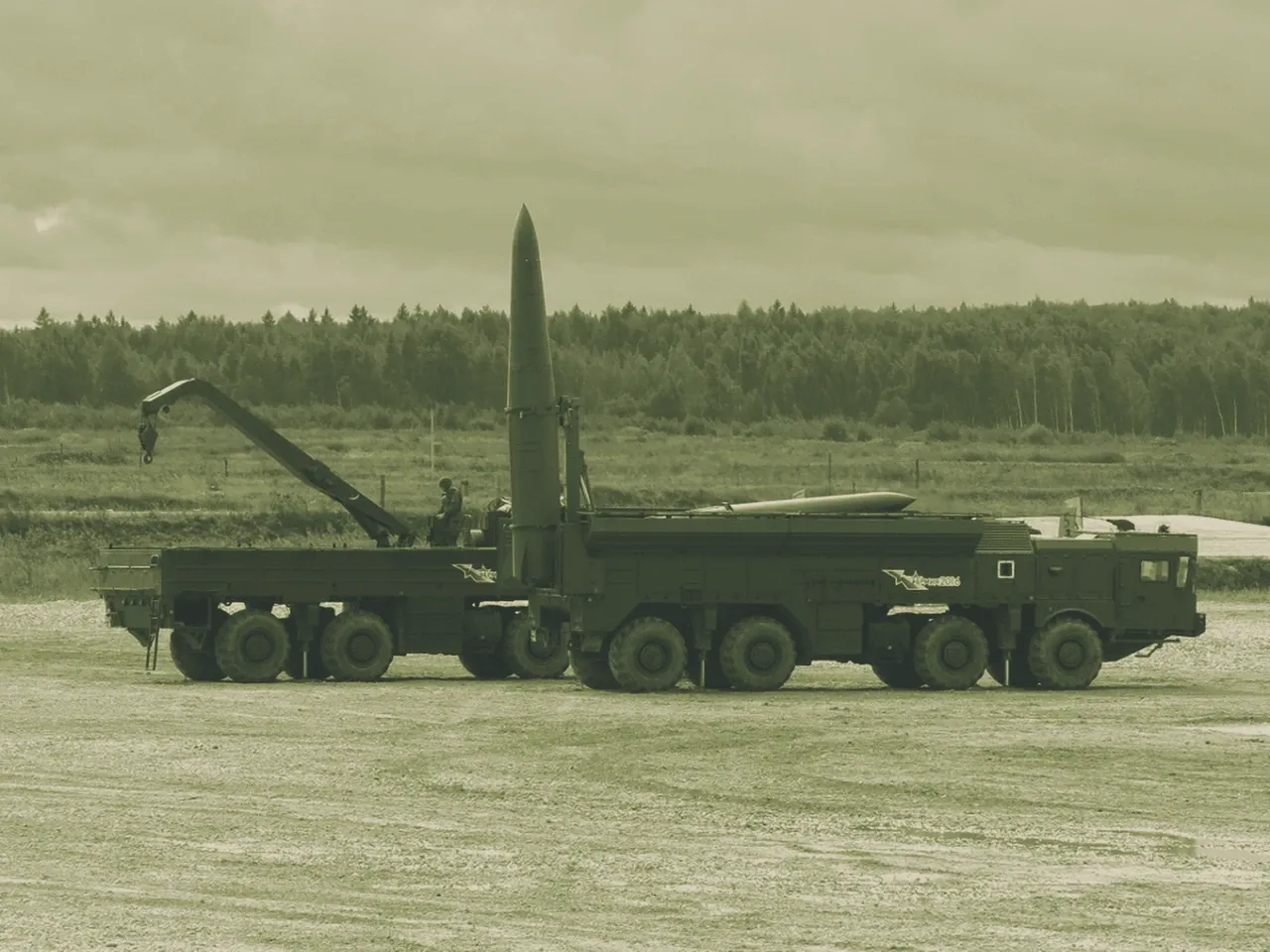
The 9K720 Iskander-M, known to NATO as the SS-26 Stone, is a road-mobile short-range ballistic missile (SRBM) system that forms the backbone of Russia’s theater precision strike capability. It fires a quasi-ballistic missile capable of depressed trajectory flight, high-g terminal maneuvering, and a variety of conventional warheads, and is publicly established as nuclear-capable. The same transporter-erector-launcher (TEL) can also fire the Iskander-K cruise missile family, giving a single brigade both ballistic and cruise-missile reach. Since 2022 the Iskander-M has been the primary Russian SRBM in the war against Ukraine, employed against command posts, air defenses, infrastructure, and city targets.
Development
The Iskander was developed by KBM Kolomna as a successor to the OTR-21 Tochka (SS-21 Scarab) SRBM and entered Russian service in 2006, according to CSIS. The 9M723 ballistic missile was complemented by a family of ground-launched cruise missiles: the 9M728 (NATO SSC-7) and the later 9M729 (SSC-8), the latter assessed by the United States as having a range exceeding the 500 km limit of the Intermediate-Range Nuclear Forces (INF) Treaty. The missile’s development and deployment became a central factor in the US withdrawal from the INF Treaty in 2019, a connection documented by CSIS.
Design & capabilities
The Iskander-M missile (9M723) is a single-stage solid-propellant quasi-ballistic missile designed to fly a lowered trajectory and execute high-g terminal maneuvers of up to 30 g, characteristics that complicate missile-defense interception. Terminal speed is estimated at Mach 6–7, as noted by CSIS. The warhead payload of 480–700 kg can be configured as high explosive, submunition, penetrator, or thermobaric, and the system is publicly established as nuclear-capable. Guidance fuses an inertial navigation system (INS) with GLONASS satellite updates and an optional optical digital scene-matching terminal seeker; the resulting circular error probable (CEP) ranges from ~200 m with INS only down to ~10–20 m when the optical seeker is employed, according to CSIS. The missile is launched from an 8×8 MZKT-7930 9P78-1 TEL, which carries two missiles and can launch either ballistic or cruise variants.
Variants
- 9M723 (Iskander-M) — baseline solid-fuel quasi-ballistic SRBM, range 400–500 km.
- 9M720 (Iskander-E) — export variant capped at 280 km to comply with Missile Technology Control Regime guidelines.
- 9M728 (SSC-7) — ground-launched cruise missile with a reported range under the INF limit.
- 9M729 (SSC-8) — longer-range cruise missile that the US assessed as an INF Treaty violation (>500 km), precipitating the treaty’s collapse.
Combat record / operational use
The Iskander-M first saw combat during the 2008 Russo-Georgian War, as documented by CSIS. It was deployed to Syria in 2016, and since at least 2018 Russia has permanently stationed Iskander brigades in Kaliningrad as a coercive signaling tool against NATO. Since the full-scale invasion of Ukraine in 2022, the Iskander-M has been the most heavily employed Russian SRBM, repeatedly striking command-and-control nodes, air-defense sites, ammunition depots, and critical infrastructure as well as urban areas, as detailed by CSIS.
Advantages
- High terminal speed (Mach 6–7) and aggressive 30 g maneuvering reduce interception probability.
- Multiple warhead types, including nuclear, provide wide mission flexibility.
- Shared TEL that fires both ballistic and cruise missiles multiplies a brigade’s strike options.
- Road-mobile launchers enhance survivability by complicating pre-launch targeting.
- Operational since 2006 with proven combat experience, giving crews and planners deep institutional confidence.
Drawbacks / limitations
- Export range (280 km) significantly constrains the missile’s utility for foreign customers.
- Its cruise-missile variant (9M729) triggered the collapse of the INF Treaty, making the system a proliferation and arms-control flashpoint.
- Despite its counter-intercept design, some Iskander missiles have been engaged or destroyed by modern air-defense systems in Ukraine.
- As a nuclear-capable theater system, its use in a conventional conflict carries acute escalation risk.
Counterparts
Outlook
The Iskander-M remains in serial production and is the principal Russian ground-launched ballistic missile for theater operations. Sustained employment in Ukraine has demonstrated its operational value, while also exposing vulnerabilities to persistent surveillance and layered air defenses. The controversy over the 9M729 cruise variant continues to shape the post-INF security environment, and follow-on systems or range enhancements are likely to emerge as Russia adapts to battlefield lessons.
Key specifications
| Spec | Value |
|---|---|
| Type | Single-stage solid-fuel quasi-ballistic SRBM |
| Range | 400–500 km (9M723); 280 km (export 9M720) |
| Speed (Mach / km·s⁻) | Mach 6–7 (terminal) |
| Warhead (type & weight) | 480–700 kg (HE, submunition, penetrator, thermobaric, nuclear-capable) |
| Guidance | INS + GLONASS + optional optical DSMAC terminal seeker |
| Accuracy (CEP) | ~200 m (INS) → ~50 m (GLONASS) → ~10–20 m (optical) |
| Launch platform(s) | 9P78-1 TEL (8×8 MZKT-7930, 2 missiles) |
| Propulsion | Single-stage solid |
| Length / diameter / launch weight | 7.3 m / 0.92 m / 3,750–4,020 kg |
Sources
- CSIS Missile Threat — SS-26 (Iskander) — https://missilethreat.csis.org/missile/ss-26-2/