Igla-S
A shoulder-fired infrared missile that Russia now launches from helicopters to hunt Ukrainian drones — and bolts to Shahed airframes so the drone can shoot back at the aircraft sent to intercept it.
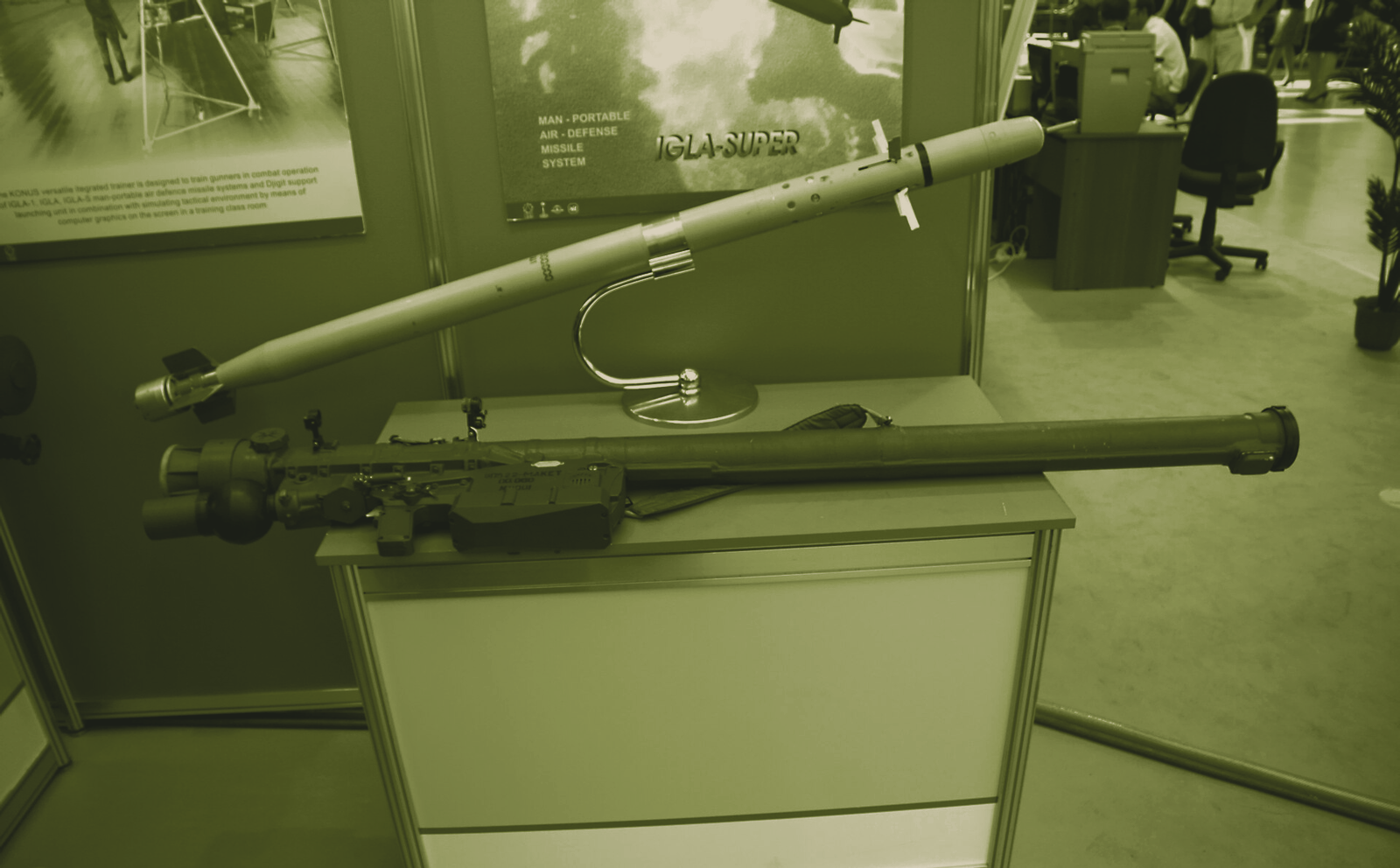
A shoulder-fired infrared missile that Russia now launches from helicopters to hunt Ukrainian long-range drones — and, in its successor form, bolts onto Shahed airframes so that a strike drone can shoot back at the aircraft sent to intercept it.
Overview
The 9K338 Igla-S ("Igla-Super"), designated SA-24 Grinch by NATO, is a Russian man-portable air-defence system developed by the KBM design bureau in Kolomna. It is a shoulder-fired, fire-and-forget missile with a passive infrared seeker, engaging targets between roughly 500 m and 6 km in range and 10 m to 3,500 m in altitude, ready to launch in about 5 seconds and deployable to a firing position in 12–13 seconds.
Its technical advance over the earlier Igla is seeker sophistication. The 9E410 seeker operates in both infrared and ultraviolet wavelengths, which sharply reduces susceptibility to decoy flares, and the Igla-S adds detectors around the main seeker to resist the pulsed infrared countermeasures commonly fitted to helicopters.
What makes it current rather than merely present is how both its role and its mounting have changed. Russia fires Igla and Igla-S from Mi-28N and Ka-52 helicopters using the Strelets remote-launch kit to hunt Ukrainian long-range attack drones. And its successor, the 9K333 Verba, has been mounted on Geran/Shahed airframes as an anti-interceptor weapon — a strike drone carrying a surface-to-air missile.
Development
The Igla-S entered Russian service in the mid-2000s as the culmination of the Igla family, itself descended from the Strela MANPADS line. The design priorities were seeker discrimination and countermeasure resistance, reflecting the maturation of infrared countermeasures on Western aircraft: a MANPADS that could be defeated by a flare dispenser had limited value against a modern helicopter.
The 9E410 dual-band infrared/ultraviolet seeker is the answer. Flares burn hot and bright in the infrared but present a different ultraviolet signature from an aircraft's engine exhaust, so a seeker comparing both bands can discriminate between them. Additional detectors arranged around the main seeker head provide resistance to pulsed infrared countermeasure jammers.
The Strelets launch system extended the weapon beyond the shoulder. Designed for automated remote launch of Igla-series missiles from sea, land and air platforms, it allows salvo firing from carriers including the Mi-28N and Ka-52 helicopters — turning a defensive infantry weapon into an air-to-air one.
The successor is the 9K333 Verba, presented by Russia as its latest-generation infrared MANPADS, with range extended to 6,000–6,400 m, altitude to 3,500 m, and improved seeker discrimination and countermeasure resistance relative to the Igla-S. Russian marketing at the 2026 World Defense Show claimed the Verba has destroyed thousands of UAVs.
Design & capabilities
- Engagement range: approximately 500 m to 6 km
- Altitude envelope: approximately 10 m to 3,500 m
- Guidance: passive infrared, fire-and-forget, using the 9E410 dual-band infrared/ultraviolet seeker
- Countermeasure resistance: dual-band operation defeats simple flares; additional detectors around the main seeker resist pulsed infrared jammers
- Reaction time: ready to launch in about 5 seconds; deployable to a combat position in 12–13 seconds
- Operation: shoulder-fired by one operator, or remotely launched via the Strelets kit from ground, naval and airborne platforms
- Target set: low-flying aircraft, helicopters, cruise missiles and certain classes of drone
The counter-drone application is real but bounded by physics. An infrared seeker needs a heat source, and the targets it can engage are those with meaningful thermal signatures: fixed-wing long-range attack drones with piston or jet engines, and helicopters. Against small electric quadcopters there is very little to home on, and the missile's cost per engagement — a MANPADS round against a few-hundred-dollar FPV — would be absurd even if it worked.
Where Russia has found genuine value is helicopter-launched anti-drone work. Ukrainian long-range one-way attack drones such as the FP-1 cruise for hours at low altitude with a hot engine, which is close to an ideal infrared target, and Russian Ka-52 and Mi-28N crews have used cannon and, increasingly, Igla-series missiles against them. Defence Express reported in October 2025 that Russian helicopters were carrying Igla MANPADS for exactly this purpose, and in August 2026 a Ka-52 was reported failing to down a Ukrainian FP-1 with a missile and reverting to its cannon — an indication that the technique is used but not reliable.
Variants
- 9K38 Igla: The predecessor, with a single-band infrared seeker.
- 9K338 Igla-S: The subject of this entry — 9E410 dual-band IR/UV seeker, additional anti-IRCM detectors, up to ~6 km.
- Strelets launch module: Not a missile variant but the remote-launch system enabling salvo firing of Igla-series missiles from Mi-28N, Ka-52, naval and ground platforms.
- 9K333 Verba: The successor system — 6,000–6,400 m range, 3,500 m altitude, improved seeker discrimination and countermeasure resistance. This is the variant documented mounted on Geran/Shahed drones.
Combat record / operational use
The Igla-S serves in three distinct roles in this war, and the second and third are the notable ones.
Conventional ground-based air defence is the designed role, performed by both sides. Britannica's survey of drone warfare lists the ZSU-23-4 and MANPADS including the Stinger and Igla-S among the kinetic countermeasures in use.
Helicopter-launched anti-drone employment is Russia's significant adaptation. Using the Strelets kit, Ka-52 and Mi-28N crews carry Igla and Igla-S to engage Ukrainian long-range attack drones — a mission previously flown with cannon alone. The Ka-52M can carry the newer Igla-S with Strelets, and the system is described as guiding missiles onto aerial targets including aircraft, helicopters, cruise missiles and jet-powered drones. Effectiveness is mixed: the August 2026 report of a Ka-52 missing an FP-1 with a missile and switching to guns suggests the engagement geometry against a small, cool, slow drone remains difficult.
Drone-mounted MANPADS is the development with the widest implications, and it involves the successor rather than the Igla-S itself. In January 2026 Ukrainian forces shot down a Russian Geran drone carrying a 9K333 Verba MANPADS launcher — the Darknode battalion is credited with the kill. ISW assessed that the MANPADS were positioned to fire ahead of the drone in flight, indicating an intent to target Ukrainian fighter jets and helicopters operating as part of the air-defence umbrella. A separate modification carries a Verba while retaining the drone's own warhead, so the airframe can engage an interceptor and still complete its strike.
That is a genuine inversion. The aircraft and helicopters Ukraine uses to intercept Shaheds have been, until now, safe from them. A one-way attack drone that can shoot back changes the risk calculus for every crewed interceptor sortie.
Advantages
- Excellent countermeasure resistance — the 9E410 dual-band IR/UV seeker defeats simple flares, and additional detectors resist pulsed infrared jammers.
- Fire-and-forget — the operator can move immediately after launch, unlike wire- or beam-guided systems.
- Very fast into action — around 5 seconds to launch readiness, 12–13 seconds to a firing position.
- Fully passive — emits nothing, so it cannot be jammed or targeted by anti-radiation missiles.
- Man-portable — one soldier, no vehicle, no radar, deployable anywhere.
- Platform-flexible via Strelets — remote salvo launch from helicopters, ground vehicles and ships.
- Effective against the right drones — long-range fixed-wing attack drones with hot engines are viable targets.
Drawbacks / limitations
- Cannot engage FPV drones — small electric quadcopters present almost no infrared signature.
- Cost per engagement — a MANPADS round against a cheap drone is an unfavourable exchange even when it works.
- Short range — ~6 km limits it to point defence.
- Weather-limited — infrared homing degrades in cloud, fog and heavy precipitation.
- Unreliable against small, slow, cool targets — the August 2026 Ka-52 engagement of a Ukrainian FP-1 required reverting to cannon after a missile miss.
- Single-shot exposure — the launch signature reveals the operator's position immediately.
- Superseded — the Verba offers better range and discrimination, and is the variant Russia is fielding in novel roles.
Counterparts
- FIM-92 Stinger (USA) — the Western MANPADS equivalent, widely supplied to Ukraine.
- Piorun (Poland) — the modern Polish MANPADS, credited with strong performance in Ukraine.
- RBS-70 NG (Sweden) — the laser beam-riding alternative, immune to infrared countermeasures.
- Strela-10 (Russia/Ukraine) — the vehicle-mounted short-range infrared system in the layer above.
- ZSU-23-4 Shilka — the gun system covering the same close-in band far more cheaply.
- Shahed-136 and Geran-4 — the drones now carrying Verba launchers.
Outlook
The Igla-S itself is a mature design nearing the end of its prominence, superseded in Russian service by the 9K333 Verba. Its interest for this lexicon lies in what Russia has done with the family rather than in the missile's own specifications.
Two adaptations matter. Helicopter-launched MANPADS against long-range attack drones is a workable if imperfect answer to a real problem — Ukrainian deep-strike drones are hard to intercept with anything else, and a Ka-52 with Strelets-launched missiles is a cheaper solution than a fighter sortie. Expect refinement rather than abandonment.
Drone-mounted MANPADS is the more consequential development and deserves watching closely. A Geran carrying a Verba, positioned to fire forward at an intercepting aircraft while retaining its own warhead, attacks the assumption on which crewed drone interception rests. Ukraine has used helicopters and aircraft with door gunners and cannon against Shahed streams throughout the war precisely because those drones could not shoot back. If a meaningful fraction now can, that layer of the defence becomes considerably more expensive.
Neither adaptation is yet at scale, and one Verba-armed Geran was shot down in January 2026 without evidence of a successful air-to-air engagement. But both are the kind of cheap, incremental modification that this war has repeatedly shown can move from curiosity to standard fit within months.
Key specifications
| Spec | Value |
|---|---|
| Type | Man-portable infrared air-defence system |
| Range | ~500 m to 6 km |
| Altitude envelope | ~10 m to 3,500 m |
| Guidance | Passive infrared, fire-and-forget; 9E410 dual-band infrared/ultraviolet seeker |
| Countermeasure resistance | Dual-band operation defeats flares; additional detectors resist pulsed IR jammers |
| Reaction time | ~5 seconds to launch readiness; 12–13 seconds to combat position |
| Launch options | Shoulder-fired, or remote/salvo launch via the Strelets kit from Mi-28N, Ka-52, ground and naval platforms |
| Target set | Low-flying aircraft, helicopters, cruise missiles, fixed-wing drones with thermal signature |
| Key limitation | Cannot acquire small electric FPV drones |
| Successor | 9K333 Verba — 6,000–6,400 m range, 3,500 m altitude, improved discrimination; documented mounted on Geran/Shahed airframes |
Sources
- Times of India — "One soldier, one missile. How the Igla-S is countering modern aerial threats." https://timesofindia.indiatimes.com/defence/news/one-soldier-one-missile-how-the-igla-s-is-countering-modern-aerial-threats/articleshow/132279057.cms
- Defense Express — "russian Helicopters Now Carry Igla MANPADS to Hunt Ukrainian Drones." https://en.defence-ua.com/news/russian_helicopters_now_carry_igla_manpads_to_hunt_ukrainian_drones-16261.html
- Militarnyi — "Russian 9K333 Verba MANPADS Mounted on Shahed Drone Shot Down by Darknode Battalion Soldiers." https://militarnyi.com/en/news/russian-9k333-verba-manpads-mounted-on-shahed-drone-shot-down-by-darknode-battalion-soldiers/
- Institute for the Study of War — "Russian Offensive Campaign Assessment, January 5, 2026" (MANPADS positioned to fire ahead of the drone; targeting Ukrainian interceptor aircraft). https://understandingwar.org/research/russia-ukraine/russian-offensive-campaign-assessment-january-5-2026/
- Aerospace Global News — "Russia fits MANPADS to Shahed drones in Ukraine war." https://aerospaceglobalnews.com/news/russia-shahed-drones-manpads-ukraine/
- UNN — "The Russian Ka-52 failed to shoot down the Ukrainian FP-1 with a missile and was forced to switch to its cannon." https://unn.ua/en/amp/the-russian-ka-52-failed-to-shoot-down-the-ukrainian-fp-1-with-a-missile-and-was-forced-to-switch-to-its-cannon
- Defence Security Asia — "Combat-Proven 9K333 Verba MANPADS Destroys Thousands of UAVs, World Defense Show 2026." https://defencesecurityasia.com/en/9k333-verba-manpads-destroys-thousands-uavs-world-defense-show-2026/
- Wikiwand — "9K38 Igla" (9E410 dual-band seeker, anti-IRCM detectors). https://www.wikiwand.com/en/9K38_Igla
🔒 The Analyst Section on Igla-S is for BattlePolicy Pro members. Below the line: procurement and contract history, the suppliers and companies behind the system, our head-to-head analyst view of the systems it actually competes with, and the BattlePolicy assessment note. Unlock the full file with BattlePolicy Pro →
Below this point
- Analyst Section
- Procurement & contracts
- Suppliers & related companies
- Comparable systems — analyst view
- Analyst note