Vepr
Vepr is a Ukrainian tracked ground robot for frontline logistics and casualty evacuation — 350 kg of cargo or two wounded, ~40 km per charge, plus remote demining, recovery and one-way strike roles. Codified by Ukraine's MoD in June 2026 after two years on the front.
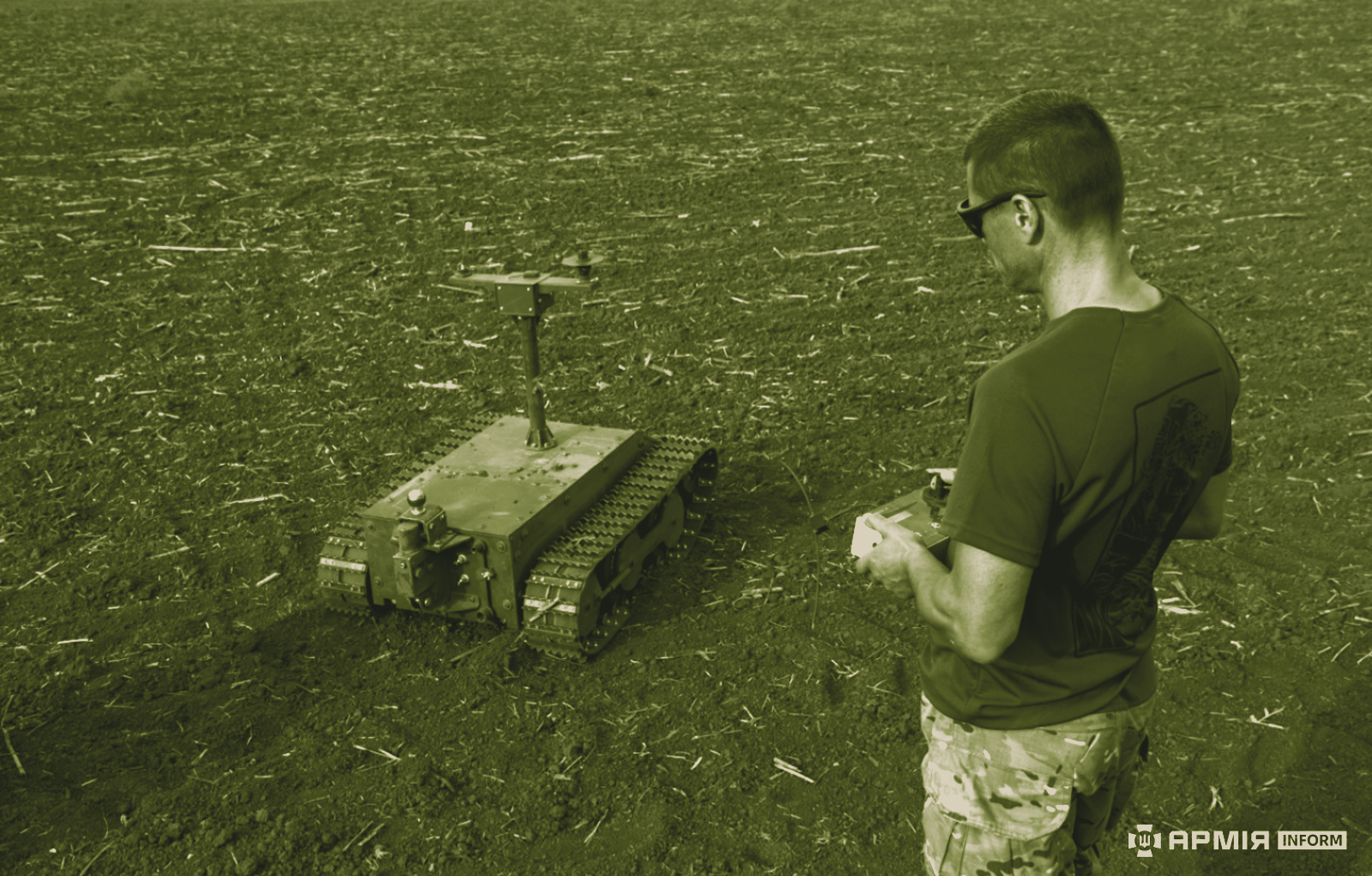
Vepr is a Ukrainian tracked ground robot for frontline logistics and casualty evacuation — hauling up to 350 kg of cargo or one to two wounded soldiers roughly 40 km per battery charge — codified for Armed Forces service by the Ministry of Defence in June 2026 after two years of front-line use.
Overview
Vepr (Ukrainian for "wild boar") is a compact tracked unmanned ground vehicle built for the jobs that kill the most infantry on a drone-saturated front: hauling ammunition and supplies to positions, and pulling the wounded out. Ukraine's Ministry of Defence codified the upgraded Vepr for Armed Forces service on June 3, 2026, clearing a platform whose earlier versions had been running front-line logistics and evacuation missions since 2024, per Defense Express and Interfax-Ukraine. Beyond cargo and medevac, the ministry lists remote mine clearance, recovery of damaged vehicles and robots, and use as a one-way strike platform among its roles.
The name is shared by unrelated weapons — Russia's Molot Vepr rifle series, Ukraine's Vepr bullpup rifle, and the smaller Ukrainian Vepryk UGV are all different systems. This entry covers the ground robotic complex (NRK) Vepr.
Development
Vepr is a product of Ukraine's wartime ground-robot boom, but an unusually anonymous one: its developers decline to be named for security reasons. One of them, identified only as "Andriy," told Oboronka the team built its first multifunctional ground drone in November 2022 — among the first at the front — and that early units even served as heated, armored sniper-training targets before one hauled a shot-up Mitsubishi L200 with its crew off the battlefield.
The original Vepr was codified by the Ministry of Defence in July 2024, with several dozen already working the line of contact, according to ArmyInform. Two years of combat feedback then drove a significant redesign, and the modernized version was codified in June 2026, as BattlePolicy reported. Vepr joins roughly 80 domestic ground robots codified since 2022 in an ecosystem the Brave1 defense-tech cluster counts at about 270 manufacturers building 550 UGV models, per Euromaidan Press and the Christian Science Monitor.
Design & capabilities
The modernized Vepr is deliberately small: 136 cm long, 112 cm wide and 138 cm tall with its rack mounted, weighing about 350 kg empty — compact enough, per ArmyInform, to ride in a pickup bed or minibus. It carries a payload equal to its own weight: up to 350 kg of ammunition and supplies, or one to two casualties at a time, according to the Ministry of Defence. Two 1,500-watt electric motors push it past 7.5 km/h, and battery capacity supports marches of nearly 40 km — in practice about 20 km out and back, per Defense Express. The tracked hull is armored; the developer told Oboronka its steel withstands 5.45 mm and 7.62 mm rounds — a company claim, not independently tested. In the evacuation configuration the tracked robot tows a wheeled carriage carrying the casualty.
Vepr is tele-operated by radio from cover, with digital cameras, multiple communication channels and a GPS return-home function. The ministry emphasizes simplicity: a clear control algorithm, easy maintenance and minimal operator training, so infantry from any unit can run it. Its most distinctive engineering task is remote demining: per ArmyInform, the robot drags a plastic-explosive line charge across a minefield — its ground pressure is too low to trigger anti-tank mines — detaches it, and the operator detonates the charge to blow a passage lane.
Variants
Vepr is an evolving family rather than a fixed model. The original codified 2024 version weighed about 300 kg, carried 250 kg on the hull and towed another 200 kg on its carriage, and ran up to five hours per charge, per the developer via Oboronka. The 2026 modernized version raises payload to 350 kg and range to ~40 km. Mission fits include a shell rack, an anti-tank-mine dropper, the demining line charge, the casualty trailer, and a one-way strike configuration.
Combat record / operational use
The Ministry of Defence dates Vepr's front-line service from 2024; the developer traces the platform's combat use to late 2022. By May 2025, Vepr was operating in more than 20 units — including the Da Vinci Wolves battalion, the National Guard's Charter brigade, and the 92nd, 109th and 110th brigades — around Avdiivka, Bakhmut and Zaporizhzhia, with roughly 300 vehicles transferred to the front, according to the developer via Oboronka.
The Da Vinci Wolves alone credited Vepr with more than 50 successful casualty evacuations by mid-2025 — including one near Avdiivka in which a Vepr absorbed 16 FPV-drone hits and still returned with its wounded passenger. Each robot run also spares the four to six soldiers who would otherwise carry a casualty under fire. Vepr's scale matters more than any single mission: Ukrainian ground robots collectively ran about 10,000 logistics and evacuation missions a month by spring 2026 — 10,281 in April — per the Ministry of Defence.
Advantages
- Pulls the two deadliest infantry tasks — resupply and casualty evacuation — out of the human kill zone.
- Payload equal to its own weight (350 kg), in a body small enough to fit in a pickup.
- Genuinely multi-role: logistics, medevac, remote demining with a line charge, recovery of damaged robots and light vehicles, one-way strike.
- Combat-proven durability, including a documented evacuation completed after 16 FPV-drone hits (developer account).
- Minimal operator training; codified, so units can procure it with state funds.
Drawbacks / limitations
- Slow: 7.5 km/h is walking pace. Ukrainian units tell Oboronka evacuation robots need 15–30 km/h to avoid becoming targets.
- No closed casualty capsule — the wounded ride an open wheeled trailer, exposed to drones and fragments, a criticism front-line medics level at most current evacuation UGVs.
- Tele-operation depends on a jammable radio link; electric drive limits endurance and imposes charging logistics.
- Manufacturer, production rate and contract terms are not publicly disclosed, making independent assessment of scale and quality difficult.
- Performance figures are ministry and developer statements; no independent testing is publicly established.
Counterparts
- TerMIT (UA logistics/casevac UGV)
- Lyut (UA combat UGV)
- THeMIS (Estonian modular UGV)
- Uran-9 (RU combat UGV)
Vepr's closest peer is TerMIT — the same Ukrainian cheap-tracked-mule concept, similar payload class, similar codify-and-scale path. Against the Western THeMIS it trades polish and sensors for cost and attritability; against Russia's Uran-9 it represents the opposite philosophy — many cheap single-job robots instead of one expensive robot tank. Within Ukraine's crowded UGV field it competes with Ratel H, Zmiy, Bizon-L and dozens of others for the same logistics/evac contracts.
Outlook
Vepr's codification is one data point in the most aggressive ground-robot procurement push anywhere: Ukraine's Defense Ministry plans to contract more than 25,000 UGVs in the first half of 2026 — double the 2025 total — toward a stated goal of moving 100 percent of front-line logistics onto unmanned platforms, per Mezha and Censor.NET; parliament has exempted UGV supplies from VAT. Meta-Defense calls this the first documented mass employment of logistics and evacuation ground robots in the world. What to watch: whether Vepr wins a meaningful share of that volume, whether the next iteration answers the speed and casualty-protection critiques (draft Ukrainian evacuation-UGV standards would require at least 15 km/h), and whether the anonymous maker follows peers like Tencore into the open — or into export and co-production.
Key specifications
| Spec | Value |
|---|---|
| Type | Tracked logistics/medevac unmanned ground vehicle (UGV) |
| Endurance | ~5 h per charge (earlier version, developer figure) |
| Range | ~40 km per charge; ~20 km one-way delivery radius |
| Cruise / max speed | over 7.5 km/h (reported) |
| Payload | up to 350 kg cargo or 1–2 casualties (upgraded version); earlier version 250 kg on hull + 200 kg towed |
| Datalink / control | Tele-operated via radio, multiple communication channels; digital cameras |
| Autonomy level | Remote-controlled; GPS return-home function |
| Dimensions / MTOW | 136 × 112 × 138 cm (with rack); ~350 kg empty, ~700 kg loaded |
| Launch & recovery | Driven from cover; transportable in a pickup bed or minibus |
Sources
- Ukraine Ministry of Defence — "Арсенал медеваків посилить модернізований НРК «Вепр»." https://mod.gov.ua/news/arsenal-medevakiv-posilit-modernizovanij-nrk-vepr
- ZBROYA (MoD arms portal) — "MoD Codifies Upgraded Evacuation Robot Vepr." https://www.zbroya.gov.ua/en/news/minoborony-kodyfikuvalo-modernizovanyi-robot-evakuator-vepr
- Defense Express — "Ukraine Officially Approves Vepr Combat Robot After Two Years of Frontline Testing." https://en.defence-ua.com/news/ukraine_officially_approves_vepr_combat_robot_after_two_years_of_frontline_testing-18699.html
- Euromaidan Press — "Ukraine's new frontline robot hauls cargo, evacuates soldiers, and clears mines. Meet Vepr." https://euromaidanpress.com/2026/06/03/ukraines-new-frontline-robot-hauls-cargo-evacuates-soldiers-and-clears-mines-meet-vepr-built-from-real-combat-experience/
- Oboronka (Mezha) — "Robots are taking the wounded away. How Ukraine is mastering the production of the most complex ground drones." https://oboronka.mezha.ua/en/roboti-dlya-poranenih-yak-v-ukrajini-osvoyuyut-virobnictvo-nayskladnishih-nazemnih-droniv-301931/
- ArmyInform — "У Міноборони кодифікували робота «Вепр»: на що здатний цей броньований «кабанчик»." https://armyinform.com.ua/2024/07/25/u-minoborony-kodyfikuvaly-robota-vepr-na-shho-zdatnyj-czej-bronovanyj-kabanchyk/
- Interfax-Ukraine — "Defense Ministry approves Ukrainian-made Vepr robotic medevac for use on front lines." https://en.interfax.com.ua/news/general/1173406.html
- Mezha.net — "Ukrainian MoD approves upgraded Vepr ground robot for frontline logistics." https://mezha.net/eng/bukvy/acbd2ac4_ukrainian_mod_approves/
- Censor.NET — "Vepr UGV joins Armed Forces of Ukraine's arsenal: can evacuate wounded and carry 350 kg of cargo." https://censor.net/en/news/4006568/vepr-ugv-approved-for-use-in-armed-forces
- UNN — "Capable of evacuating two wounded simultaneously: Vepr robotic medevac cleared for combat operations." https://unn.ua/en/news/capable-of-evacuating-two-wounded-simultaneously-vepr-robotic-medevac-approved-for-combat-operations
- Meta-Defense — "Ukraine will have produced 25,000 UGVs and Vepr medical-evacuation robots in the first six months of 2026." https://meta-defense.fr/en/2026/06/05/ukraine-25000-ugv-vepr-first-half-2026/
- U.S. Army — "Let's Make Innovative Ideas: UGVs Resupplying the Front Line." https://www.army.mil/article/290022/lets_make_innovative_ideas_ugvs_resupplying_the_front_line
- RBC-Ukraine — "Ukraine deploys new Vepr ground drone for battlefield evacuations." https://newsukraine.rbc.ua/news/ukraine-deploys-new-vepr-ground-drone-for-1780578177.html
- Christian Science Monitor — "Robot wars: Ukraine now adding 'land drones' to its futuristic arsenal." https://www.csmonitor.com/World/Europe/2026/0531/ukraine-russia-drone-war-robot-ugv
🔒 The Analyst Section on Vepr is for BattlePolicy Pro members. Below the line: procurement and contract history, the suppliers and companies behind the system, our head-to-head analyst view of the systems it actually competes with, and the BattlePolicy assessment note. Unlock the full file with BattlePolicy Pro →